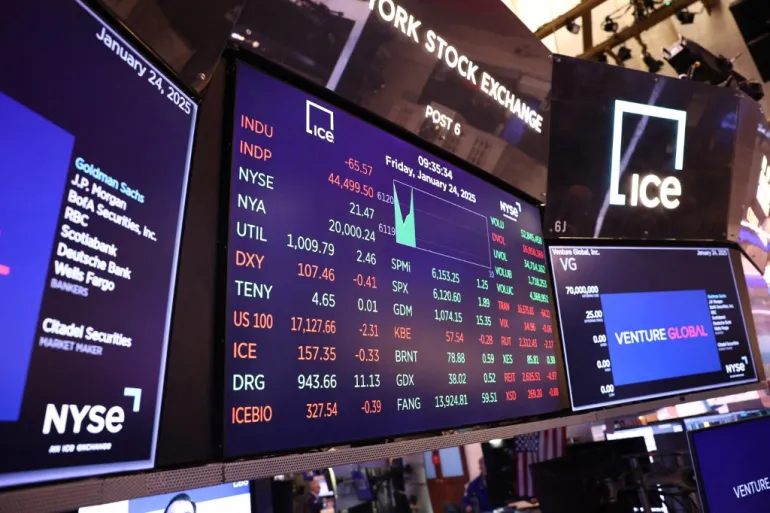
Wall Street moved higher on Friday despite renewed pressure in the bond market. Gains in materials stocks, cryptocurrency-related shares and stronger U.S. business activity data helped support investor sentiment.
The rebound came after major U.S. indexes suffered sharp losses in the previous session as Treasury yields climbed again.
S&P 500, Nasdaq and Dow Move Higher
At 11:00 ET, the S&P 500 gained 0.5% to 7,678.69 points.
The technology-heavy Nasdaq Composite rose 0.4% to 26,163.60, while the Dow Jones Industrial Average advanced 0.8% to 53,176.08.
The gains helped Wall Street recover part of Thursday’s losses.
During the previous session, the Dow fell 1.3%, the S&P 500 declined 0.9% and the Nasdaq dropped 1%.
Treasury Yields Pressure U.S. Stocks
Thursday’s market decline was largely triggered by another rise in U.S. Treasury yields.
The move reversed much of Wednesday’s relief rally, which followed an announcement that the U.S. Treasury would increase purchases of longer-dated government debt.
However, investors remain skeptical that Treasury intervention can provide a lasting solution to elevated borrowing costs.
Analysts at Deutsche Bank said markets currently appear to view the Treasury measures as a temporary response rather than a solution to the structural forces pushing yields higher.
Bond Selloff Continues
Treasury yields moved higher again on Friday.
During the previous trading session, the 10-year Treasury yield climbed to around 4.70%, while the 30-year Treasury yield reached approximately 5.25%.
Bond yields move inversely to prices, meaning falling bond prices typically result in higher yields.
Persistent increases in long-term yields remain an important risk for equity markets.
Higher Yields Weigh on Technology Stocks
Technology and other growth stocks are particularly sensitive to rising interest rates.
Higher yields increase the discount rate investors use to calculate the present value of future corporate earnings. This can reduce the appeal of companies whose valuations depend heavily on expectations for future growth.
Major technology companies also face another challenge.
Many have increasingly turned to debt markets to finance enormous investments in artificial intelligence infrastructure, including data centers, chips and computing capacity.
That combination of higher borrowing costs and aggressive capital spending contributed to weakness across major technology shares on Thursday.
Materials and Crypto Stocks Support Wall Street
Despite continued bond market pressure, strength in other areas helped lift U.S. equities on Friday.
Materials stocks were among the strongest performers, while cryptocurrency-related shares also rallied.
The gains helped offset weakness associated with rising Treasury yields and provided broader support for the S&P 500 and other major indexes.
Positive U.S. economic data also improved investor confidence.
Oil Above $94 Adds Inflation Concerns
Energy prices remain another potential headwind for Wall Street.
Brent crude traded above $94 per barrel as tensions between the United States and Iran surrounding the Strait of Hormuz remained unresolved.
The strategic waterway is a critical route for global energy shipments, making continued disruption a major concern for oil markets.
Higher oil prices could increase transportation and production costs across the economy.
That has revived concerns that inflation could remain elevated for longer than expected.
Rising Oil Prices Could Influence Fed Policy
Persistent energy inflation could complicate the outlook for the Federal Reserve.
If higher oil prices contribute to renewed inflationary pressure, policymakers may have less flexibility to lower interest rates.
Markets are currently assigning roughly a two-in-three probability that the Fed will leave rates unchanged at 3.5% to 3.75% at its September meeting.
Investors are therefore closely monitoring economic data for clues about the next phase of monetary policy.
Jackson Hole Moves Into Focus
Attention is increasingly turning toward the Jackson Hole Economic Policy Symposium later this month.
Comments from Federal Reserve officials could provide important guidance on inflation, economic growth and future interest-rate decisions.
Any change in expectations for Fed policy could have a significant impact on Treasury yields, the U.S. dollar and equity markets.
U.S. Business Activity Remains Resilient
Investors also received preliminary August data on U.S. business activity.
So far, economic indicators have remained relatively resilient despite rising oil prices and uncertainty surrounding the conflict involving Iran.
The data suggests the U.S. economy continues to maintain momentum even as financial conditions remain challenging.
However, investors are also considering the possibility that persistent inflation could encourage central banks to maintain higher interest rates or even consider additional tightening.
Wall Street Balances Growth Against Rising Yields
Friday’s rebound shows that investors remain willing to buy stocks despite continued pressure from the bond market.
Strength in materials, cryptocurrency-related shares and U.S. economic activity helped offset concerns surrounding rising Treasury yields and oil prices.
The next direction for Wall Street and the S&P 500 will likely depend heavily on inflation, Federal Reserve policy, bond yields and geopolitical developments in the Middle East.