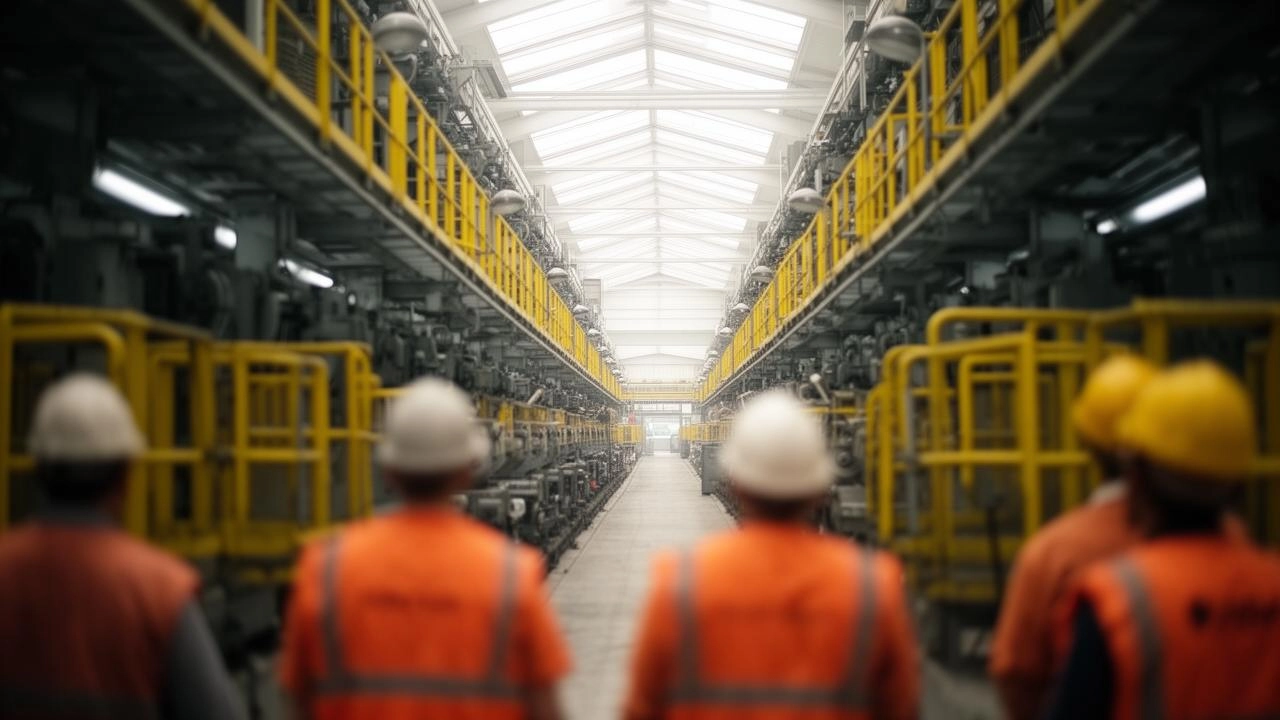
US manufacturing output increased in September, recovering from the previous month’s decline. However, factory activity slowed considerably during the third quarter as rising energy costs, supply chain disruptions, and geopolitical tensions weighed on industrial growth.
According to the Federal Reserve’s latest report, manufacturing production rose 0.3% in September, matching economists’ expectations. The increase followed a revised 0.2% decline in August, compared with the previously reported 0.3% contraction.
On an annual basis, factory output climbed 1.1% in September. Nevertheless, the broader quarterly figures revealed a significant slowdown in manufacturing momentum.
US Manufacturing Growth Slows Sharply in Third Quarter
Manufacturing output expanded at an annualized rate of just 0.7% during the third quarter, down significantly from the 5.6% growth recorded in the previous three months.
The slowdown highlights mounting challenges for American manufacturers despite continued investment in technology and resilient domestic demand.
Manufacturing accounts for approximately 9.4% of the US economy, making the sector an important indicator of broader economic conditions.
Investment in artificial intelligence infrastructure and inventory rebuilding have helped sustain factory activity. Businesses have also increased production to meet relatively strong domestic demand.
However, several factors threaten further expansion, including higher borrowing costs, elevated energy prices, and ongoing trade tensions with Canada.
Rising Energy Prices Threaten Factory Production
The ongoing Middle East conflict has disrupted global supply chains and contributed to rising energy costs, creating additional pressure on American manufacturers.
Diesel prices have reportedly reached record highs amid the prolonged US-Israeli conflict with Iran, raising transportation and distribution expenses.
Economists warn that these higher costs could eventually spread throughout the economy, affecting consumer goods, groceries, and other essential products.
Food retailers, logistics companies, agricultural businesses, and manufacturers that depend heavily on transportation could face particularly strong cost pressures.
As businesses pass rising expenses on to consumers, household purchasing power may weaken. Consequently, consumer demand could slow, placing additional pressure on manufacturing activity.
Durable Goods Production Records Modest Increase
Production of durable manufactured goods increased 0.1% in September, supported by stronger output in several industrial categories.
Primary metals, machinery, electrical equipment, appliances, and related components contributed to the monthly improvement.
However, motor vehicle and parts production declined 3.0%, highlighting continued weakness in the automotive industry.
Despite the mixed monthly performance, durable goods manufacturing expanded at an annualized rate of 3.8% during the third quarter.
A particularly strong contribution came from semiconductor production and related electronic components, which surged 28.4%.
The increase reflected substantial investment in artificial intelligence infrastructure, as technology companies continued expanding computing capacity and demand for advanced hardware.
Nondurable Manufacturing Faces Quarterly Decline
Nondurable goods production increased 0.4% in September, supported by gains in chemical manufacturing and printing activity.
However, the quarterly performance remained weaker.
Nondurable manufacturing output contracted at an annualized rate of 1.6% during the third quarter, suggesting that the monthly improvement was insufficient to reverse the broader slowdown.
The contrast between durable and nondurable goods highlights the uneven nature of the manufacturing sector’s performance.
While AI-related investment continues to support selected industries, other manufacturers face growing pressure from operating costs and changing demand conditions.
Mining and Utilities Support Industrial Production
Outside manufacturing, mining production increased 0.2% in September.
The sector expanded at an annualized rate of 5.0% during the July–September quarter, contributing positively to broader industrial activity.
Utilities output recorded a much stronger monthly increase of 3.5%, driven largely by higher electricity demand for air conditioning.
For the third quarter, utilities production surged at an annualized rate of 14.8%.
These gains helped offset some of the weakness in manufacturing and supported overall industrial production.
US Industrial Production Rises 0.7% in September
Total US industrial production increased 0.7% in September, accelerating from the 0.1% gain recorded in August.
Compared with the same month a year earlier, industrial output rose 2.2%.
However, quarterly growth showed signs of weakening.
Industrial production expanded at an annualized rate of 2.8% in the third quarter, down from 4.8% in the second quarter.
The figures suggest that industrial activity remained positive overall, although growth became less robust as the quarter progressed.
Capacity Utilization Remains Below Historical Average
The Federal Reserve also reported an improvement in industrial capacity utilization, which measures how extensively businesses use their available production resources.
Overall industrial capacity utilization increased to 76.9% in September, compared with 76.4% in August.
Despite the improvement, the rate remained 2.5 percentage points below its historical average for the 1972–2025 period.
Within manufacturing, capacity utilization edged up to 75.9% from 75.8% the previous month.
That figure was still 2.3 percentage points below its long-term average, indicating that factories continued operating with unused production capacity.
What Lies Ahead for US Manufacturing?
The September rebound offers some encouragement for the US manufacturing sector, but the sharp slowdown in quarterly growth points to persistent challenges.
Investment in AI infrastructure, semiconductor production, and domestic inventory rebuilding could continue supporting industrial activity.
At the same time, elevated energy costs, geopolitical uncertainty, trade tensions, and expensive financing may limit further expansion.
Higher transportation expenses could also contribute to inflationary pressures and weaken consumer spending, potentially reducing demand for manufactured goods.
Looking ahead, investors and policymakers will closely monitor industrial production, factory capacity utilization, energy prices, and consumer demand for signs of whether US manufacturing output can sustain its recovery.