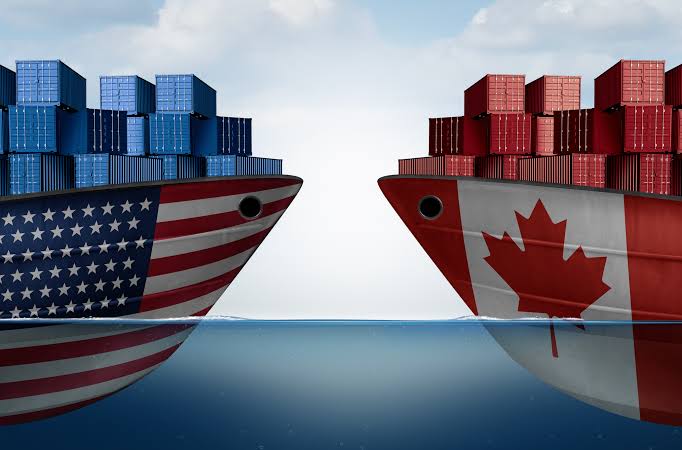
Top trade officials from the United States and Canada are set to meet in Washington for a third consecutive day as both countries attempt to reach a trade agreement before new US tariffs are scheduled to take effect.
The negotiations come after roughly 18 months of strained trade relations between the two neighboring countries. Tensions intensified after President Donald Trump introduced tariffs on major Canadian imports, prompting Ottawa to respond with its own countermeasures.
US Tariff Deadline Puts Pressure on Negotiations
President Trump has threatened to impose a new 50% tariff on approximately $20 billion worth of Canadian goods if an agreement is not reached.
The tariffs are scheduled to take effect at 12:01 a.m. EDT on Saturday, significantly increasing pressure on negotiators to finalize a deal.
Canada’s minister responsible for trade with the United States, Dominic LeBlanc, is scheduled to meet US Trade Representative Jamieson Greer in Washington.
The two officials held more than three hours of discussions on Thursday.
Following those talks, LeBlanc said Canada and the United States were very close to reaching an agreement, although several issues still needed to be resolved.
Canada Faces Domestic Pressure Over Trade Concessions
Even if negotiators secure a deal, Canadian Prime Minister Mark Carney could face resistance at home.
A recent Leger opinion poll found that 56% of Canadians do not want the government to make additional concessions to the United States.
Carney may also need to convince the premiers of Canada’s 10 provinces that the final agreement represents an acceptable outcome.
Provincial governments have significant economic interests at stake, particularly in industries affected by tariffs.
Auto, Steel and Aluminum Tariffs in Focus
According to people familiar with the negotiations, a potential agreement could lower tariffs on Canadian-built vehicles from 25% to 15%.
The deal could also reduce tariffs on Canadian steel and aluminum from 50% to approximately 25%.
However, officials in Ontario have pushed for those tariffs to be removed entirely.
Ontario is one of Canada’s most important steel and aluminum-producing regions, making the issue particularly important for the province.
US Alcohol Restrictions Could Become Part of the Deal
Another source of tension between Washington and Ottawa involves restrictions on American alcohol products.
Carney has reportedly called on major Canadian provinces to lift their bans on sales of US alcohol.
Those measures were introduced as part of Canada’s response to US trade policies and have become an irritant for Washington.
Resolving the dispute could therefore become another element of a wider US-Canada trade agreement.
Canadian Leaders Debate How Tough Ottawa Should Be
Not all Canadian political leaders believe Ottawa should compromise further.
Manitoba Premier Wab Kinew argued that Canada currently holds a stronger negotiating position and should continue taking a firm stance.
He suggested that Washington’s willingness to negotiate indicates that Canada has greater leverage than some observers assume.
However, the economic relationship remains heavily weighted toward the United States.
Canada Remains Highly Dependent on US Trade
The Canadian economy is roughly one-tenth the size of the US economy, while around 70% of Canadian exports are sent south of the border.
That dependence makes Canada particularly exposed to aggressive US tariff policies.
A prolonged trade dispute could therefore have significant consequences for Canadian exporters, manufacturers and other industries that rely heavily on access to the US market.
JD Vance Criticizes Carney’s Trade Strategy
US Vice President JD Vance has also publicly criticized Carney’s handling of the negotiations.
Speaking at a fundraiser in Southampton, New York, Vance mocked the Canadian prime minister’s attempt to present a tough negotiating stance toward Trump.
According to a recording obtained by the Canadian Press, Vance also argued that Canada had backed down on several issues while presenting the negotiations domestically as a victory.
His comments highlight the political tensions surrounding the talks on both sides of the border.
US-Canada Trade Deal Enters Critical Stage
The next round of negotiations could prove decisive as the tariff deadline approaches.
A successful agreement could ease months of economic tension and provide greater certainty for businesses operating across the US-Canada border.
However, any compromise will likely face political scrutiny in Canada, particularly if tariffs remain in place on important industries such as automobiles, steel and aluminum.
With significant tariffs scheduled to take effect unless an agreement is reached, the coming talks could determine the next phase of US-Canada trade relations.