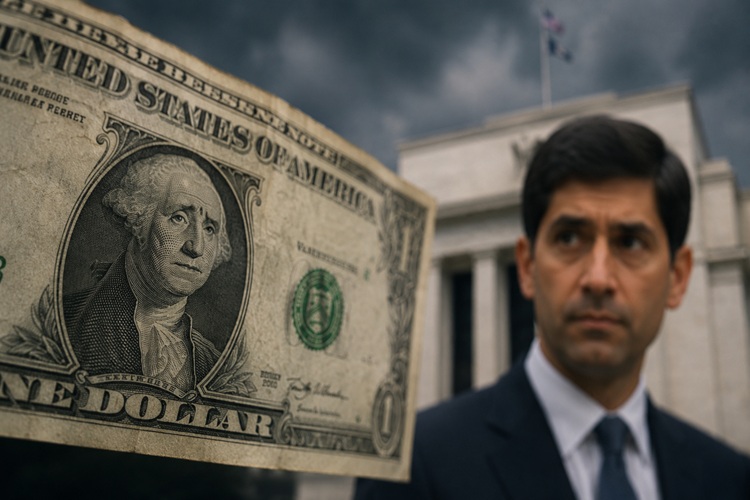
The U.S. dollar gave up part of its earlier gains on Wednesday after Federal Reserve Chair Kevin Warsh said inflation expectations and related risks had eased in recent weeks.
Investors also remained cautious ahead of Thursday’s closely watched U.S. employment report.
Meanwhile, the Japanese yen recovered after earlier falling to its weakest level against the dollar in around 40 years.
Warsh Avoids Signaling the Fed’s Next Move
Speaking during an international central banking panel, Warsh declined to provide clear guidance on future interest rates.
He said Federal Reserve officials would decide whether to raise rates when they meet again. He also made clear that markets should not expect him to outline a predetermined policy path.
The dollar had previously benefited from growing expectations that the Fed could increase borrowing costs later this year.
U.S. inflation remains well above the central bank’s 2% target. However, several analysts believe price pressures could moderate over the coming months.
Standard Chartered Sees No Rapid Economic Imbalance
Steve Englander, head of global G10 foreign exchange research and North American macro strategy at Standard Chartered, said there was little evidence of rapidly worsening economic or inflation imbalances.
He argued that the Federal Reserve could afford to wait for more evidence before changing policy.
Englander also highlighted weak unit labor costs. Softer labor costs could help limit underlying inflation, even while economic growth remains resilient.
AI Investment Continues to Support the Dollar
The dollar is also benefiting from factors beyond expectations for higher interest rates.
Rapid investment in artificial intelligence has attracted capital to the United States. Strong demand for U.S. technology assets and infrastructure has therefore provided additional support for the currency.
A resilient labor market has strengthened the outlook for the wider U.S. economy as well.
Employment growth has exceeded expectations during the past three months, reinforcing confidence in U.S. economic momentum.
U.S. Jobs Report Takes Center Stage
Thursday’s employment report is expected to show that the U.S. economy added 110,000 jobs in June.
Economists also expect the unemployment rate to remain unchanged at 4.3%.
A stronger-than-expected result could revive expectations for a Federal Reserve rate increase and support the dollar.
However, weaker employment data could reduce those expectations and provide relief to currencies such as the euro and yen.
Fed funds futures indicated a 60% probability of a rate increase by September. That was down from 65% on Tuesday.
The U.S. Dollar Index was last up 0.04% at 101.28 after surrendering part of its earlier advance.
Yen Recovers From Four-Decade Low
The Japanese yen has suffered heavily during the dollar’s recent rally.
Its weakness has placed Japan’s Ministry of Finance under pressure to decide whether another currency intervention is necessary.
Japan’s top currency diplomat, Atsushi Mimura, reportedly said that an intervention conducted two months earlier had been effective. He also indicated that some U.S. officials had supported the action.
The yen later strengthened 0.15% to 162.35 per dollar.
Japan May Be More Tolerant of Yen Weakness
Joey Chew, head of Asian foreign exchange strategy at HSBC, said Japanese authorities may currently be more willing to tolerate a weaker yen.
One reason is that the dollar has strengthened against several major currencies, rather than only against the yen.
Falling oil prices have also reduced inflationary pressure in Japan. This has eased some of the urgency for the Bank of Japan to tighten monetary policy.
Japanese officials may also be waiting to see whether Thursday’s U.S. jobs report weakens the dollar naturally.
Traders Watch for Possible Yen Intervention
Some traders view Friday’s U.S. public holiday as a possible opportunity for Japanese authorities to intervene.
Lower market liquidity could increase the immediate effect of official yen purchases.
However, analysts warned that intervention during thin trading conditions may deliver only temporary support.
The Bank of Japan also appears in no hurry to raise interest rates aggressively. Although the Japanese economy has performed slightly better than expected, the improvement may not be strong enough to change the policy outlook.
Euro Falls as Eurozone Inflation Cools
The euro declined 0.24% to $1.1394.
Fresh data showed that Eurozone inflation slowed more than expected in June and fell below 3%.
The weaker inflation reading reduced pressure on the European Central Bank to raise interest rates again.
A widening policy gap between the ECB and the Federal Reserve could continue to support the dollar against the euro.
Bitcoin Rebounds From Recent Low
Bitcoin gained 2.14% to $59,921 after earlier falling to $57,776.
That marked its lowest level since September 2024 before buyers returned to the market.
The cryptocurrency’s rebound came as investors reassessed interest-rate expectations, dollar strength and broader risk sentiment.
Markets Await Fresh Direction
Currency markets are now focused on Thursday’s U.S. jobs report.
The data could influence expectations for Federal Reserve policy and determine whether the dollar resumes its rally.
Traders will also continue monitoring the risk of Japanese intervention, the ECB’s policy outlook and changes in global capital flows.