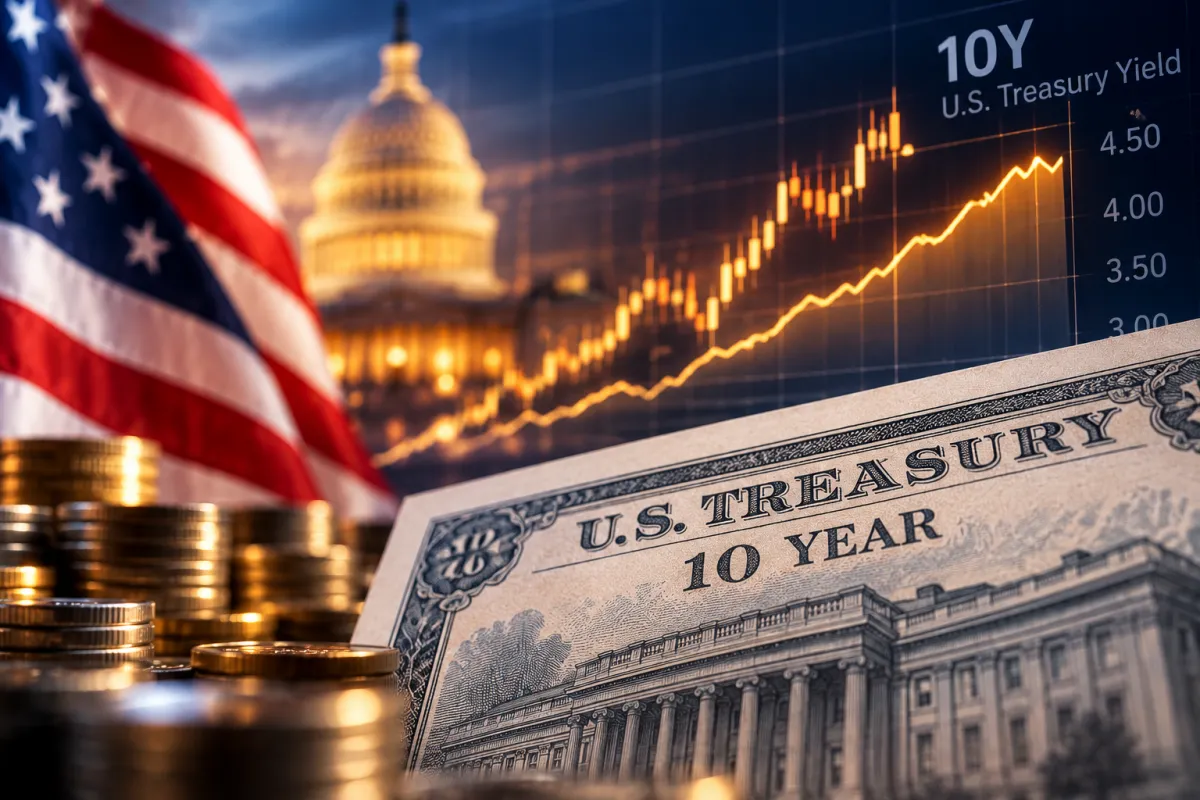
U.S. Treasury yields fell sharply on Thursday as investors returned to government bonds amid growing concerns about corporate borrowing and massive artificial intelligence investments. The rally pushed bond prices higher, with the benchmark 10-year Treasury recording its strongest daily percentage gain since early August 2025.
The rebound marked a significant change in market sentiment. U.S. government bonds had recently experienced heavy selling pressure, sending yields to multi-decade highs. However, renewed uncertainty surrounding corporate debt and AI-related spending has revived demand for traditional safe-haven assets.
The 10-year Treasury yield dropped 12.8 basis points to 5.061%, while the 30-year yield declined 10.4 basis points to 5.420%.
Meanwhile, the more interest-rate-sensitive two-year Treasury yield fell 4.5 basis points, closing at 4.757%.
AI Investment Concerns Trigger a Rally in U.S. Treasury Bonds
Growing skepticism about the financial returns from artificial intelligence investments has emerged as a major driver of the Treasury market recovery.
Technology giants and semiconductor companies have borrowed substantial amounts of money to finance AI infrastructure, including data centers, advanced computing systems and other capital-intensive projects.
The rapid expansion of corporate debt issuance has placed additional pressure on credit markets, contributing to higher borrowing costs and wider corporate bond spreads.
However, investors are now increasingly questioning whether these enormous investments can generate sufficient profits to justify their financing costs.
Sonu Varghese, chief macro strategist at Carson Group, highlighted the growing dependence of financial markets on the success of artificial intelligence.
According to Varghese, when investors expect exceptional returns from AI investments, a bond yield of around 5% appears relatively unattractive. However, if expectations for AI profitability deteriorate, the same yield can suddenly become significantly more appealing.
This shift in investor expectations has helped fuel renewed demand for U.S. Treasury bonds.
Corporate Debt Risks Push Investors Toward Safe-Haven Assets
Concerns about aggressive corporate borrowing have intensified as technology companies continue committing hundreds of billions of dollars to AI infrastructure development.
Over recent months, major debt offerings from AI hyperscalers and semiconductor manufacturers have increased the supply of corporate bonds, putting pressure on credit markets.
At the same time, elevated financing costs have raised doubts about whether heavily leveraged companies can generate adequate returns on their investments.
The cost of protecting investment-grade technology debt against default has also increased, reflecting heightened investor concerns about credit risk.
Consequently, market participants have begun reducing their exposure to corporate bonds and technology stocks while shifting capital toward U.S. government securities.
The move toward safer assets coincided with significant losses across global equity markets.
The Nasdaq Composite declined nearly 1.9%, while South Korea’s technology-heavy KOSPI plunged approximately 8% overnight. The sharp Korean market selloff triggered a downside trading halt through its circuit-breaker mechanism.
These developments accelerated the movement into U.S. Treasuries, reinforcing their traditional role as a defensive investment during periods of market uncertainty.
Federal Reserve Rate Expectations Add to Treasury Market Volatility
The rally in U.S. government bonds also reflected changing expectations surrounding the Federal Reserve’s monetary policy outlook.
Investors reassessed the possibility of additional interest rate increases following the release of September’s Consumer Price Index (CPI) report.
Headline U.S. inflation accelerated to 3.7% year-over-year, while core consumer prices increased 0.3% on a monthly basis.
Although the figures indicated persistent inflationary pressures, financial markets remained largely convinced that the Federal Reserve would leave interest rates unchanged at its October 27–28 policy meeting.
Recent comments from Federal Reserve officials have supported expectations that policymakers may prefer to evaluate additional economic information before considering further monetary tightening.
Nevertheless, the possibility of another rate increase later in the year remains an important factor for bond investors.
U.S. Bond Market Outlook Hinges on AI Spending and Fed Policy
The sharp decline in Treasury yields highlights how quickly investor sentiment can change when concerns about corporate debt and economic growth begin to outweigh expectations for higher investment returns.
While persistent inflation continues to complicate the Federal Reserve’s policy decisions, growing uncertainty surrounding AI-related borrowing has strengthened demand for government bonds.
Looking ahead, investors will closely monitor corporate financing conditions, technology sector performance and upcoming U.S. economic data.
Further deterioration in risk appetite could support additional Treasury bond gains. Conversely, renewed inflation concerns or expectations of tighter monetary policy could push yields higher again.
For now, the U.S. Treasury market has regained some of its safe-haven appeal as investors reassess the risks associated with heavily financed artificial intelligence expansion.