Trump Says U.S.-Iran Talks Will Continue but Ceasefire Is Over
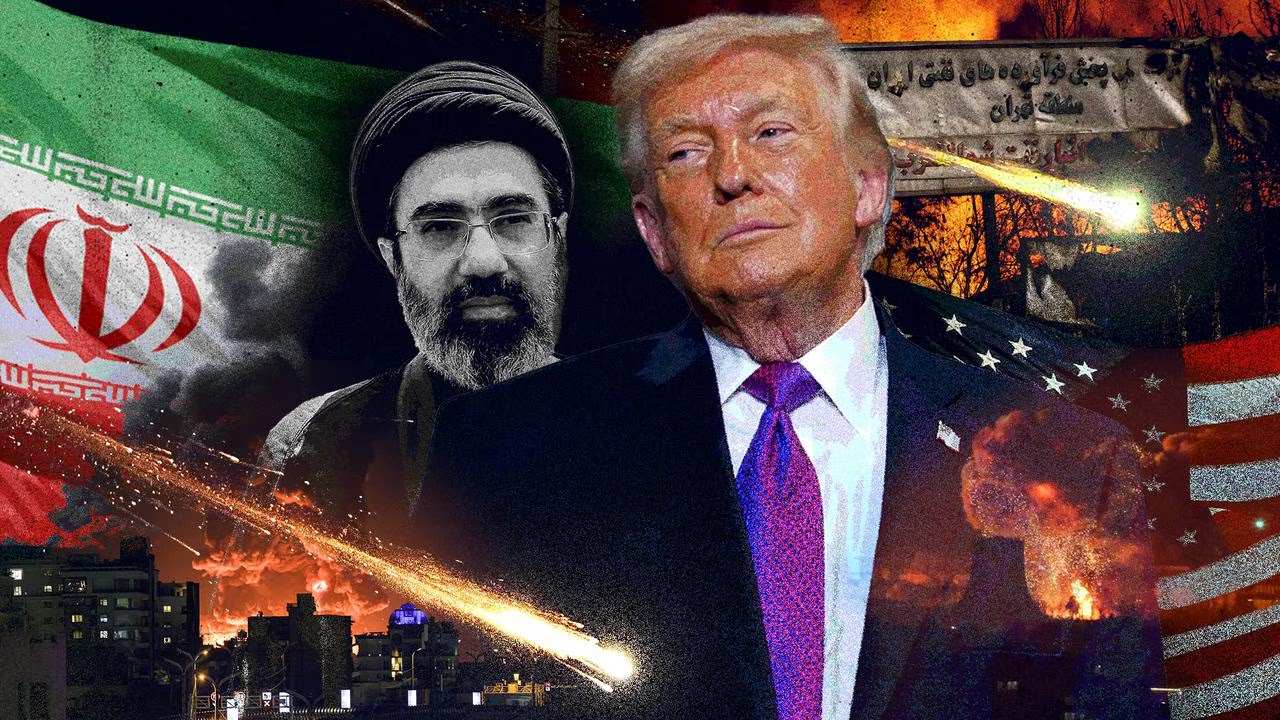
U.S. President Donald Trump said on Friday that Iran had requested further talks and that Washington had agreed to continue negotiations.
However, Trump also declared that the ceasefire reached in June was no longer in effect.
His comments followed a fresh exchange of attacks involving commercial tankers, Iranian targets and U.S. military installations across the Gulf region.
Tanker Attacks Trigger New Military Escalation
Three commercial tankers linked to Qatar and Saudi Arabia came under fire earlier in the week.
The United States responded by striking sites inside Iran. Tehran then carried out retaliatory attacks against U.S. military facilities in neighbouring Gulf states on Thursday.
No new attacks were reported on Friday.
In a post on Truth Social, Trump said Iran had asked to resume talks. He added that the United States had accepted the request but had made clear that the ceasefire was over.
Interim U.S.-Iran Agreement Under Pressure
The United States and Iran reached an interim agreement last month after four months of conflict.
The fighting had already caused thousands of deaths and severely disrupted global energy supplies.
Under the agreement, Washington ended its naval blockade of Iranian ports.
Iran, meanwhile, agreed to guarantee the safe passage of commercial vessels through the Strait of Hormuz.
The latest attacks have placed that arrangement under serious strain.
Qatar Steps Up Mediation Efforts
Qatari officials met Iranian representatives on Friday in an effort to reduce tensions.
The discussions focused on the implementation of the U.S.-Iran memorandum of understanding and the disputes that led to the latest escalation.
Navigation through the Strait of Hormuz was also a central issue.
Iran’s semi-official Tasnim news agency reported that a Qatari delegation had travelled to Iran as Doha sought to strengthen its role as a mediator.
Strait of Hormuz Traffic Slows Again
Daily tanker traffic through the Strait of Hormuz appeared to slow on Friday.
The decline followed several attacks that renewed concerns about global oil supply and shipping security.
Before the war, the strait handled roughly one-fifth of the world’s oil shipments.
Iran has since expanded its influence over the waterway, contributing to a prolonged confrontation with the United States.
Oil Prices Remain Elevated
Oil prices eased slightly on Friday.
However, they were still heading for a weekly gain of around 5% because of the renewed hostilities.
The risk of further disruption in the Strait of Hormuz continues to support energy prices.
Higher shipping costs, military tensions and uncertainty over safe passage remain major concerns for oil traders.
Washington and Tehran Clash Over Control of the Strait
The United States said its military action was intended to keep the Strait of Hormuz open.
Washington also rejected Iran’s claim that Tehran controls the waterway.
Iran warned that the strait would reopen only under its own conditions.
Tehran also said any further U.S. intervention would trigger a severe response.
The governing council of the United Nations shipping agency condemned Iran’s attempt to claim sovereignty over the strait.
It also criticised Tehran’s decision to create a body designed to control traffic through the waterway.
Tanker Traffic Remains Below Pre-War Levels
Before the latest attacks, daily tanker traffic through the strait had risen to its highest level since the conflict began.
Around 40 vessels were passing through the waterway each day.
However, that remained far below the pre-war average of between 125 and 140 daily crossings.
The reduced traffic shows that the recovery in global oil shipping remains fragile.
Iran Holds Ceremony for Ali Khamenei
Iran buried former Supreme Leader Ayatollah Ali Khamenei on Thursday at the country’s holiest shrine in Mashhad.
His burial followed a week of funeral processions and public rallies.
Khamenei was killed in an airstrike on the first day of the war, on February 28.
A further condolence ceremony was scheduled for Friday evening in Qom.
The event was organised on behalf of Supreme Leader Mojtaba Khamenei in honour of his father.
Questions Remain Over Mojtaba Khamenei
Mojtaba Khamenei was reportedly injured in the same strike that killed his father.
However, he has not appeared publicly since the attack.
His location and condition remain unclear, creating uncertainty over Iran’s leadership during a highly unstable period.
The lack of public appearances has also fuelled speculation about his plans for the country.
Political Pressure Builds on Trump
The continuing war has also created political pressure for Trump.
His inability to secure a lasting end to the conflict has reportedly caused frustration inside the administration.
The issue is becoming more sensitive as the Republican Party prepares for midterm elections later this year.
High fuel prices and growing voter dissatisfaction could become major political risks if the conflict continues.