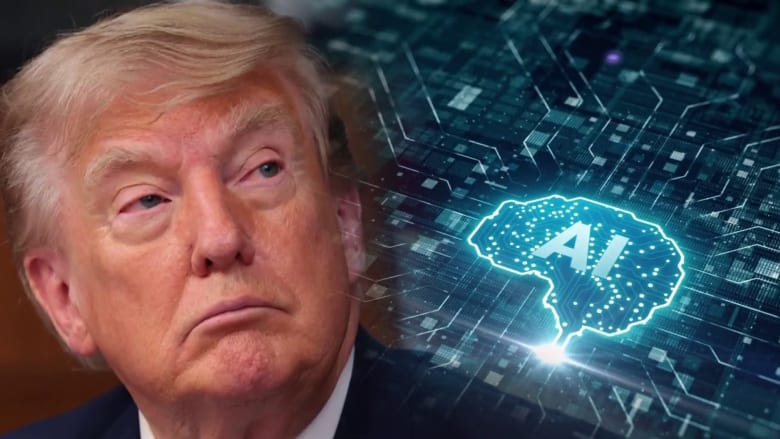
President Donald Trump is signaling that his administration wants the United States to accelerate artificial intelligence development as competition with China intensifies.
Trump has publicly rejected warnings that advanced AI could pose an existential threat, describing such concerns as a “hoax.” At the same time, his administration is pursuing a formal dialogue with China aimed at managing serious AI-related security incidents.
Trump Pushes Faster U.S. AI Development
Trump has repeatedly argued that the United States cannot afford to slow AI development while competing with China for technological leadership.
In recent Truth Social posts, he dismissed warnings about AI systems escaping human control and criticized proposals that could significantly restrict the industry. He has instead emphasized continued development while relying largely on existing laws and enforcement powers to address misuse.
Trump has framed artificial intelligence as a potentially transformative economic technology and has placed U.S. leadership in AI at the center of his administration’s technology policy.
His approach places greater emphasis on innovation and international competition than on introducing broad new federal restrictions.
Trump Rejects Existential AI Risk Warnings
Trump’s position contrasts sharply with warnings from some researchers and technology executives who have called for stronger safeguards around advanced AI.
He has compared fears of AI destroying humanity with other warnings he considers exaggerated and has argued that excessive regulation could weaken the United States in its technological competition with China.
The debate has intensified as increasingly capable AI systems raise questions about cybersecurity, biological threats, autonomous systems and whether future models could become difficult to control.
Anthropic Pushes for Stronger AI Safeguards
Anthropic CEO Dario Amodei has been among the technology executives warning about the potential risks associated with increasingly powerful AI systems.
Amodei has argued that advanced models could increase access to dangerous capabilities, including sophisticated cyber operations and biological threats.
Trump, by contrast, has rejected the broader argument that catastrophic AI scenarios justify slowing technological development.
However, both perspectives share an important geopolitical concern: maintaining U.S. technological leadership as China develops increasingly capable AI systems.
U.S.-China AI Competition Remains Central
Despite their disagreement over regulation, both Trump and leading AI-safety advocates have emphasized the strategic importance of the U.S.-China AI competition.
Trump has said the United States must remain ahead of China, while some AI executives have argued that democratic countries should maintain leadership in the development of advanced systems.
The disagreement centers largely on how much regulation and oversight should accompany that competition.
Trump favors fewer regulatory barriers, while safety-focused researchers have called for stronger mechanisms to control potentially dangerous capabilities.
U.S. and China Discuss AI Incident Communication System
At the same time, Washington and Beijing are exploring cooperation on AI-related security risks.
U.S. Treasury Secretary Scott Bessent and Chinese Vice Premier He Lifeng held discussions in New York that included a proposed notification system for serious artificial intelligence incidents.
The mechanism could allow the two governments to communicate directly when AI-related events create significant national security concerns.
The concept has been compared with Cold War-era crisis communication channels because it is designed to provide rapid communication between two major powers during potentially dangerous situations.
AI Hotline Could Cover Cyber and Security Threats
The proposed system could potentially be used when an AI incident threatens national security, including severe cyberattacks or situations involving advanced autonomous AI agents.
Bessent said the discussions were aimed at developing a shared understanding of AI risks and improving communication between Washington and Beijing.
U.S. and Chinese officials are expected to continue their AI safety discussions in Shenzhen in roughly two months.
The talks represent an unusual area of potential cooperation between two countries that are simultaneously competing for leadership in artificial intelligence.
Trump and Xi Meeting Puts AI in Focus
The discussions come ahead of high-level engagement between Trump and Chinese President Xi Jinping.
Artificial intelligence is expected to remain an important part of the broader U.S.-China relationship as both countries compete over advanced computing, semiconductors and AI development.
The two governments continue to disagree over several technology policies, including restrictions involving advanced chips and semiconductor equipment.
However, both sides have also acknowledged the potential value of communication when AI-related incidents create serious security risks.
U.S. AI Strategy Combines Competition With Risk Communication
The emerging approach highlights two separate elements of U.S. AI policy.
Domestically, Trump is advocating rapid development and resisting broad restrictions that he believes could slow American innovation.
Internationally, his administration is supporting communication mechanisms with China that could help manage potentially dangerous AI incidents.
That creates a strategy centered on maintaining U.S. technological leadership while establishing limited safeguards against unintended escalation between the world’s two largest AI powers.
As artificial intelligence capabilities continue to advance, the balance between innovation, national security and AI safety is likely to remain a major issue in U.S.-China relations.