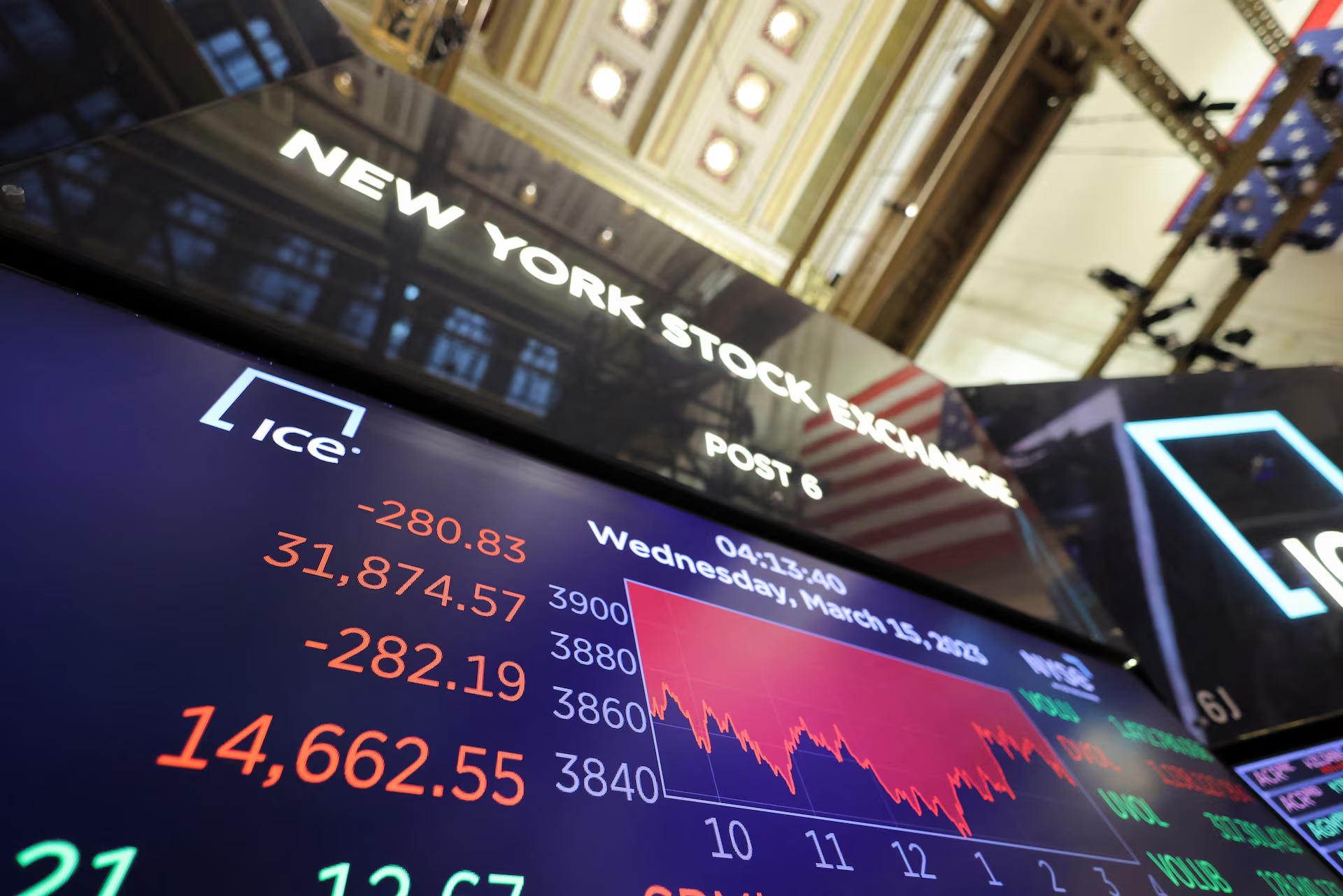
U.S. stocks moved sharply lower on Wednesday as investors reacted to continued weakness in semiconductor shares, uncertainty surrounding the Federal Reserve’s interest-rate decision and a renewed surge in oil prices.
The latest decline placed additional pressure on the artificial intelligence trade ahead of quarterly earnings from Microsoft and Meta Platforms. Both technology giants are scheduled to report after the closing bell.
Wall Street Indexes Fall Sharply
At 12:06 ET, the S&P 500 was down 1.1% at 7,347.02 points.
Meanwhile, the technology-focused Nasdaq Composite fell 1.4% to 24,519.58 points. The Dow Jones Industrial Average performed even worse, declining 1.7% to 51,830.86 points.
The broad market weakness reflected caution across several sectors. Technology stocks remained under pressure, while rising energy prices renewed concerns about inflation and interest rates.
Microsoft and Meta Earnings in Focus
Investors are preparing for an important test of the artificial intelligence investment trend.
Microsoft and Meta Platforms are due to publish their quarterly results after Wednesday’s market close. Both companies have committed billions of dollars to AI infrastructure, including data centers, processors and cloud-computing capacity.
Their earnings reports could determine whether confidence returns to AI-related stocks or whether the sector’s recent decline continues.
Tesla and Google parent Alphabet recently highlighted plans to maintain elevated AI spending. Therefore, investors will closely examine whether Microsoft and Meta can demonstrate sufficient revenue growth to justify their own large investments.
Chip Stocks Extend Their Losing Streak
Semiconductor stocks remained one of the largest sources of pressure on the market.
The Philadelphia Semiconductor Index was heading toward its fifth consecutive daily decline. This would represent its longest losing streak since late December.
The selloff reflects growing concerns that valuations across the AI chip sector had become too stretched following a powerful rally.
Nvidia Data Center Report Raises Concerns
This week’s semiconductor decline began after a Wall Street Journal report said Nvidia was discussing a potential contribution of around $250 billion to a major OpenAI-linked data center project.
The report raised questions about increasingly interconnected investments within the AI industry.
Some investors are concerned that chipmakers, cloud providers and AI developers are financially supporting one another in ways that could make demand appear stronger than it actually is.
The scale of spending has also increased concerns about whether future AI revenue will be sufficient to generate attractive returns on these investments.
Chinese Competition Pressures U.S. Chipmakers
Rapid progress within China’s technology sector has added further pressure to U.S. semiconductor stocks.
Recent developments include the performance of Moonshot AI’s Kimi K3 model and the strong Shanghai market debut of Chinese memory chipmaker CXMT.
China has also reportedly made progress in producing immersion deep ultraviolet lithography machines domestically. These systems are essential for semiconductor manufacturing.
Such developments have raised concerns that Chinese companies may reduce their dependence on Western chip suppliers and compete more effectively in advanced AI markets.
SK Hynix Results Disappoint Investors
SK Hynix became another catalyst for semiconductor selling after publishing its latest quarterly results.
The South Korean memory chip producer reported a 557% year-over-year increase in operating profit to 60.54 trillion won, equivalent to approximately $41.70 billion.
The company benefited from rising prices for premium high-bandwidth memory chips used in artificial intelligence systems.
However, the results still failed to meet extremely high investor expectations.
Ryan Lee of Direxion said the market had priced SK Hynix for near-perfect performance following a share-price increase of more than 250% over the previous year.
Despite the disappointment, he noted that demand continued shifting toward the company’s higher-margin memory products. This could support SK Hynix over the longer term, particularly as AI computing requirements increase.
SK Hynix shares closed 9.6% lower in South Korea. The decline contributed to a 6% drop in the broader KOSPI index.
Investors Await Federal Reserve Decision
The Federal Reserve is another major source of uncertainty for financial markets.
The Federal Open Market Committee is scheduled to publish its policy statement at 14:00 ET. Fed Chair Kevin Warsh will then hold a press conference at 14:30 ET.
According to the CME FedWatch Tool, markets are pricing in approximately a 64% probability that rates will remain unchanged. However, traders also see nearly a 36% chance of a 25-basis-point increase.
This level of uncertainty is unusually high for a Federal Reserve meeting.
Analysts Expect Rates to Remain Unchanged
Peter Tuz, president of Chase Investment Counsel, said he does not expect the Fed to raise interest rates at this meeting.
He argued that although inflation remains a concern, the June reading fell significantly from May. He also suggested that energy prices could eventually decline if the conflict involving Iran reaches a resolution.
According to Tuz, Warsh may emphasize that inflation is trending lower and that an immediate rate increase is unnecessary.
He also said the broader market environment does not appear strongly bearish. Corporate revenue and earnings remain generally solid, while inflation has shown some signs of moderation.
However, Tuz acknowledged that investors are rotating away from semiconductor companies that may have become overextended and toward more attractively valued stocks.
Kevin Warsh’s Hawkish Tone Under Scrutiny
Investors will closely monitor Kevin Warsh’s language during his second press conference as Federal Reserve chair.
Warsh has delivered largely hawkish comments since the central bank’s June policy decision. He has repeatedly stressed the Fed’s commitment to price stability.
He has also launched a broad review of the Federal Reserve’s operations by creating five task forces. These groups are expected to examine areas such as communications and the central bank’s inflation framework.
Paul Stanley of Arca said markets are still becoming familiar with Warsh’s communication style.
He does not expect the Fed to raise rates immediately. However, he believes policymakers will maintain a direct position against persistently high inflation.
Oil Prices Complicate the Fed Outlook
The Federal Reserve’s decision has become more complicated because of volatility in the Middle East and the resulting movements in crude oil prices.
During the Fed’s previous meeting in June, oil prices were also elevated. At that time, nearly half of FOMC officials expected interest-rate increases during the year.
Oil later declined after an interim peace agreement between the United States and Iran. However, that agreement has since broken down, causing crude prices to rise again.
Higher oil prices can increase transportation, production and consumer costs. Therefore, prolonged energy inflation could make it harder for the Fed to reduce interest rates.
Stanley described the Strait of Hormuz as one of the most important indicators for the inflation outlook because the Federal Reserve cannot directly control price increases caused by geopolitical conflict.
Treasury Yields Add Pressure to the Economy
Rising U.S. Treasury yields have created an additional challenge for businesses and consumers.
The benchmark 10-year Treasury yield has increased by more than 14 basis points since the Fed’s June meeting.
Higher government bond yields can raise borrowing costs across the economy, including mortgage rates, corporate financing costs and consumer loans.
As a result, rising yields can tighten financial conditions in a way that resembles an official interest-rate increase.
Oil Prices Jump Nearly 7%
Oil prices surged almost 7% on Wednesday after the United States said Iran had attempted a surprise missile attack against American forces in the Middle East.
U.S. Central Command said the missiles were successfully intercepted.
President Donald Trump later said American forces had only minutes to respond to the incoming attack. He also indicated that the United States planned a strong military response.
The renewed escalation reversed losses recorded on Monday and Tuesday, when markets had reacted positively to a brief pause in hostilities.
U.S. and Saudi Arabia Strike Iran-Backed Groups
U.S. Central Command also said American and Saudi forces carried out precision strikes against Iran-backed groups in Iraq.
According to the statement, the targeted groups had been directed by Iran’s Islamic Revolutionary Guard Corps to attack U.S. forces and Saudi energy infrastructure.
The military developments revived concerns about oil supply disruptions across the Middle East.
A wider conflict could threaten production facilities, pipelines and shipping routes, particularly around the Strait of Hormuz.
Stock Market Faces Several Major Tests
Wall Street is currently being influenced by three major risks.
First, the semiconductor sector is experiencing a significant correction after AI-related valuations reached elevated levels.
Second, investors remain uncertain about whether the Federal Reserve will keep rates unchanged or surprise markets with additional tightening.
Finally, rising oil prices are renewing inflation fears and increasing the possibility that borrowing costs will remain elevated for longer.
Microsoft and Meta’s earnings may provide the next important signal for technology stocks. However, the Fed’s policy decision and developments in the Middle East are likely to remain the strongest short-term drivers of market sentiment.