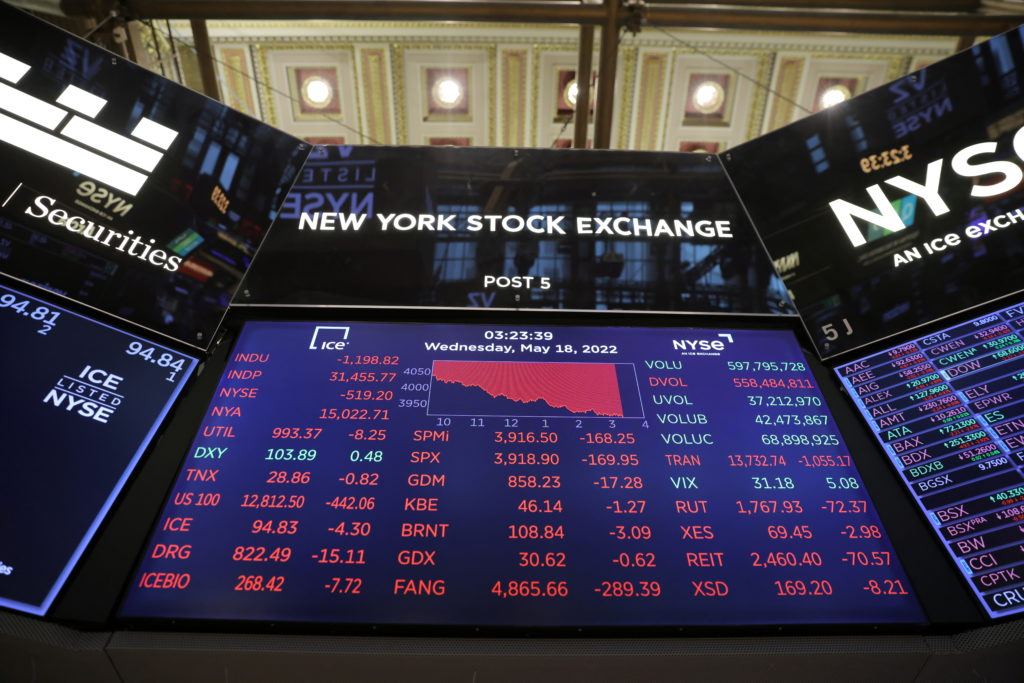
Wall Street ended Friday’s session mixed as falling oil prices and strong gains in real estate stocks helped offset renewed weakness in semiconductor shares.
However, the major U.S. stock indexes still recorded weekly losses. Investors remained concerned about the expanding conflict in the Middle East, heavy artificial intelligence spending by companies such as Alphabet and Tesla, and renewed trade tensions following the introduction of fresh U.S. tariffs.
Markets are now preparing for a major week that will include the Federal Reserve’s latest interest-rate decision and a wave of quarterly earnings reports.
S&P 500 and Dow Gain While Nasdaq Falls
The S&P 500 edged 0.1% higher to close at 7,412.62 points.
The Dow Jones Industrial Average gained 0.5% and finished at 51,946.51 points. Meanwhile, the technology-heavy Nasdaq Composite fell 0.6% to 24,975.82 points.
Despite Friday’s mixed performance, all three indexes ended the week lower.
The S&P 500 declined 0.6% for the week. The Nasdaq lost 2.1%, while the Dow fell 0.4%.
Iran Conflict and AI Spending Weigh on Markets
Michael Antonelli, market strategist at Baird Private Wealth Management, said investors were trying to assess two major risks.
The first was the inflationary impact of the conflict involving the United States and Iran. The second was uncertainty over how companies were adapting to the rapidly changing artificial intelligence market.
Higher oil prices have increased concerns that inflation could accelerate again. This may encourage the Federal Reserve to keep interest rates elevated or consider another rate increase.
At the same time, investors are becoming more cautious about rising capital expenditure and higher memory-chip prices across the technology sector.
Former high-flying AI stocks have therefore come under renewed pressure.
Real Economy Stocks Outperform Technology
While semiconductor and technology shares struggled, several sectors linked to the broader economy performed well.
Railroad companies, trucking groups and real estate stocks recorded solid gains.
The rotation suggested that some investors were moving away from expensive AI-related names and toward businesses with more direct exposure to transportation, property and economic activity.
Oil Prices Fall After Brent Tops $100
Oil prices moved lower on Friday after surging during the previous session.
Brent crude had climbed above $100 per barrel after Iran-backed Houthi militants in Yemen said they attacked Saudi Arabian oil tankers in the Red Sea.
The attacks raised concerns about shipping through the Bab el-Mandeb Strait. The Strait of Hormuz, another major energy route, was also facing serious security risks.
With two critical waterways under threat, investors became increasingly worried about potential oil supply disruptions.
Brent Records Strong Weekly Gain
Crude oil benchmarks pulled back on Friday as traders took profits following the sharp rally.
However, Brent was still heading toward a weekly gain of approximately 11%.
The rapid increase in energy prices revived concerns about inflation. Higher oil costs can increase transportation, manufacturing and consumer expenses across the economy.
These pressures could persuade central banks, including the Federal Reserve, to maintain tighter monetary policy.
Inflation fears were also reflected in rising U.S. Treasury yields as investors sold government bonds.
Shipping Activity Remains Uneven
Shipping-data provider Kpler reported mixed traffic across the Strait of Hormuz and the Bab el-Mandeb Strait.
Confirmed crossings through the Strait of Hormuz fell to six, a decline of 60% from the previous day.
Meanwhile, the Bab el-Mandeb Strait recorded 49 confirmed crossings. These included sanctioned vessels, shadow-fleet ships and several vessels operating with limited tracking visibility.
Some ships that had previously reversed direction completed their journeys. However, others remained on hold as operators continued to assess regional security conditions.
The data indicated that maritime activity was recovering cautiously rather than returning to normal.
U.S.-Iran Fighting Continues
The conflict between the United States and Iran showed few signs of easing.
U.S. Central Command said it had completed a 13th consecutive night of strikes against Iranian targets.
Tehran responded by attacking U.S. military bases, mainly in Bahrain, Kuwait and Jordan.
The continued military exchange increased fears that the conflict could spread further across the Gulf region.
Ceasefire Reports Create More Uncertainty
Diplomatic efforts also appeared to be struggling.
The New York Times reported that Iran had rejected a U.S.-supported ceasefire proposal delivered by Iraqi Prime Minister Ali al-Zaidi.
According to the report, Tehran objected to a temporary agreement that did not resolve the question of control over the Strait of Hormuz.
The proposal was reportedly the only ceasefire plan under consideration.
However, the Iraqi prime minister’s office denied the report and described it as entirely unfounded.
Semiconductor Stocks Recover From Bear Market Levels
The artificial intelligence trade remained another major focus for investors.
Earlier in the year, enthusiasm around AI helped Wall Street return to record highs despite geopolitical concerns.
Semiconductor stocks played a major role in that rally. The Philadelphia Semiconductor Index recorded an 18-day winning streak in April and reached a record close of 14,634.70 points on June 22.
However, the index later experienced a sharp correction and entered bear-market territory.
Chip stocks recovered by approximately 1.2% during the week, although the rebound appeared largely driven by technical buying.
AI Valuations and Spending Raise Concerns
Investors remain worried about the high valuations of AI-related companies and the uncertain returns from massive infrastructure spending.
Technology companies are investing billions of dollars in data centres, processors, servers, software and other systems needed to train and operate artificial intelligence models.
However, markets are questioning how quickly these investments will generate sustainable profits.
This uncertainty has placed pressure on companies with aggressive AI spending plans.
Alphabet and Tesla Fail to Calm Investors
Alphabet and Tesla released their quarterly results on Wednesday.
The reports did little to ease concerns about the cost of artificial intelligence investment.
Alphabet reported its first quarterly cash burn on record. Meanwhile, Tesla recorded negative free cash flow for the first time since the first quarter of 2024.
The results reinforced worries that heavy spending could weaken cash generation even as companies continue expanding their AI infrastructure.
Intel Offers a More Positive AI Signal
Intel’s results provided a more encouraging view of the artificial intelligence boom.
The U.S. chipmaker reported second-quarter earnings and revenue that exceeded expectations.
Part of the improvement came from growing demand for Intel processors used in advanced AI agents and data-centre systems.
The results showed that some semiconductor companies are beginning to benefit directly from the expansion of AI infrastructure.
Trump Introduces New Import Tariffs
Trade tensions also weakened market sentiment during the week.
President Donald Trump imposed new double-digit tariffs on imports from 60 major U.S. trading partners.
The announcement came shortly after the administration introduced an additional 50% tariff on Canadian goods.
The latest measures range from 10% to 12.5%. They replace a previous global tariff of 10% that had expired.
White House Defends Tariff Measures
The Trump administration said the new tariffs were necessary because several U.S. trading partners had failed to enforce restrictions on products linked to forced labour.
Canada and the European Union were both placed under 10% tariffs, despite having laws that prohibit imports involving forced labour.
U.S. officials said the measures followed investigations into all 60 affected economies.
The administration is relying on Section 301 of the U.S. Trade Act of 1974. This provision allows the White House to impose tariffs and sanctions in response to trade practices considered unfair or discriminatory.
Critics Question the Legal Basis
Scott Lincicome, vice president of general economics at the Cato Institute, criticised the forced-labour justification.
He argued that the policy represented an attempt to rebuild Trump’s tariff system after earlier measures faced legal challenges.
However, he noted that Section 301 may offer a stronger legal foundation than previous emergency-powers tariffs.
Courts may also be reluctant to challenge the president’s trade-policy decisions.
Fed Decision and Earnings Take Centre Stage
Investors now face a busy week filled with major economic and corporate developments.
The Federal Reserve’s interest-rate decision will be closely watched for guidance on inflation and future monetary policy.
Markets will also analyse a large number of earnings reports for signs of how companies are managing higher costs, tariffs and AI-related spending.
Until uncertainty surrounding the Iran conflict, oil prices and trade policy begins to ease, Wall Street is likely to remain volatile.