Wall Street Moves Higher Despite Technology Weakness
U.S. stocks mostly advanced on Tuesday as falling oil prices and several positive earnings reports helped offset a sharp sell-off in semiconductor shares.
At 12:12 ET, the S&P 500 rose 0.4% to 7,440.90, while the Dow Jones Industrial Average gained 1.2% to 52,858.40.
The technology-heavy Nasdaq Composite was nearly unchanged at 24,934.88 after recovering from an earlier decline of as much as 1.4%.
Nvidia Concerns Pressure the AI Trade
Artificial intelligence stocks came under pressure after Nvidia shares fell 5% on Monday.
The decline followed reports that Nvidia was discussing a potential $250 billion financial commitment connected to a large OpenAI data-centre project.
The news increased concerns about circular financing in the AI industry. Under such arrangements, technology companies may financially support customers that later use the funds to purchase their products.
Investors are also questioning whether the enormous sums being invested in AI infrastructure will generate sufficient long-term returns.
Nvidia Financing Draws Comparisons With the Dot-Com Era
AJ Bell investment director Russ Mould compared Nvidia’s reported commitments with practices seen in the telecommunications industry around the turn of the century.
At that time, some equipment manufacturers financed customer purchases, temporarily strengthening demand before the technology bubble eventually collapsed.
The comparison added to fears that financial support from chipmakers could be inflating demand for AI hardware.
Asian Chip Stocks Suffer Heavy Losses
The semiconductor sell-off spread across Asian markets on Tuesday.
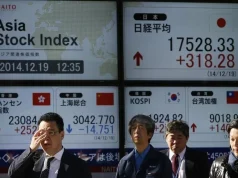
South Korea’s KOSPI plunged more than 10%, while Samsung Electronics dropped 13.4% and SK Hynix lost 14.7%.
In Japan, the Nikkei 225 declined 4%, with memory-chip producer Kioxia falling 18.3%.
The steep losses reflected growing concerns about AI investment, chip demand and intensifying competition from China.
Chinese Competition Weighs on US Semiconductor Companies
Recent developments in China have increased pressure on American chipmakers.
These include the success of Moonshot AI’s Kimi K3 model, the strong Shanghai market debut of memory-chip producer CXMT and progress in China’s domestic production of advanced lithography equipment.
Memory and semiconductor stocks were among the weakest performers in U.S. trading.
Sandisk, Western Digital, Seagate, Micron, Lam Research and Arm recorded notable declines.
The Philadelphia Semiconductor Index fell 4%, while the wider S&P 500 Technology sector lost 0.9%.
Apple Briefly Reaches $5 Trillion Valuation
Apple provided one of the few bright spots in the technology sector.
Its shares rose approximately 0.9% and briefly lifted the company’s market value above $5 trillion for the first time.
The milestone came as investors moved toward larger technology companies considered less exposed to the latest AI financing concerns.
Microsoft, Meta and Fed Decision Take Center Stage
Investors are preparing for a highly important Wednesday session.
Microsoft and Meta Platforms are scheduled to report quarterly results, while the Federal Reserve will announce its latest interest-rate decision.
Fed Chair Kevin Warsh will also hold a press conference after the announcement.
The combination of major technology earnings and the central bank decision could create significant volatility across financial markets.
AI Spending Plans Face Greater Scrutiny
Investors will closely examine the capital expenditure forecasts provided by Microsoft and Meta.
Concerns are growing about the uncertain returns from the billions of dollars being spent on AI infrastructure, including data centres, chips, networking equipment and software.
Tesla and Alphabet recently outlined further increases in AI-related spending, adding to concerns about pressure on cash flow and profitability.
Markets are now looking for evidence that these investments are producing measurable returns.
Federal Reserve Expected to Hold Rates Steady
The Federal Reserve is widely expected to leave interest rates unchanged.
The CME FedWatch tool indicated an estimated 71% probability that policymakers would maintain current borrowing costs.
However, the outlook has become less predictable due to developments in the Middle East and the recent increase in energy prices.
Oil had climbed approximately 20% over two weeks as the United States and Iran exchanged strikes linked to control of the Strait of Hormuz.
Markets Await Guidance From Kevin Warsh
Investors will pay close attention to comments from Fed Chair Kevin Warsh.
Since the previous central bank meeting, Warsh has maintained a relatively hawkish position and emphasised the Federal Open Market Committee’s commitment to controlling inflation.
He has also launched a broad review of Federal Reserve operations, including task forces focused on communication policies and inflation frameworks.
Rick Gardner, chief investment officer at RGA Investments, said Wednesday could be one of the most important market sessions in recent memory.
He noted that investors would be looking for guidance on interest rates and evidence that the technology sector’s AI investments are delivering returns.
Bond Yields May Reduce Need for a Rate Hike
Gardner said an interest-rate increase this year remained unlikely.
He argued that bond yields had already risen toward the upper end of their recent range, effectively tightening financial conditions without direct action from the Federal Reserve.
He also noted that stocks were no longer moving entirely in line with oil prices.
This could indicate that investors are placing greater emphasis on corporate earnings rather than reacting solely to geopolitical developments.
Strong Earnings Support the Stock Market
The second-quarter earnings season has remained stronger than analysts initially expected.
Deutsche Bank analysts said nearly 90% of reporting companies had exceeded forecasts, with combined earnings approximately 10% above consensus estimates.
S&P 500 earnings growth for the quarter was on course to reach 34% year over year.
That would exceed the market consensus forecast of 26% and Deutsche Bank’s earlier estimate of 29%.
Analysts also noted that earnings forecasts for the third and fourth quarters, as well as 2027, continued to improve.
Sherwin-Williams and Coca-Cola Lift the Dow
Several major companies rose after releasing encouraging financial results.
Sherwin-Williams shares jumped 8.4% after the company raised its full-year profit outlook and announced an 8% price increase across its product range.
Coca-Cola gained 5.3% after reporting that the FIFA World Cup supported 5% quarterly volume growth for its flagship brand.
The gains in both companies provided substantial support to the Dow Jones Industrial Average.
Boeing and PayPal Rise After Earnings
Boeing shares advanced 4.7% after the aircraft manufacturer exceeded quarterly revenue expectations.
The company also generated $600 million in positive free cash flow, providing investors with evidence of improving financial performance.
PayPal gained approximately 3.9% after raising its full-year profit forecast and outlining new cost-saving measures.
These earnings-related gains helped offset weakness across semiconductor and AI-related stocks.
Oil Prices Fall as US-Iran Fighting Pauses
Oil prices dropped more than 5%, extending their sharp losses from the previous session.
The decline followed a continued pause in military activity between the United States and Iran.
President Donald Trump said Washington was holding productive discussions with Tehran and suggested that an agreement to end the conflict remained possible.
However, he warned that military action could restart if diplomatic negotiations failed.
Trump Repeats Warning to Iran
Trump renewed his threat of further attacks if Iran refused to reach an agreement.
He suggested that bridges, power facilities and other important infrastructure could be targeted rapidly.
Despite the warning, the temporary pause in fighting reduced immediate fears of energy-supply disruptions.
Lower oil prices helped ease inflation concerns and supported sectors of the stock market outside the technology industry.