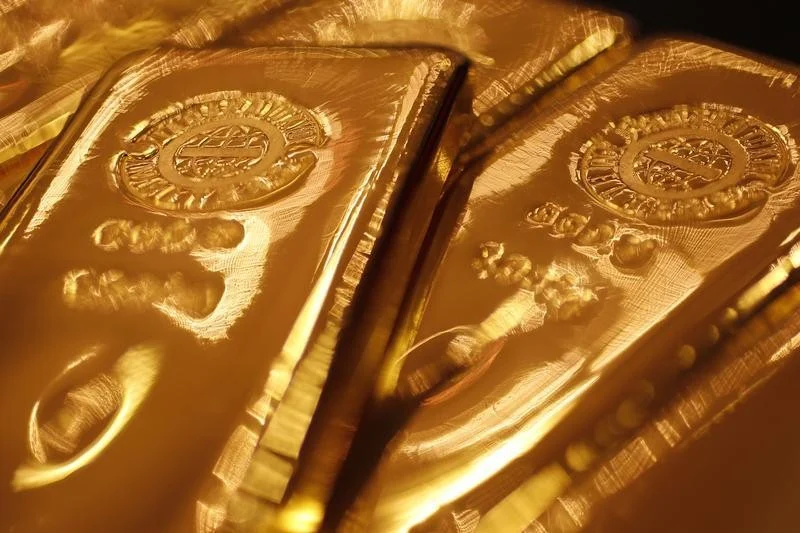
Gold prices moved lower on Wednesday as a stronger U.S. dollar and expectations for further Federal Reserve interest rate increases weighed on demand for bullion.
Investors also remained focused on inflation risks and geopolitical developments involving the United States and Iran.
Spot gold fell around 0.4% to $4,324.79 an ounce, while gold futures edged 0.1% higher to $4,379.09.
Other precious metals were also weaker. Spot silver declined 0.7% to $66.55 an ounce, while platinum dropped 1% to $1,816.79.
Stronger Dollar Pressures Gold Prices
The U.S. Dollar Index climbed 0.1% to 100.71, reaching its strongest level since July 30.
A stronger dollar typically creates pressure on gold because bullion becomes more expensive for buyers using other currencies.
The dollar has recently benefited from expectations that the Federal Reserve may keep monetary policy restrictive for longer.
Persistent inflation and elevated energy prices have increased concerns that price pressures could remain difficult to control.
Federal Reserve Rate Outlook Weighs on Bullion
The Federal Reserve raised interest rates by 25 basis points last week.
Fed Chair Kevin Warsh has also indicated that additional rate increases may be necessary in the months ahead if inflation remains elevated.
Other policymakers have expressed similar concerns.
St. Louis Fed President Alberto Musalem and Chicago Fed President Austan Goolsbee have both highlighted the possibility that further monetary tightening could be required to bring inflation under control.
Higher interest rates can reduce the appeal of gold because the metal does not generate interest or yield.
Oil Prices Decline as Middle East Concerns Ease
Oil prices extended their decline for a sixth consecutive session as concerns over potential supply disruptions in the Middle East eased.
Fresh diplomatic efforts also improved hopes that tensions could eventually de-escalate.
Energy prices remain important for gold markets because higher oil prices can contribute to inflation.
If inflation remains elevated, central banks may be more likely to maintain tighter monetary policy.
Conversely, falling oil prices can reduce inflationary pressure and potentially lessen the need for aggressive rate increases.
U.S.-Iran Talks Remain in Focus
Investors were also watching developments surrounding relations between the United States and Iran.
President Donald Trump was scheduled to address the United Nations General Assembly in New York.
Trump had also indicated that he was open to meeting Iranian President Masoud Pezeshkian on the sidelines of the gathering.
The diplomatic signals followed a period of heightened tensions between Washington and Tehran.
Any progress toward reducing geopolitical risks could limit safe-haven demand for gold in the short term.
However, renewed uncertainty or escalation could quickly increase demand for defensive assets.
Gold ETF Inflows Provide Longer-Term Support
Despite short-term pressure from the dollar and interest rate expectations, investment demand for gold has continued to improve.
Around 50 tonnes of gold have flowed into bullion-backed ETFs so far in September, according to ANZ.
That puts the sector on track to record a third consecutive month of inflows.
The stronger ETF demand suggests that investors continue to maintain exposure to gold despite concerns over higher interest rates.
ANZ noted that gold has remained within a relatively narrow trading range as markets balance expectations for tighter monetary policy against improving investment demand.
Chinese Gold Demand Remains Strong
Demand from China is also providing support for the longer-term gold outlook.
Chinese gold imports reached approximately 1,000 tonnes during the first eight months of 2026, according to ANZ research.
Meanwhile, Chinese gold ETFs added around 44 tonnes in August.
The People’s Bank of China also accelerated its gold purchases, buying roughly 20 tonnes during August.
Continued central bank and investment demand could help support gold even if higher interest rates create pressure in the near term.
Copper Prices Also Move Lower
Industrial metals also weakened during Wednesday’s session.
Benchmark copper futures on the London Metal Exchange declined around 0.7% to $14,683.33 per tonne.
U.S. copper futures slipped approximately 0.3% to $6.8225 per pound.
For now, gold traders remain focused on the direction of the U.S. dollar, Federal Reserve interest rate expectations, inflation trends and geopolitical developments.
While tighter monetary policy continues to create short-term pressure, strong ETF inflows and continued Chinese demand remain important sources of longer-term support for bullion.