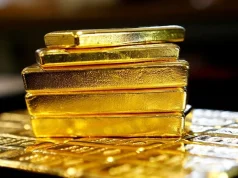
Gold prices extended their decline on Monday after losing more than 2% during the previous week. Elevated oil prices and stronger US economic data increased expectations that the Federal Reserve could keep interest rates higher for longer.
Spot gold, or XAU/USD, fell 2.3% to around $4,188.84 per ounce. Gold futures also dropped 2.3% to approximately $4,221.12.
Other precious metals came under even greater pressure. Silver fell 4.1% to $61.65, while platinum declined 3% to $1,727.90.
Meanwhile, the US Dollar Index gained 0.1% to 101.11, adding further pressure on dollar-denominated gold.
Strait of Hormuz Tensions Keep Oil Prices Elevated
Oil prices moved higher after Iran said it would not ease its conditions for reopening the Strait of Hormuz.
The dispute has maintained uncertainty around one of the world’s most important routes for global energy supplies.
US President Donald Trump rejected Iran’s seven-day proposal to reopen the waterway. However, he said he expects negotiations with Tehran to resume this week.
The US-Iran conflict is now entering its eighth month, while Brent crude oil has risen approximately 70% this year.
Persistently high energy prices are increasing concerns about inflation. As a result, oil has become an increasingly important factor for investors assessing the Federal Reserve’s next interest rate decisions.
Fed Rate Hike Expectations Pressure Gold
Expectations for additional Federal Reserve rate hikes are creating another challenge for gold prices.
Cleveland Fed President Beth Hammack said long-term Treasury yields have been rising due to stronger economic growth expectations, concerns surrounding government debt and expectations for further interest rate increases.
Federal Reserve officials unanimously voted to increase the benchmark interest rate by 25 basis points in mid-September.
Since then, several policymakers have indicated that additional rate increases may be necessary if inflation remains elevated.
Markets are currently pricing in approximately a 65% probability of another Fed rate hike in October.
Higher interest rates are generally a headwind for gold because the precious metal does not generate interest. As bond yields rise, interest-bearing assets can become relatively more attractive to investors.
Treasury Yields Add to Gold’s Decline
Developments in the US bond market have also weighed on bullion.
The yield spread between 10-year and two-year US Treasury bonds narrowed to as little as 17 basis points last week. That represented the smallest gap since early 2025.
Higher Treasury yields increase the opportunity cost of holding non-yielding assets such as gold.
At the same time, strength in the US dollar has added another source of pressure. A stronger dollar can make gold more expensive for buyers using other currencies.
Gold Remains Well Below January Record
Gold has traded within a relatively narrow range of approximately $4,230 to $4,510 this month as investors repeatedly reassess the outlook for US monetary policy.
Despite remaining at historically elevated levels, gold is still well below its January record high of almost $5,600 per ounce.
The recent decline reflects growing uncertainty over whether the Federal Reserve will need to maintain restrictive monetary policy for longer than previously expected.
Gold ETF Demand Remains Strong
ANZ said the broader macroeconomic environment remains challenging for gold, particularly because of higher bond yields and a strong US dollar.
However, investor demand for gold exchange-traded funds remains relatively resilient.
According to the bank, gold ETF holdings have increased by around 50 tonnes so far this month.
Strong ETF demand could provide some support for bullion even as monetary policy conditions remain unfavorable.
US Consumer Sentiment Weakens
Recent US economic data have provided investors with mixed signals.
US consumer sentiment weakened in September, falling to its lowest level in four months as concerns about prices and the broader economy increased.
Meanwhile, US Treasury Secretary Scott Bessent called on the Federal Reserve to remain open-minded when considering future interest rate decisions.
Bessent argued that productivity improvements driven by artificial intelligence and deregulation could help contain inflationary pressures.
PCE Inflation and Jobs Data in Focus
Investors will now turn their attention to two major US economic reports that could influence the next move in gold prices.
August PCE inflation data is scheduled for Wednesday. The PCE price index is closely watched because it is the Federal Reserve’s preferred measure of inflation.
The September US jobs report will follow on Friday, providing fresh information on employment and payroll growth.
Stronger-than-expected inflation or labor market data could reinforce expectations for further Fed rate hikes. In contrast, weaker readings could reduce pressure on policymakers to continue tightening monetary policy.
For gold, the combination of oil prices, Treasury yields, the US dollar and Federal Reserve expectations is likely to remain central to the near-term outlook.