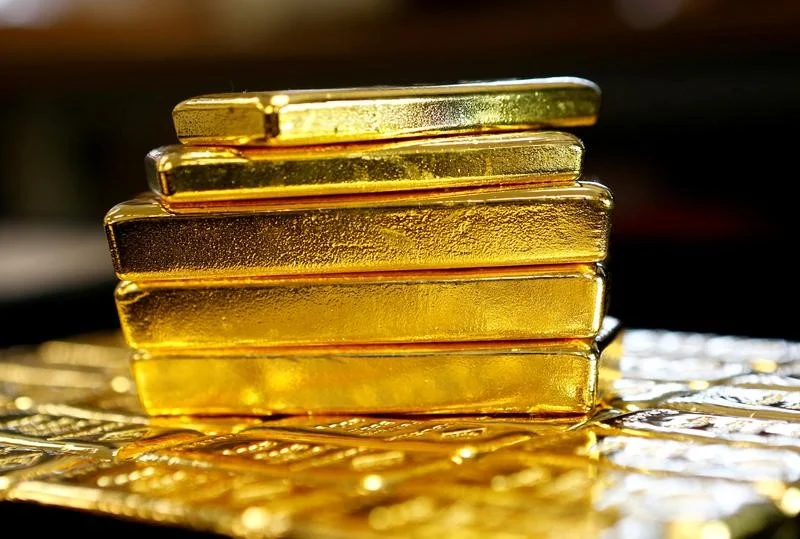
Gold prices remained close to $4,400 per ounce on Monday as stronger-than-expected U.S. payroll data and renewed tensions around the Strait of Hormuz increased expectations for a Federal Reserve rate hike.
At 20:48 ET, spot gold traded near $4,426.93 an ounce, while gold futures slipped slightly to around $4,473.66.
Silver rose 0.2% to $66.37 an ounce, while platinum declined 0.5% to $1,813.77. Meanwhile, the U.S. Dollar Index fell 0.2% to 99.09.
Strong U.S. Payrolls Lift Fed Rate Hike Expectations
The latest U.S. jobs report showed that employers added 162,000 jobs in August, beating market expectations.
The unemployment rate remained unchanged, reinforcing the view that the U.S. labor market is still relatively resilient.
As a result, markets are now pricing in roughly a 60% chance of a Federal Reserve rate hike at the September 15-16 policy meeting.
Higher interest rates can create pressure for gold because yield-generating assets become more attractive compared with non-yielding precious metals.
Stronger Dollar Adds Pressure to Gold
The U.S. dollar also strengthened on Friday, creating another headwind for gold.
Because bullion is priced in dollars, a stronger greenback can make gold more expensive for investors using other currencies.
Gold finished last week near $4,429 per ounce, down about 0.6%.
The metal traded on both sides of the $4,400 level as investors repeatedly adjusted their expectations for Federal Reserve policy.
Investors Await U.S. Inflation Data
Attention is now shifting to U.S. inflation data due later this week.
The consumer price report could provide another important signal about whether the Federal Reserve is likely to tighten monetary policy.
A hotter-than-expected inflation reading could strengthen the case for higher interest rates, while softer data could reduce pressure on gold.
Strait of Hormuz Tensions Raise Energy Risks
Geopolitical tensions also remained a major factor in the gold market.
Iran said it had targeted three oil tankers in the Strait of Hormuz, along with several vessels linked to the United States, following earlier U.S. attacks on ships.
The latest escalation has renewed concerns about energy shipments through the strategically important waterway.
Rising Oil Prices Add to Inflation Concerns
Brent crude traded near $97 per barrel, increasing concerns that higher energy costs could keep inflation elevated.
Persistent inflation could make the Federal Reserve more cautious about easing monetary policy.
That creates a complicated environment for gold, which can benefit from geopolitical uncertainty but may face pressure when interest-rate expectations rise.
Gold Holds Above Key Long-Term Support
Gold has remained within a relatively narrow range since rebounding from levels near $4,000 per ounce in July.
However, the metal fell below its 200-day moving average near $4,526 last week.
That break caused some short-term technical weakness.
Even so, some analysts continue to view the broader trend more positively.
Analyst Sees Gold Base Near $3,942
Tony Sycamore, senior market analyst at IG, said the recent technical weakness has not changed his medium-term outlook.
He believes gold established an important base around the late-June low near $3,942 per ounce.
Sycamore continues to favor buying gold on pullbacks and expects prices to eventually move toward $5,000 per ounce.
For now, the gold price outlook remains closely tied to Federal Reserve expectations, U.S. inflation data, the dollar and developments around the Strait of Hormuz.