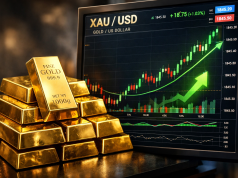
Gold prices extended their advance on Wednesday, staying firmly above the $4,400-per-ounce level as investors assessed the latest U.S. inflation figures and their potential impact on Federal Reserve policy.
At 09:26 ET, spot gold rose 1.1% to $4,418.08 an ounce, while gold futures gained 0.8% to $4,478.10.
U.S. Inflation Cools in July
U.S. consumer inflation eased slightly in July, broadly matching economists’ expectations.
Annual headline inflation slowed to 3.4% from 3.5% in June.
On a monthly basis, the Consumer Price Index rose 0.1%, rebounding from a 0.4% decline in the previous month.
Core CPI, which excludes volatile food and energy prices, increased 0.2% month over month and 2.5% year over year. Both readings were in line with forecasts.
Fed September Decision Remains Uncertain
The inflation report left investors divided over the Federal Reserve’s next move.
According to CME FedWatch data cited in the report, markets assigned around a 56% probability that the Fed will keep interest rates unchanged in September.
Meanwhile, traders saw a 44% chance of a quarter-point rate increase.
The interest-rate outlook remains especially important for gold. Higher rates increase the opportunity cost of holding non-yielding assets such as bullion.
Energy Prices Could Complicate the Inflation Outlook
Rising energy costs remain a potential challenge for Federal Reserve policymakers.
If higher oil and fuel prices feed into broader inflation, the central bank could be forced to keep monetary policy tighter for longer.
That scenario could create resistance for gold, although continued geopolitical uncertainty is also supporting safe-haven demand.
Strait of Hormuz Tensions Support Gold
Gold remained close to a two-month high as investors monitored diplomatic efforts surrounding the Strait of Hormuz.
Earlier reports suggested Washington and Tehran could be moving closer to an agreement over reopening the important shipping route.
Pakistan’s defense minister said the two sides were approaching an arrangement, while separate reports pointed to advanced discussions involving Iran and Oman.
However, significant differences remain.
Iran has insisted that the Strait will stay restricted until the United States meets several demands, including lifting restrictions on Iranian ports and providing compensation for damage caused by U.S. military strikes.
Middle East Hostilities Remain a Key Risk
Military tensions also continued across the region.
The United States and Yemen’s Iran-aligned Houthis reported separate attacks involving shipping around the Strait of Hormuz and Bab el-Mandeb.
A U.S. Navy helicopter also fired missiles at a Panama-flagged cargo vessel that was attempting to cross the Gulf of Oman.
The conflicting diplomatic and military developments have kept uncertainty elevated across both gold and energy markets.
China Continues to Increase Gold Reserves
Demand from China is providing another source of support for bullion.
The People’s Bank of China increased its gold holdings for a 21st consecutive month in July, adding around 640,000 troy ounces.
Its total reserves reached approximately 76.08 million ounces.
Chinese gold-backed exchange-traded funds have also continued to attract investment, pointing to stronger institutional demand.
Gold Faces Key Technical Resistance
Gold is now approaching an important technical area that could determine whether the rally extends further.
IG senior market analyst Tony Sycamore identified resistance around $4,460, based on a downward trend line extending from the late-January record high.
The 200-day moving average near $4,495 could create another obstacle.
A sustained breakout above both levels could strengthen the case for a broader recovery and potentially open the door toward the $5,000 level.
For now, gold remains supported by softer inflation, central-bank demand and geopolitical uncertainty, while the Federal Reserve outlook and technical resistance remain key factors for the next move.