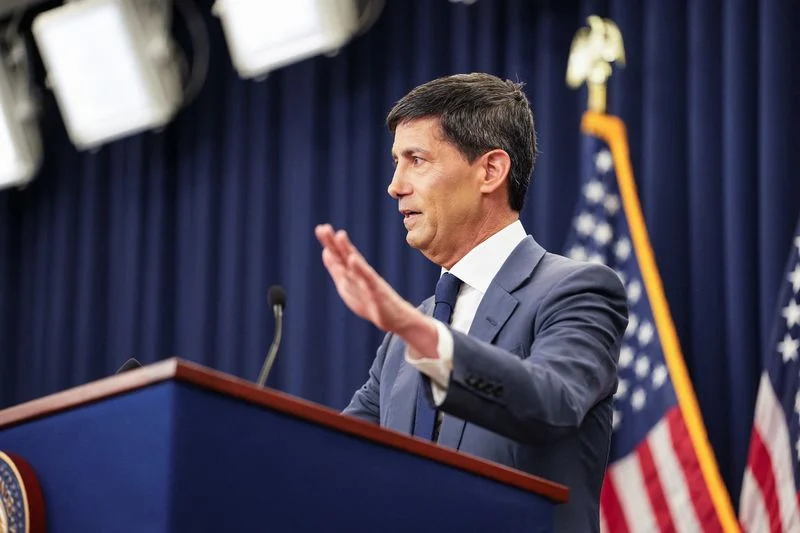
Fed Chair Kevin Warsh Vows to Protect Central Bank Independence
Federal Reserve Chair Kevin Warsh said on Tuesday that he would continue to “do my job” if President Donald Trump challenged him or attempted to influence monetary policy.
His comments were his clearest statement so far on how he would respond to the type of political pressure faced by his predecessor.
Warsh Says Politics Has No Place Inside the Fed
During testimony before the U.S. House Financial Services Committee, lawmakers asked Warsh how he would react if Trump continued to target the central bank.
The questioning referenced previous efforts involving Federal Reserve officials, including the attempted removal of Governor Lisa Cook.
Warsh pointed to a recent U.S. Supreme Court ruling that reaffirmed the Federal Reserve’s independence when setting monetary policy.
He said that even if he were personally targeted, he would remain focused on his responsibilities.
Warsh acknowledged that politics is unavoidable outside the Federal Reserve. However, he said his goal was to ensure that political considerations did not influence decisions inside the central bank.
Democrats Raise Concerns About Fed Independence
Warsh’s relationship with Trump became a central issue during the first day of his two-day congressional testimony.
Trump had praised Warsh extensively when he was sworn in as Fed chair in May.
Democratic lawmakers warned that Warsh should not rely only on the Supreme Court ruling to protect the central bank’s independence.
They questioned whether he would be willing to resist pressure from the White House, particularly if Trump continued demanding lower interest rates.
Inflation Remains Above the Fed’s Target
Warsh is taking control of monetary policy at a difficult moment for the U.S. economy.
Inflation remains above the Federal Reserve’s long-term target of 2%. At the same time, renewed tensions in the Middle East could push energy prices higher and reverse recent progress.
Data released on Tuesday showed that annual U.S. consumer inflation slowed to 3.5% in June.
The decline was stronger than economists had expected and was largely supported by lower energy prices.
Markets Reduce Expectations for a July Rate Hike
Following the inflation report, traders reduced their expectations for an immediate interest-rate increase.
Markets assigned roughly a 12% probability to a quarter-point rate hike at the Fed’s July 28–29 meeting.
That was down sharply from approximately 42% on Monday, according to CME Group’s FedWatch tool.
The probability of a September rate increase also fell to around 53%, compared with approximately 75% one day earlier.
Warsh Keeps Focus on Price Stability
Warsh told lawmakers that bringing inflation back to the Fed’s 2% target remained his top priority.
He said the central bank’s policymakers were united around the need to restore price stability.
However, that approach could create tension with Trump, who has repeatedly called for lower interest rates.
Warsh said that successful monetary policy could bring the inflation surge of the previous five years to an end.
Senate Testimony Will Draw Further Scrutiny
Warsh is scheduled to appear before the Senate Banking Committee on Wednesday.
The panel recommended his confirmation in late April through a party-line vote.
Democratic senators had raised concerns about his ties to Trump and questioned whether he would act independently.
Those concerns were intensified by Trump’s previous statement that he would only nominate a Fed chair whom he expected to lower interest rates.
No Clear Signal of an Imminent Rate Cut
Warsh has so far shown little indication that rate cuts are approaching.
His early policy stance appears similar to that of former Fed Chair Jerome Powell, who faced sustained criticism from Trump for keeping interest rates elevated.
Warsh’s first appointments to several Federal Reserve task forces were viewed as a sign of independence.
The groups included experienced economists, central bankers and corporate leaders rather than strongly partisan figures.
Economists See Distance Between Warsh and Trump
Jon Faust, a former senior adviser to Powell and an economics professor at Johns Hopkins University, said Warsh’s early actions should ease concerns that he would simply follow Trump’s preferences.
Faust pointed to Warsh’s first press conference, where his comments suggested that interest rates could remain unchanged for some time.
He also said the Fed’s new task forces reinforced the view that Warsh wanted major policy debates to be handled by experienced and neutral experts.
Warsh May Take a More Independent Long-Term View
Samuel Tombs, chief U.S. economist at Pantheon Macroeconomics, said Warsh may initially have gained Trump’s support by appearing open to lower interest rates.
However, Tombs argued that Warsh now has the freedom to take a more impartial and long-term approach.
He noted that Powell demonstrated how much independence a Federal Reserve chair can maintain despite political pressure.
Warsh may also be considering his long-term reputation and the possibility of serving under a future president.
Warsh Becomes More Cautious on AI
Warsh has also adopted a more measured view of artificial intelligence.
Before his nomination, he suggested that AI could improve productivity, reduce inflation and allow interest rates to fall.
However, the Federal Reserve’s latest monetary policy report noted that AI investment may also be increasing certain costs.
Heavy spending on data centers, software, construction workers and infrastructure could create inflationary pressure before productivity benefits fully emerge.
AI Benefits May Take Time to Appear
Warsh has acknowledged that the timing of AI-driven productivity gains remains uncertain.
The benefits may take years to influence the broader economy.
Meanwhile, demand for capital, energy, skilled labor and computing infrastructure is already increasing.
This creates a more complicated relationship between artificial intelligence, inflation and monetary policy.
Warsh Rejects Traditional Forward Guidance
Unlike other Federal Reserve policymakers, Warsh did not submit an interest-rate projection at the Fed’s June 16–17 meeting.
He said he does not plan to provide one in the future because he opposes that form of forward guidance.
At his first meeting as Fed chair, Warsh said there was only one policy proposal under consideration.
There was no discussion of an interest-rate cut.
Trump-Warsh Relationship Could Face Tests
Warsh’s relationship with Trump may face greater pressure in the coming months.
If inflation remains high, support for additional rate increases could grow among Federal Reserve officials.
Such a move would conflict with Trump’s preference for lower borrowing costs.
The administration could also renew efforts to remove Democratic appointees from the Fed’s Board of Governors.
That could force Warsh to choose between defending the institution and maintaining his relationship with the president.
Warsh Appears Committed to Independence for Now
At Warsh’s swearing-in ceremony, Trump told him to act independently and not consider the president’s preferences.
Warsh appears to be taking that message seriously.
Former Cleveland Fed President Loretta Mester said the relationship had worked well so far, although it remained unclear how long that would continue.
She also described Warsh’s task force appointments as encouraging and professionally credible.
For now, Warsh is presenting himself as an independent Fed chair focused on inflation, institutional credibility and politically neutral monetary policy.