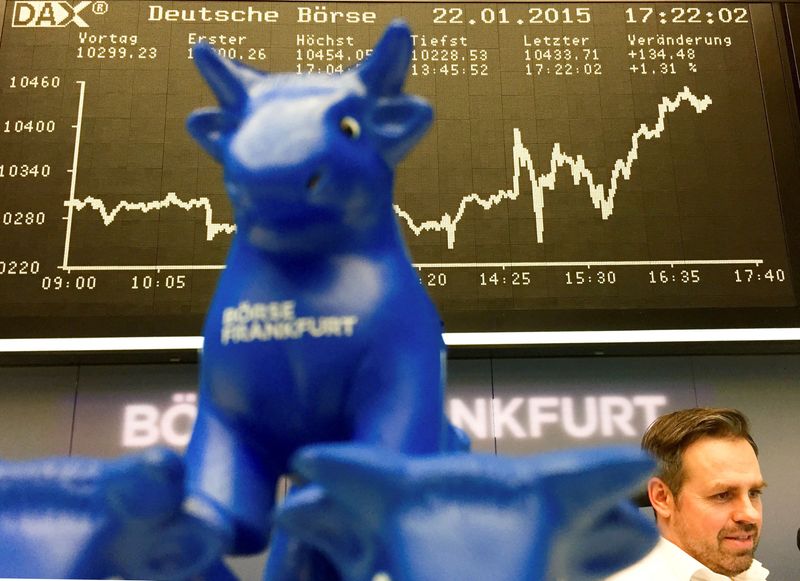
European stocks traded cautiously on Thursday, October 29, as investors awaited the European Central Bank’s (ECB) interest rate decision and key US inflation data.
The STOXX 600 remained relatively unchanged during early trading, reflecting uncertainty surrounding monetary policy and mixed corporate earnings.
Meanwhile, investors continued assessing the Federal Reserve’s latest policy announcement and contrasting results from major US technology companies.
Attention is also turning toward the upcoming US core Personal Consumption Expenditures (PCE) inflation report, which could influence expectations for future interest rate decisions.
European Stocks Hold Steady Ahead of ECB Decision
European stock markets showed limited movement as traders avoided taking major positions before the ECB’s monetary policy announcement.
The pan-European STOXX 600 Index traded near unchanged levels.
Germany’s DAX advanced approximately 0.2%, while France’s CAC 40 gained 0.6%.
Meanwhile, London’s FTSE 100 climbed 0.3%, supported by positive earnings developments in several major companies.
Despite these modest gains, uncertainty surrounding interest rates, energy prices, and corporate profitability continued to limit broader market momentum.
Investors are particularly focused on ECB President Christine Lagarde’s upcoming press conference for guidance about the direction of European monetary policy.
ECB Expected to Keep Interest Rates at 2.50%
The European Central Bank is widely expected to maintain its deposit facility rate at 2.50% following interest rate increases in June and September.
However, investors remain concerned about persistent inflationary pressures, particularly those associated with elevated energy costs.
Crude oil prices remain above $100 per barrel, while European natural gas prices are trading near levels last seen during the 2022 energy crisis.
These conditions have increased expectations that the ECB could consider additional monetary tightening before the end of 2026.
According to interest rate futures pricing cited ahead of the meeting, markets assigned approximately an 80% probability to a 25-basis-point rate increase in December.
Nevertheless, policymakers must balance inflation concerns against the risk of weakening economic activity.
Higher government borrowing costs and tighter bank lending conditions could reduce the need for further interest rate increases.
Consequently, Lagarde’s comments will be closely examined for indications about the ECB’s next policy move.
US PCE Inflation Data Takes Center Stage After Fed Decision
European investors are also monitoring developments in US monetary policy following Wednesday’s Federal Reserve announcement.
The Federal Open Market Committee maintained its benchmark interest rate within the 3.75%–4.00% range.
Although the decision was widely anticipated, Federal Reserve Chair Kevin Warsh provided limited guidance about future interest rate increases.
As a result, investors remain uncertain about whether the central bank will resume tightening monetary policy before the end of the year.
Attention is now shifting toward September’s US Personal Consumption Expenditures (PCE) price index.
Economists expect core PCE inflation to increase 0.3% month-over-month, compared with a 0.2% rise in August.
A stronger-than-expected inflation reading could reinforce expectations for additional Federal Reserve rate hikes.
Conversely, weaker inflation figures could ease concerns about prolonged monetary tightening and provide support for global equity markets.
Shell Shares Rally While Volkswagen Earnings Disappoint
Corporate earnings created contrasting movements across European stock markets.
Shell shares advanced approximately 2.6% after the energy giant reported stronger-than-expected quarterly profits and increased its share buyback program.
Higher oil and gas prices contributed to the company’s earnings performance, providing support for the broader European energy sector.
However, Volkswagen experienced a significantly more challenging quarter.
The German automaker reported that operating profit for the first nine months of 2026 had fallen approximately 98.7% compared with the previous year.
The disappointing figures highlighted the financial pressure facing Europe’s automotive industry amid restructuring costs, international competition, and changing market conditions.
Volkswagen shares declined approximately 1.6% following the announcement.
The contrasting results demonstrated how elevated energy prices can benefit oil producers while creating additional challenges for other industries.
Alphabet and Microsoft Earnings Highlight AI Investment Risks
Technology stocks remained under pressure as investors assessed the financial impact of rapidly expanding artificial intelligence infrastructure spending.
Alphabet disappointed investors despite reporting substantial revenue growth, with attention shifting toward its elevated capital expenditures and weaker-than-expected earnings.
The company’s aggressive AI investment strategy raised concerns about near-term free cash flow and the time required to generate meaningful returns.
Microsoft, however, delivered a more encouraging performance.
The technology giant benefited from stronger cash generation and continued growth in its Azure cloud computing business.
The contrasting results reinforced growing investor scrutiny of AI-related spending across the technology sector.
Meanwhile, upcoming earnings announcements from Amazon and Intel could provide further insights into corporate demand for AI infrastructure.
European Semiconductor Stocks Face Selling Pressure
European semiconductor equipment manufacturers also experienced weakness as concerns about artificial intelligence spending affected investor sentiment.
Shares of ASML, ASM International, and BE Semiconductor declined during the trading session, reflecting uncertainty surrounding future data center investments.
These companies provide important equipment and technologies used in advanced semiconductor manufacturing.
Consequently, their financial outlooks are closely connected to investment trends among major technology and chip manufacturers.
STMicroelectronics also declined approximately 2%, despite reporting third-quarter operating profit above market expectations.
The weakness suggested that investors were focusing increasingly on future growth prospects rather than current quarterly performance alone.
Upcoming earnings from major US technology companies could therefore influence sentiment toward European semiconductor shares.
European Stock Market Outlook Hinges on ECB and US Inflation
The near-term outlook for European stocks remains closely tied to monetary policy decisions, inflation developments, and corporate earnings.
The ECB’s interest rate announcement and Lagarde’s policy guidance could influence European bond yields, the euro, and regional stock valuations.
Meanwhile, US core PCE inflation data may affect expectations for Federal Reserve interest rates and broader global financial conditions.
Corporate earnings will also remain an important market driver, particularly as investors evaluate the profitability of large-scale artificial intelligence investments.
Although European equities have shown resilience, uncertainty surrounding energy costs and monetary tightening could continue limiting market momentum.
For now, investors appear focused on upcoming economic releases and central bank communications for clearer signals about the direction of European stock markets.