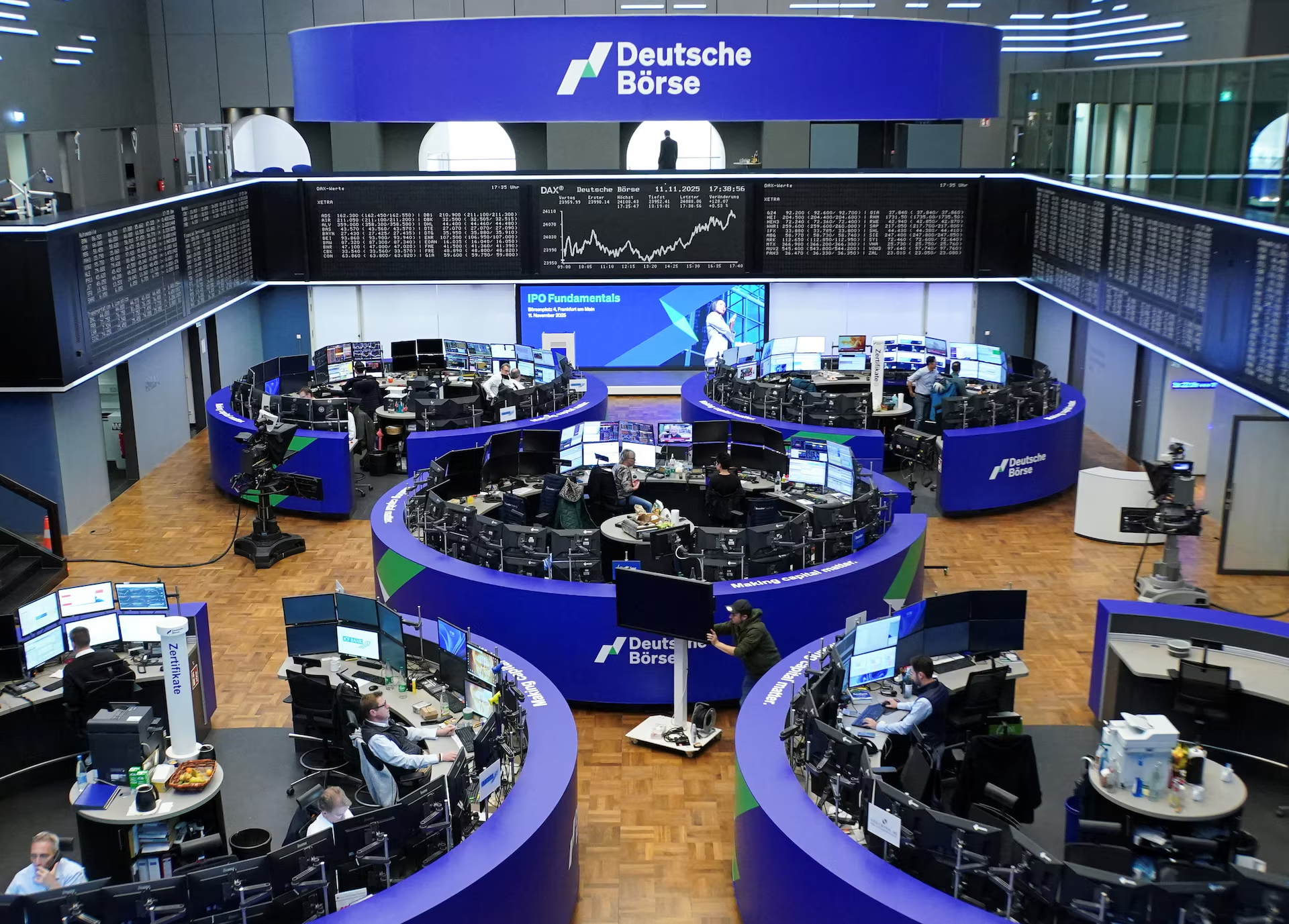
European stocks declined on Tuesday, November 3, 2026, as a global technology selloff intensified following Apple’s warning about rising memory chip costs and weaker profit margins.
Investor concerns deepened after Oracle announced plans to raise $20 billion through debt and equity financing to support its artificial intelligence infrastructure expansion.
Meanwhile, uncertainty surrounding the US midterm elections and the Federal Reserve’s interest rate outlook added pressure to European financial markets.
European Stocks Slide as Technology Selloff Intensifies
The pan-European STOXX 600 index declined approximately 0.7% during Tuesday’s trading session, with technology companies leading the losses.
Germany’s DAX fell nearly 1%, while France’s CAC 40 dropped 0.5%. London’s FTSE 100 also weakened, losing approximately 0.4%.
Southern European markets experienced similar pressure. Italy’s FTSE MIB and Spain’s IBEX 35 both declined more than 1%.
The widespread weakness followed a retreat in US technology shares, where investors have become increasingly concerned about elevated valuations and the rising costs of artificial intelligence development.
Apple’s cautious profitability outlook and Oracle’s substantial financing plans reinforced those concerns, prompting investors to reduce exposure to technology-related stocks.
Apple Margin Warning Hits European Semiconductor Stocks
Apple (NASDAQ: AAPL) contributed to the negative market sentiment after warning that surging memory chip prices could significantly affect profitability during the holiday shopping quarter.
Although the iPhone maker reported stronger-than-expected quarterly earnings, its forward guidance disappointed investors.
Apple expects gross profit margins of between 45% and 46% for the December quarter, compared with analysts’ expectations of approximately 46.9%.
The warning raised concerns about the broader technology hardware industry, particularly companies exposed to semiconductor manufacturing and electronic components.
European semiconductor stocks experienced substantial selling pressure as investors assessed the potential consequences of rising production costs.
Shares of ASML, ASM International, and BE Semiconductor Industries came under pressure, with several chip equipment companies recording declines of between 2% and 4%.
Meanwhile, semiconductor manufacturers STMicroelectronics and Infineon also weakened amid concerns about demand and profitability.
Investors fear that technology companies may face difficult choices between absorbing higher component costs and passing those increases on to consumers.
Either scenario could affect earnings growth across the semiconductor supply chain.
Oracle’s $20 Billion Financing Plan Raises AI Investment Concerns
Investor anxiety intensified after Oracle (NYSE: ORCL) announced plans to raise approximately $20 billion through a combination of bond and share sales.
The enterprise software company intends to use the financing to support its expanding cloud computing and artificial intelligence infrastructure operations, alongside other corporate purposes.
Oracle’s fundraising plans include approximately $10 billion in debt financing and another $10 billion through an equity offering.
The announcement renewed concerns about the enormous financial commitments required to build AI data centers and related infrastructure.
Investors are increasingly questioning whether technology companies can generate sufficient revenue and cash flow to justify their accelerating capital expenditure.
Higher borrowing costs and additional share issuance also create potential challenges for companies pursuing aggressive expansion strategies.
Oracle’s announcement therefore added to selling pressure across global technology stocks, including European companies connected to semiconductor production and data center infrastructure.
European Earnings Season Brings Mixed Corporate Results
Beyond the technology sector, investors are closely monitoring Europe’s third-quarter corporate earnings season.
Approximately 20% of STOXX 600 companies are expected to release their quarterly results this week, making it one of the busiest periods of the reporting calendar.
Several major European companies have already delivered contrasting financial results.
German airline group Lufthansa saw its shares rise approximately 1.6%, despite reducing the upper end of its full-year 2026 operating profit forecast.
The company cited higher aviation fuel expenses linked to Middle Eastern supply disruptions and elevated energy prices.
However, Lufthansa’s stronger-than-expected quarterly earnings helped support investor sentiment.
Meanwhile, Dutch healthcare technology company Philips gained approximately 6.4% after reporting improved adjusted operating earnings and stronger customer orders.
The contrasting performances highlight the importance of company-specific financial results during periods of broader market volatility.
US Midterm Elections Add to European Market Uncertainty
The November 3 US midterm elections represent another important source of uncertainty for European investors.
American voters are deciding control of Congress during the second half of President Donald Trump’s second presidential term.
The election outcome could influence US fiscal policy, corporate regulation, trade relations, and government spending priorities.
A Democratic victory in one or both chambers could complicate the administration’s legislative agenda and create greater political uncertainty.
A divided Congress could also make negotiations over federal spending and the US debt ceiling more challenging.
For European financial markets, changes in American economic policy could influence international trade, corporate investment, and global risk appetite.
Consequently, investors are closely monitoring the election results for indications of how US policy may develop over the coming years.
Federal Reserve Interest Rate Outlook Remains in Focus
Alongside political developments, investors are awaiting important US economic data that could influence the Federal Reserve’s next interest rate decision.
Friday’s October nonfarm payrolls report is expected to provide additional insight into employment conditions and the strength of the American economy.
Stronger labor market figures could reinforce expectations that US interest rates will remain elevated or potentially increase further.
Conversely, weaker employment data could reduce expectations of additional monetary tightening.
Changes in US interest rate expectations can influence European equities through bond yields, currency movements, and international capital flows.
Technology companies are particularly sensitive to these developments because higher financing costs can reduce the present value of expected future earnings.
The combination of political uncertainty and monetary policy expectations has therefore encouraged a cautious approach among investors.
European Stock Market Outlook Remains Cautious
European stocks face several challenges as investors reassess technology valuations, corporate earnings, and the outlook for global monetary policy.
Apple’s warning about rising component costs has increased concerns about profitability across the semiconductor industry.
Meanwhile, Oracle’s substantial financing plans have renewed questions about the financial sustainability of large-scale artificial intelligence investments.
Although companies such as Philips and Lufthansa have delivered positive quarterly earnings surprises, broader market sentiment remains fragile.
Investors will now focus on upcoming European corporate results, US election developments, and key economic indicators for signs of improving confidence.
For now, the decline in European stocks highlights growing uncertainty about technology-sector profitability and the potential consequences of rising investment costs.