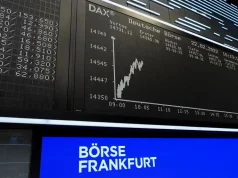
European stocks traded broadly flat on Wednesday after falling to their weakest levels in more than a month during the previous session.
The ongoing global bond selloff continued to pressure equity valuations as higher government borrowing costs reduced investor appetite for stocks.
Germany’s DAX and France’s CAC 40 both closed at their lowest levels in more than a month on Tuesday. London’s FTSE 100 also moved closer to a one-month low.
Rising Bond Yields Pressure European Equities
The weakness in European stocks reflects the sharp rise in sovereign bond yields across major markets.
Germany’s 10-year Bund yield remained near levels last seen in 2011 at around 3.35%.
Meanwhile, the U.S. 10-year Treasury yield climbed above 4.78%, reaching a multi-year high.
Higher bond yields create direct pressure on stocks because investors can earn more attractive returns from lower-risk government debt.
Equity Risk Premium Comes Under Pressure
As government bond yields rise, the additional return investors expect from owning equities becomes less attractive.
This can encourage large institutional investors to shift capital away from volatile stocks and into fixed-income assets.
The change in relative returns can weigh on demand for equities even when corporate fundamentals remain stable.
Higher Discount Rates Reduce Stock Valuations
Rising yields also affect the way investors calculate the value of future corporate earnings.
Many valuation models discount future cash flows using interest rates linked to government bond yields.
When those benchmark yields rise, the value of future earnings falls in present-day terms.
This effect tends to hit long-duration growth sectors particularly hard.
Technology, renewable energy and real estate companies are often among the most sensitive to higher interest rates.
Corporate Borrowing Costs Increase
Higher long-term yields also make it more expensive for companies to borrow money or refinance existing debt.
Rising financing costs can reduce corporate profit margins and lead analysts to lower future earnings-per-share estimates.
As earnings expectations decline, equity strategists may also reduce their fair-value targets for major stock indexes.
Oil Prices Add to Inflation Concerns
Geopolitical tensions are creating another challenge for European markets.
Crude oil prices have climbed above $90 per barrel following direct military exchanges between the United States and Iran in the Persian Gulf.
The rise in energy prices has renewed concerns that inflation could remain elevated for longer than previously expected.
Higher oil costs can feed directly into transportation, manufacturing and consumer prices.
Fed Rate Hike Expectations Remain Elevated
Investors are also preparing for the possibility of tighter monetary policy in the United States.
Markets are pricing in roughly a 60% to 65% probability that the Federal Reserve could raise interest rates by 25 basis points at its September 16 meeting.
Expectations for further tightening increased after Federal Reserve Chair Kevin Warsh delivered a hawkish message at Jackson Hole.
Higher U.S. interest rates can also influence European markets by pushing global bond yields higher and strengthening the dollar.
ECB Faces Renewed Inflation Pressure
Inflation data in the eurozone has added uncertainty to the European Central Bank’s outlook.
Preliminary August figures showed core inflation easing slightly to 2.4%.
However, headline inflation accelerated to around 3.3%, largely because of higher energy prices.
That combination could keep pressure on the ECB to consider further monetary tightening at its September 10 meeting.
Technology and Cyclical Stocks Lead Weakness
Rate-sensitive and economically sensitive sectors were among the weakest performers across European markets.
Technology shares, automakers and other high-beta cyclical stocks faced renewed selling pressure.
Capital goods and consumer discretionary companies also struggled as investors reduced exposure to sectors vulnerable to higher borrowing costs.
Germany’s DAX fell around 0.2%, while France’s CAC 40 traded close to unchanged.
FTSE 100 Shows Relative Resilience
London’s FTSE 100 performed slightly better than several continental European indexes.
The index benefits from a relatively large weighting toward major energy companies, which can gain when oil prices rise.
Oil majors such as Shell and BP therefore helped offset some of the pressure from higher bond yields.
BP shares also rose after the company appointed Ian Tyler as chairman.
European Markets Remain Focused on Rates and Inflation
The outlook for European stocks remains closely tied to bond yields, oil prices and central bank policy.
If global yields continue to climb, equity valuations could remain under pressure.
At the same time, persistently high energy prices could keep inflation elevated and reduce the likelihood of easier monetary policy.
For investors, upcoming decisions from the Federal Reserve and European Central Bank will be critical in determining whether European equities can recover from their recent one-month lows.