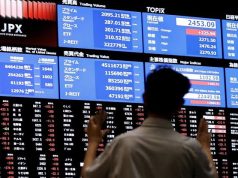
Asian stocks fell sharply on Wednesday, with markets in Japan and South Korea leading the decline.
The selloff came as higher oil prices pushed global bond yields upward and renewed concerns that central banks may need to keep interest rates elevated for longer.
Wall Street had also closed modestly lower overnight as rising government bond yields weighed on equities.
Futures linked to the S&P 500 and Nasdaq moved lower during Asian trading.
Nikkei and KOSPI Lead Regional Losses
Japan’s Nikkei 225 dropped around 3%, while the broader TOPIX index fell roughly 2.5%.
Technology shares were among the biggest losers as higher bond yields placed additional pressure on growth-sensitive stocks.
Japanese markets were also affected by expectations that the Bank of Japan could raise interest rates later this month.
BOJ Governor Kazuo Ueda recently said policymakers would continue evaluating whether further rate increases were appropriate based on inflation and economic conditions.
The comments followed a meeting between Ueda and U.S. Treasury Secretary Scott Bessent, who called for stronger monetary action to address weakness in the Japanese yen.
South Korean Stocks Fall Sharply
South Korea’s KOSPI dropped around 4%, making it one of the weakest performers in the region.
Major technology companies also came under pressure.
Samsung Electronics and SK Hynix both fell more than 4%, reflecting broader weakness across semiconductor and technology shares.
Oil Prices Fuel Inflation Concerns
Brent crude climbed toward $96 per barrel on Wednesday, extending its recent rally after previously reaching a five-week high.
Higher oil prices have increased concerns that inflation could remain elevated if energy supply disruptions continue.
That could complicate monetary policy decisions for central banks and reduce the likelihood of lower interest rates.
Higher energy prices also tend to increase costs for businesses and consumers, adding further pressure to the global economic outlook.
Bond Yields Rise Across Major Markets
The U.S. 10-year Treasury yield climbed to around 4.80%, reaching its highest level since January 2025.
Japan’s 10-year government bond yield also touched 3%.
The sharp rise in yields has been particularly challenging for technology and growth stocks, which are often more sensitive to changes in borrowing costs.
Investors are also pricing in a higher probability that the Federal Reserve could raise interest rates this month.
Expectations for tighter U.S. monetary policy have also provided support for the dollar.
Chinese and Hong Kong Stocks Decline
Chinese equities also moved lower.
The Shanghai Composite and the Shanghai Shenzhen CSI 300 both fell around 1%.
Hong Kong’s Hang Seng Index slipped approximately 0.5%.
The losses reflected broader concerns about global interest rates, inflation and slowing risk appetite.
Australia GDP Beats Expectations
Investors also reacted to fresh economic data from Australia.
The Australian economy expanded 0.4% in the second quarter compared with the previous three months.
Annual GDP growth came in at 2.1%, according to the Australian Bureau of Statistics.
The figures showed that the economy continued to expand despite higher borrowing costs and concerns over weakening domestic demand.
Stronger GDP Raises RBA Rate Hike Expectations
Australia’s S&P/ASX 200 finished around 1% lower.
The stronger-than-expected GDP data increased expectations that the Reserve Bank of Australia could raise interest rates again this year.
Persistent economic growth gives policymakers more room to maintain a tighter stance if inflation remains elevated.
Reserve Bank of New Zealand Raises Rates
In New Zealand, the central bank raised its official cash rate by 25 basis points to 2.75%.
It marked the Reserve Bank of New Zealand’s second consecutive rate increase.
Policymakers are attempting to keep inflation under control as renewed energy-price pressures complicate the economic outlook.
New Zealand’s NZX 50 still closed around 1% higher.
Mixed Performance Across Other Asian Markets
Elsewhere in the region, India’s Nifty 50 fell approximately 0.9%.
Singapore’s Straits Times Index moved against the broader trend and gained around 0.2%.
Asian markets are likely to remain sensitive to oil prices, bond yields and expectations surrounding upcoming central bank decisions.
For investors, the key question is whether higher energy costs and persistent inflation will force policymakers to keep interest rates higher for longer.