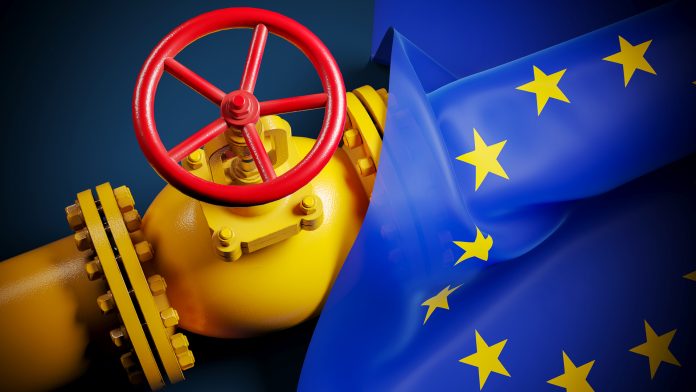
European wholesale natural gas prices climbed sharply on Monday, reaching their highest level in more than a month.
The increase followed renewed military tensions in the Middle East and reports that Iran had closed the Strait of Hormuz. The development raised serious concerns about global liquefied natural gas supplies.
Dutch and British Gas Prices Jump
The benchmark Dutch front-month gas contract rose by 4.1% to approximately €50.65 per megawatt-hour during afternoon trading.
British natural gas prices recorded an even larger increase. The equivalent contract gained nearly 5% to trade around 122 pence per therm.
Both markets moved higher as traders reacted defensively to the sudden deterioration in regional stability.
Strait of Hormuz Closure Triggers Supply Concerns
The immediate catalyst was Iran’s announcement that the Strait of Hormuz had been closed until further notice.
The declaration followed a fresh exchange of military strikes between Iranian and U.S. forces.
However, U.S. Central Command said the shipping route remained open to commercial vessels.
Despite that statement, the possibility of a prolonged blockade was enough to unsettle global energy markets.
Why the Strait of Hormuz Matters for Europe
The Strait of Hormuz is one of the world’s most important energy transportation routes.
Around one-fifth of global liquefied natural gas trade passes through the waterway. It also handles most of Qatar’s LNG exports.
Qatar is one of the largest LNG suppliers in the world. Therefore, any interruption to its exports could significantly affect European and Asian energy markets.
For Europe, the threat comes at a particularly sensitive time as countries continue rebuilding gas inventories ahead of the next winter heating season.
Recent Diplomatic Progress Begins to Fade
A temporary easing of Middle East tensions had previously reassured energy traders.
Many market participants believed that a broader regional conflict could be avoided. That optimism helped gas prices retreat from earlier spikes.
However, the latest military exchanges have weakened hopes of a diplomatic solution.
Analysts now expect European natural gas prices to remain highly volatile while uncertainty surrounding the Strait of Hormuz continues.
U.S. Natural Gas Producers Could Benefit
Bernstein continues to see potential gains for U.S. exploration and production companies with significant exposure to natural gas.
The investment bank maintained its Outperform ratings on several producers linked closely to Henry Hub prices.
Henry Hub is the main benchmark for U.S. natural gas. It is based on prices at a major pipeline junction in Louisiana.
Companies with strong Henry Hub exposure may benefit if global LNG disruptions increase demand for U.S. natural gas exports.
European Gas Storage Levels Remain Below Last Year
Europe is currently replenishing its gas storage facilities for the 2026–2027 winter season.
However, storage sites are only around 47% full. This compares with approximately 56% at the same point last year.
Lower inventory levels leave the region more exposed to unexpected supply disruptions.
Competition With Asian Buyers Could Intensify
A prolonged reduction in LNG exports from the Gulf could force European buyers to compete more aggressively with Asian importers.
This competition could push wholesale gas prices even higher.
Much will depend on whether commercial shipping continues through the Strait of Hormuz and whether the latest military escalation can be contained.
Until the situation becomes clearer, supply fears are likely to remain the main driver of European natural gas prices.