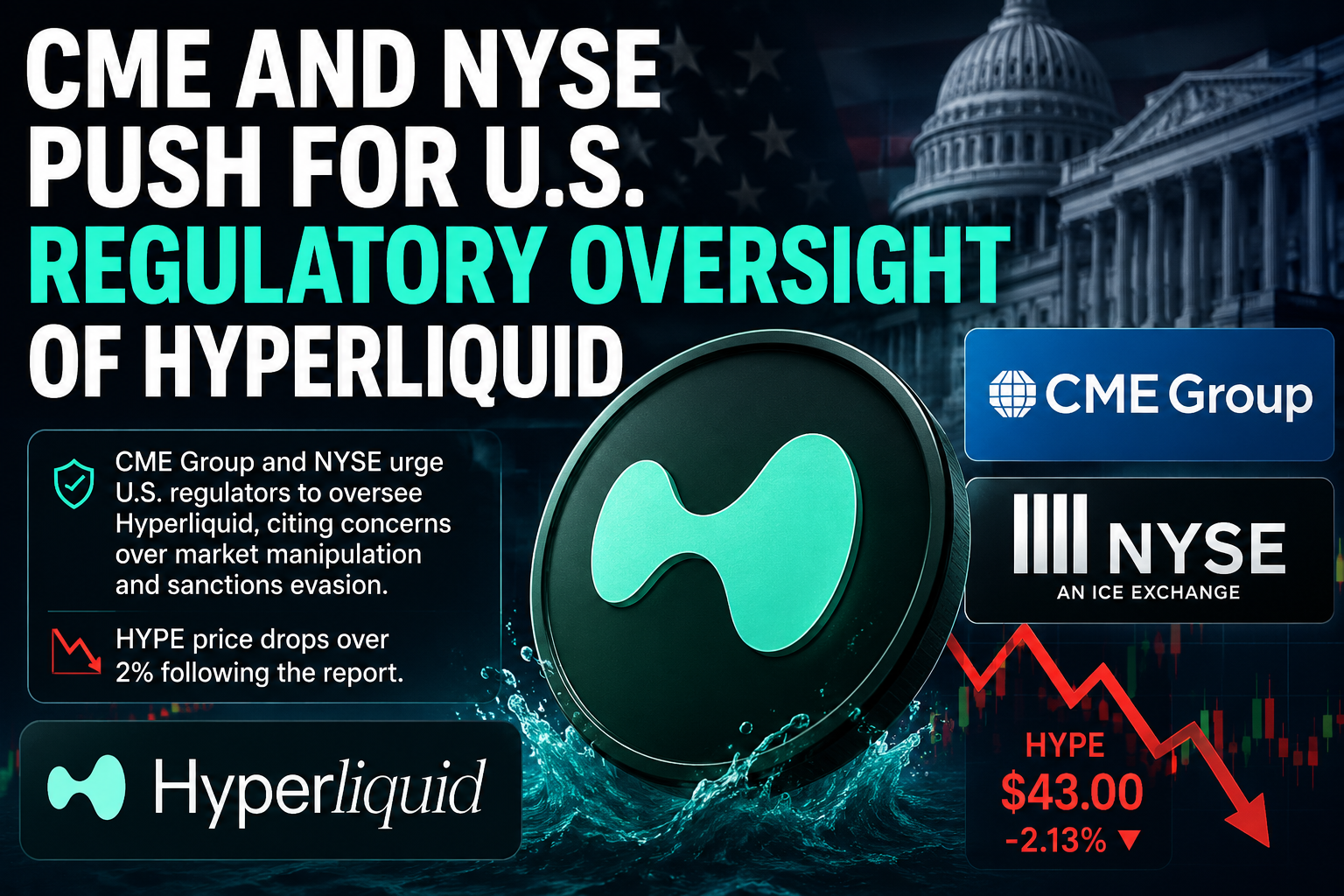
Traditional finance giants are increasing pressure on regulators to oversee Hyperliquid, one of the fastest-growing decentralized derivatives exchanges. The latest push from major U.S. institutions has sparked concerns within the crypto industry and contributed to renewed selling pressure on the HYPE token.
CME and NYSE Call for Regulation of Hyperliquid
According to reports, the parent company of the New York Stock Exchange (NYSE), Intercontinental Exchange (ICE), alongside CME Group, has urged U.S. authorities to introduce regulatory oversight for Hyperliquid. Their concerns reportedly focus on potential market manipulation risks, sanctions evasion, and the broader impact decentralized trading platforms could have on traditional financial markets.
The institutions allegedly warned officials from the Commodity Futures Trading Commission (CFTC) and lawmakers in Washington that Hyperliquid’s structure may create opportunities for insider trading activity or misuse by sanctioned entities.
One key concern raised involves the possibility that decentralized perpetual futures markets could eventually influence pricing mechanisms tied to commodities, including oil.
HYPE Token Falls Following Regulatory Concerns
The regulatory discussion triggered weakness in Hyperliquid’s native token, HYPE. After previously climbing near $45, the token dropped toward the $43 level, recording losses of more than 2% over the day.
The decline comes shortly after HYPE experienced strong upside momentum. The token had rallied roughly 20% after announcements surrounding a partnership involving Coinbase and Hyperliquid. Under the collaboration, Coinbase is expected to become the official USDC treasury deployer for the decentralized exchange ecosystem.
Hyperliquid’s Growth May Be Fueling Competition Concerns
Hyperliquid has continued expanding its presence in crypto derivatives trading through 24/7 perpetual markets. Its ecosystem upgrades, including HIP-3 and HIP-4, allow exposure to traditional assets such as stocks, commodities, and prediction-style outcome markets.
Because these offerings increasingly overlap with products available through established financial institutions, some crypto community members believe traditional exchanges may view Hyperliquid as emerging competition rather than solely a regulatory risk.
Blockchain investigator ZachXBT questioned why criticism appears focused on Hyperliquid while similar decentralized platforms receive less scrutiny. He also pointed toward connections between established institutions and other blockchain-based markets.
Bitwise Launches Hyperliquid ETF on NYSE
Despite regulatory pressure, institutional interest in Hyperliquid products continues to grow. Asset manager Bitwise officially launched its Hyperliquid ETF under the ticker BHYP on the NYSE.
The fund becomes the second spot Hyperliquid ETF available in the U.S., following a competing product introduced by 21Shares earlier in the week.
Bitwise stated that part of the ETF strategy may include staking exposure through its internal staking division. Meanwhile, investment giant Grayscale has also moved forward with filings tied to a potential Hyperliquid ETF product that could incorporate staking features.
21Shares Hyperliquid ETF Records Early Demand
Early trading activity for 21Shares’ Hyperliquid ETF appears encouraging. Market analysts noted healthy initial volumes, with the fund attracting over $1 million during its first days and building several million dollars in net assets shortly after launch.
The increasing launch of ETF products linked to Hyperliquid suggests institutional appetite remains strong, even as debates over regulation intensify.