Asian stocks traded mostly higher on Wednesday as softer oil prices and a modest pullback in global bond yields supported risk sentiment.
However, investors remained cautious ahead of key U.S. inflation data that could influence expectations for the Federal Reserve’s next policy moves.
U.S. stock futures also edged higher during Asian trading after Wall Street ended the previous session with limited movement amid elevated Treasury yields.
Japan Stocks Lead Regional Gains
Japanese equities were among the strongest performers in Asia.
The Nikkei 225 climbed 2.2%, while the broader TOPIX gained 1.9%.
Technology and semiconductor-related stocks helped drive the rally, while shares of SoftBank Group jumped around 7%.
Chinese markets also moved higher.
The CSI 300 and Shanghai Composite each gained around 0.5%, while Hong Kong’s Hang Seng Index rose 0.3% after reversing earlier losses.
South Korea Stocks Move Lower
South Korea moved against the broader regional trend.
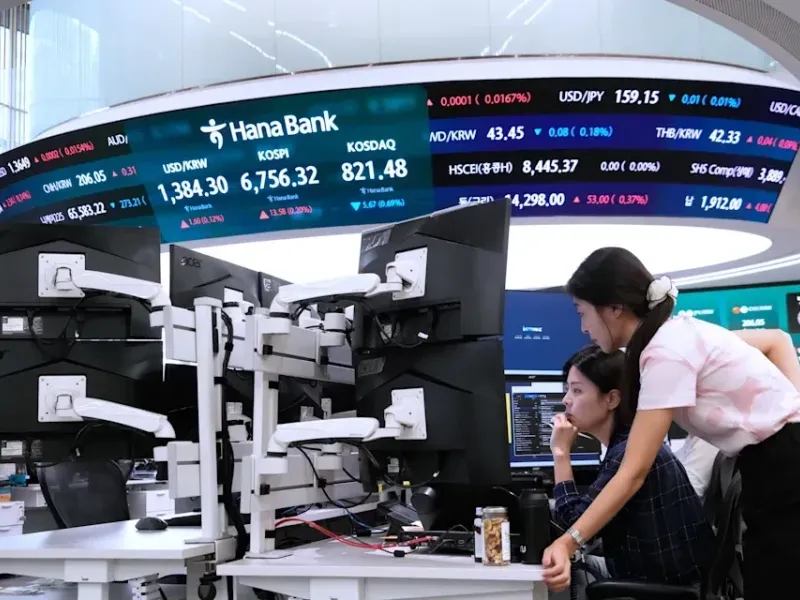
The KOSPI fell 0.4%, making it one of the weaker major Asian indexes during the session.
Singapore’s Straits Times Index and India’s Nifty 50 also slipped around 0.1% each.
Treasury Yields Ease From Recent Highs
Global bond markets offered some relief to equities.
The U.S. 30-year Treasury yield eased to around 5.55% during Asian trading.
It had reached 5.6206% on Tuesday, its highest level since 2002.
Lower bond yields generally support equity markets because they reduce pressure on stock valuations and borrowing costs.
Oil Prices Stabilize Near $103
Oil prices were broadly stable following a sharp decline in the previous session.
Brent crude traded around $103 per barrel as investors monitored developments in the Middle East and ongoing uncertainty surrounding the Strait of Hormuz.
Signs of recovering Saudi crude exports and greater use of alternative supply routes helped ease some concerns over energy supplies.
U.S. PCE Inflation Takes Center Stage
Investor attention is now turning to the U.S. Personal Consumption Expenditures price index for August.
The report is the Federal Reserve’s preferred inflation measure and could have a major impact on interest-rate expectations.
Markets expect inflation to remain above the Fed’s 2% annual target.
A stronger-than-expected reading could revive concerns over tighter monetary policy, while softer data may help extend the recent decline in Treasury yields.
Australia Inflation Rises to 4%
Australia’s S&P/ASX 200 gained around 1.1%.
Fresh data showed that Australian inflation accelerated to 4.0% in August, up from 3.5% in July.
However, the reading came in slightly below economists’ expectations.
Inflation remained well above the Reserve Bank of Australia’s 2%-3% target range.
The data arrived one day after the RBA raised its cash rate to 4.6%, the highest level in 15 years.
China PMI Signals Better Factory Activity
Economic data from China also attracted investor attention.
The official manufacturing PMI returned to expansion territory, while the non-manufacturing PMI also improved.
Meanwhile, the private RatingDog manufacturing PMI climbed to a five-month high.
The private survey pointed to stronger factory activity than the official data suggested.
Japan Industrial Production Disappoints
Japan’s latest industrial production figures showed continued weakness in manufacturing.
Factory output fell 1.7% in August from July, compared with expectations for an increase.
The decline marked a second consecutive monthly contraction.
Overall, Asian stock markets remained supported by lower bond yields and softer oil prices, but upcoming U.S. PCE inflation data could determine the next major move in global risk sentiment.