Asian stocks moved modestly higher on Thursday after the Federal Reserve delivered its first interest-rate increase since 2023.
Fed Chair Kevin Warsh’s focus on inflation also helped calm part of the recent selloff in global bond markets.
U.S. equity futures strengthened during Asian trading. Nasdaq 100 futures rose around 0.6%, while S&P 500 futures gained about 0.7% after Wall Street declined following the Fed decision.
Fed Raises Rates and Signals More Tightening
The Federal Reserve unanimously raised its benchmark interest rate by 25 basis points to 3.75%-4.00%.
The central bank’s latest projections also pointed to another possible increase before the end of the year.
Money markets now assign a meaningful chance to another rate hike in October, while expectations for a December increase have strengthened.
The move reinforced the Fed’s focus on persistent inflation despite pressure for lower borrowing costs.
Bond Market Pressures Ease
U.S. Treasury yields pulled back after recent sharp increases.
The two-year Treasury yield slipped by around one basis point to 4.72% after reaching its highest level since 2024 in the previous session.
Meanwhile, both the 10-year and 30-year Treasury yields fell by roughly two basis points.
The easing in bond yields provided some support for equity markets across Asia.
Asian Markets Trade Mostly Higher
The MSCI Asia Pacific Index gained around 0.4%.
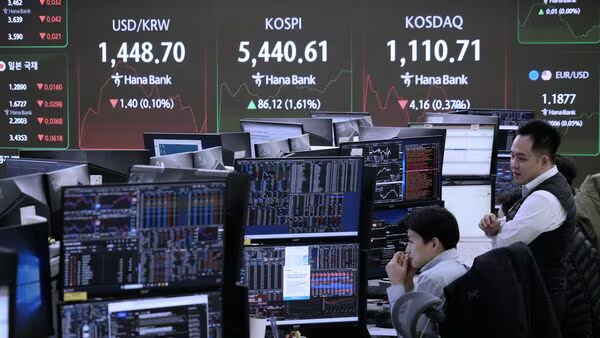
Japan’s Nikkei 225 advanced about 0.4%, while South Korea’s KOSPI also moved higher.
Japan’s broader TOPIX index rose approximately 0.7%.
Australia’s S&P/ASX 200 added about 0.3%, while New Zealand’s NZX 50 climbed close to 0.9%.
Singapore’s Straits Times Index also advanced modestly.
China Shares Underperform
Chinese equities lagged behind the broader regional market.
Hong Kong’s Hang Seng Index fell around 1.1%, while the CSI 300 slipped about 0.4%.
Weakness among major Chinese technology companies contributed to the decline.
Alibaba, Tencent and Meituan all moved lower during the session.
The weaker performance in China contrasted with modest gains across several other major Asian markets.
Semiconductor Stocks Trade Mixed
Asian semiconductor shares produced a mixed performance as investors weighed higher borrowing costs against continued optimism surrounding artificial intelligence.
South Korea’s SK Hynix declined, while Samsung Electronics traded close to unchanged.
In Japan, Kioxia and Murata Manufacturing also moved lower.
Chinese semiconductor companies showed mixed performance, with NAURA Technology gaining while SMIC and Cambrian Technologies declined.
AI Valuations Remain in Focus
Technology stocks remain sensitive to changes in interest-rate expectations.
Higher borrowing costs can place pressure on growth and technology valuations because future earnings become less valuable when discount rates rise.
At the same time, investors continue to monitor whether large technology companies will maintain aggressive spending on artificial intelligence infrastructure.
These competing factors contributed to uneven trading across Asian chip and technology stocks.
BOE and BOJ Decisions Come Into Focus
Attention is now shifting toward other major central banks.
The Bank of England is widely expected to keep interest rates unchanged.
However, investors will watch for signs that higher energy prices could encourage policymakers to consider another rate increase later in the year.
The Bank of Japan is also expected to raise interest rates and could signal that further tightening remains possible.
Oil Prices Ease as Supply Concerns Fade
Oil prices also moved lower as some concerns over Middle East supply disruptions eased.
Brent crude traded near $105.75 per barrel after falling sharply in the previous session.
Saudi Arabia is reportedly working to restore part of the capacity of its East-West pipeline after recent drone attacks disrupted operations.
Comments from U.S. President Donald Trump suggesting that the conflict with Iran could end soon also reduced some geopolitical risk premiums.
Broader Asian Markets Show Mixed Performance
Elsewhere in the region, Thailand’s SET Index moved higher, while the Philippines’ PSEi also posted gains.
Malaysia’s KLCI slipped slightly, while Indonesia’s Jakarta Composite was broadly unchanged.
Indian equity futures also traded close to flat.
The mixed performance highlights how investors are balancing tighter monetary policy, inflation concerns and regional growth expectations.
Investors Watch the Next Central Bank Moves
The focus now turns to upcoming policy decisions from the Bank of England and Bank of Japan.
Markets are assessing whether the Federal Reserve can bring inflation under control without causing a significant slowdown in economic growth.
For Asian stocks, future moves in bond yields, interest rates and technology valuations are likely to remain key drivers in the near term.