Alan Greenspan, Former Federal Reserve Chairman, Dies at 100
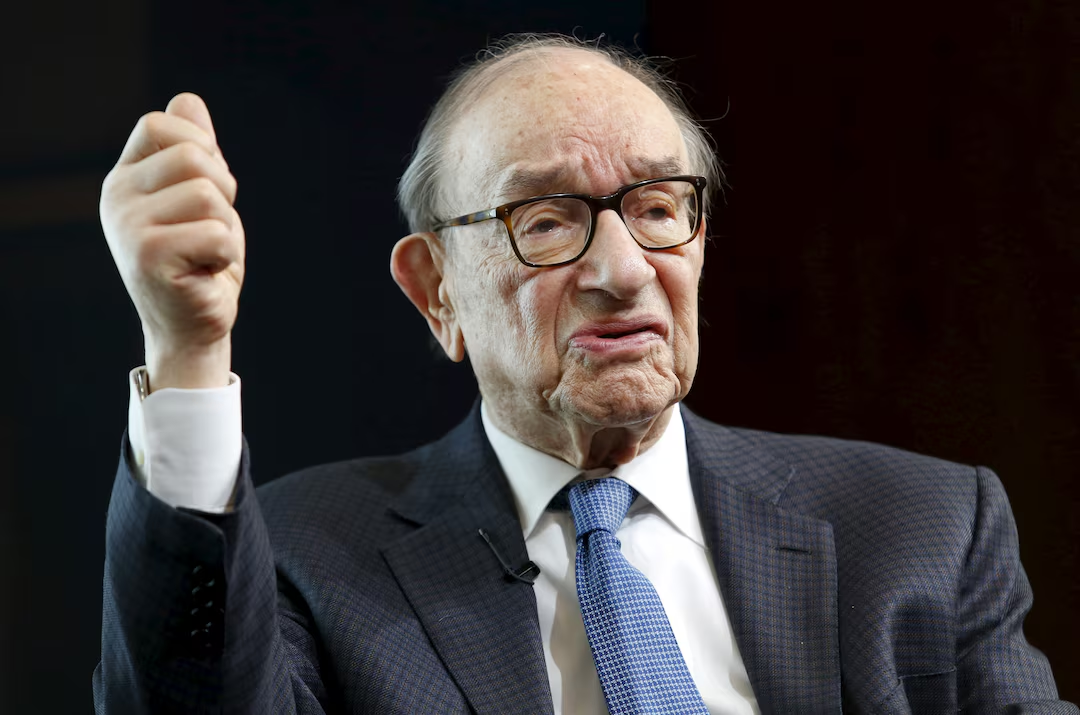
Alan Greenspan, the influential economist who led the Federal Reserve under four U.S. presidents, died on June 22, 2026. He was 100 years old.
Greenspan died at his home following complications related to Parkinson’s disease, according to his wife, NBC News journalist Andrea Mitchell.
Andrea Mitchell Confirms Alan Greenspan’s Death
In a statement announcing his death, Mitchell described Greenspan as an influential figure who helped shape the U.S. economy for decades.
She also praised his willingness to acknowledge mistakes, despite the enormous influence he held over American monetary policy and global financial markets.
Mitchell remembered him personally as a kind and brilliant husband. The couple’s relationship began with their first date in 1984.
Outside economics, Greenspan had a strong interest in baseball, tennis, golf, music and the Washington Commanders. Jazz was reportedly one of his greatest passions.
Greenspan’s Historic Federal Reserve Tenure
President Ronald Reagan appointed Greenspan as chairman of the Federal Reserve in 1987.
He remained in the position for approximately 18 and a half years, giving him the second-longest tenure of any Federal Reserve chairman in U.S. history.
His leadership spanned four presidential administrations and several major economic cycles. During that period, Greenspan became one of the most powerful and closely followed financial officials in the world.
Washington and Wall Street often referred to him as “the Maestro” because of his influence over interest rates, economic growth and financial markets.
Responding to the 1987 Black Monday Crash
Greenspan faced his first major crisis only two months after taking office.
On October 19, 1987, the Dow Jones Industrial Average fell approximately 22% in a single trading session. The event became known as Black Monday.
Greenspan responded by assuring financial institutions that the Federal Reserve would provide enough liquidity to support the economic and banking system.
His rapid intervention helped contain the crisis and contributed to the later development of the so-called “Fed put.” This term describes the market’s belief that the Federal Reserve may intervene when a severe decline threatens financial stability.
Economic Growth During the Great Moderation
Much of Greenspan’s tenure coincided with a period known as the Great Moderation.
During this era, the United States experienced relatively low inflation, sustained economic expansion and strong stock market performance. The technology boom of the 1990s also helped drive investment and productivity growth.
Supporters credited Greenspan’s monetary policies with creating a stable environment for businesses and financial markets.
However, critics later questioned whether that stability encouraged excessive risk-taking and the formation of speculative bubbles.
The Warning About “Irrational Exuberance”
In 1996, Greenspan introduced one of the most famous phrases in modern financial history: “irrational exuberance.”
He used the expression while questioning whether excessive investor optimism had pushed asset prices beyond reasonable valuations.
The warning came as technology shares continued rising during the dot-com boom. Although the market climbed for several more years, the technology bubble eventually collapsed in the early 2000s.
The phrase remains widely used to describe speculative market behavior and unsustainable investor enthusiasm.
How Greenspan Changed Federal Reserve Communication
Greenspan also transformed how the Federal Reserve communicated with investors and the public.
Before his leadership, the central bank operated with significantly less transparency. Greenspan gradually moved the institution toward more frequent public communication.
However, his statements were often deliberately complex and difficult to interpret. This communication style became known as “Fed speak.”
Investors, economists and financial journalists carefully studied his speeches and congressional testimony for clues about future interest-rate decisions.
This practice helped create the modern culture of closely monitoring every statement made by central bank officials.
His Support for Deregulated Financial Markets
As a young economist, Greenspan was influenced by libertarian philosopher and writer Ayn Rand.
He strongly believed that efficient markets could often regulate themselves without extensive government intervention. Under his leadership, the Federal Reserve generally supported financial deregulation.
This environment contributed to the rapid expansion of derivatives, credit default swaps and other complex financial products.
Greenspan believed these instruments could distribute financial risk across a broader range of institutions. However, the global financial crisis later exposed serious weaknesses in that assumption.
The Subprime Mortgage Controversy
Greenspan left the Federal Reserve in early 2006, when his reputation remained extremely strong.
However, his legacy became increasingly controversial after the global financial crisis began unfolding in 2007 and 2008.
Critics argued that the Federal Reserve kept interest rates too low for too long following the dot-com crash. Cheap credit encouraged borrowing and contributed to rapidly rising housing prices.
These conditions helped fuel the subprime mortgage boom, which eventually collapsed and placed major financial institutions under severe pressure.
Greenspan Admitted a Flaw in His Economic Ideology
During congressional testimony in 2008, Greenspan acknowledged that the financial crisis had revealed a flaw in his free-market beliefs.
He admitted that he had placed too much confidence in the ability of banks and lending institutions to regulate themselves and protect their shareholders.
The admission became one of the most significant moments of his later career. It also reshaped public debate surrounding deregulation, central banking and financial supervision.
Alan Greenspan’s Lasting Economic Legacy
Despite the criticism surrounding his policies, Greenspan remains one of the most influential central bankers in modern history.
His decisions shaped how policymakers respond to market crashes, inflation, economic slowdowns and banking crises.
He also helped establish the Federal Reserve as a proactive institution capable of influencing not only the U.S. economy but also global financial markets.
Alan Greenspan’s death marks the end of a major era in American economic history. His policies, successes and mistakes continue to influence how central banks manage interest rates, financial stability and market intervention.