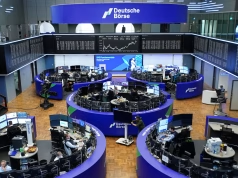
Asian stocks declined across several major markets on Tuesday, November 3, 2026, as investors reacted to Apple’s disappointing earnings outlook, weakness in technology shares, and uncertainty surrounding the US midterm elections.
South Korea’s stock market recorded some of the region’s steepest losses, while Chinese equities also came under pressure. Meanwhile, Australia’s central bank raised interest rates to their highest level in 18 years as it continued battling persistent inflation.
Despite the broader weakness, Australian, Hong Kong, and Indian stocks managed to advance, highlighting mixed investor sentiment across Asia.
Asian Stocks Fall Following Wall Street Technology Selloff
Asian stock markets faced renewed selling pressure after major US indexes closed lower on Monday.
The S&P 500 declined approximately 0.5%, while the technology-heavy Nasdaq Composite lost 1.1%.
Weakness in major technology companies weighed on market sentiment as investors reassessed elevated valuations and the financial risks associated with artificial intelligence investment.
US stock futures also edged lower during Tuesday’s Asian session, reflecting continued caution ahead of the US midterm elections.
The political outcome could reshape the balance of power in Congress and influence President Donald Trump’s economic and regulatory agenda.
Investors remain particularly focused on potential changes to government spending, trade policy, and regulations affecting major industries.
Apple Earnings Outlook Weighs on Asian Technology Stocks
Apple (NASDAQ: AAPL) added to negative technology-sector sentiment after issuing a weaker-than-expected profitability outlook for the holiday quarter.
Although the iPhone maker reported stronger-than-anticipated quarterly earnings, management warned that rising memory-chip costs could pressure future profit margins.
Apple expects its gross margin to range between 45% and 46% during the December quarter, below analysts’ expectations of approximately 46.9%.
The company also projected Services revenue growth of 8% to 9%, falling short of Wall Street forecasts.
These developments raised concerns about profitability across the technology sector, particularly as companies face rising component costs and increased spending on artificial intelligence infrastructure.
Investors are questioning whether substantial AI investments will generate sufficient returns to justify current spending levels.
The uncertainty contributed to broader weakness among Asian semiconductor manufacturers and other technology-related companies.
South Korea’s KOSPI Drops Nearly 4% as Chinese Stocks Retreat
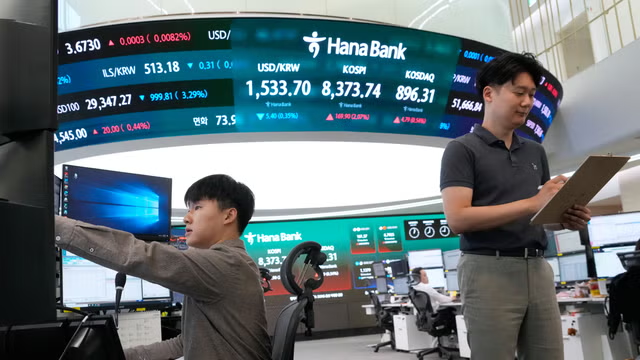
South Korea’s KOSPI index led regional losses, falling nearly 4% during Tuesday’s session.
The decline reflected significant selling pressure across technology and semiconductor stocks, which represent an important portion of the South Korean equity market.
Chinese equities also weakened as investors assessed global market conditions and domestic monetary policy developments.
The Shanghai Composite Index declined approximately 1.2%, while the blue-chip CSI 300 fell 0.7%.
Singapore’s Straits Times Index also retreated, losing around 0.7%.
However, several regional markets avoided the broader selloff.
Hong Kong’s Hang Seng Index advanced approximately 0.2%, while India’s Nifty 50 gained 1.1%.
Japanese financial markets remained closed for a public holiday, limiting trading activity across the region.
The contrasting performances demonstrated how local economic developments and sector exposure influenced market reactions.
Australian Stocks Rise as RBA Raises Interest Rates to 4.85%
Australia’s S&P/ASX 200 gained approximately 0.3% despite another interest rate increase by the Reserve Bank of Australia (RBA).
The central bank raised its benchmark cash rate by 25 basis points to 4.85%, marking its fifth rate hike of 2026.
The decision pushed Australian interest rates to their highest level since 2008.
Policymakers cited persistent inflationary pressures, elevated energy costs, and strong domestic demand as reasons for maintaining a restrictive monetary policy.
However, the decision was not unanimous.
Six members of the nine-person Monetary Policy Board supported the increase, while three preferred to leave interest rates unchanged at 4.60%.
The divided vote attracted investor attention because it suggested that policymakers remain uncertain about the need for additional tightening.
Despite the higher borrowing costs, Australian stocks recorded modest gains as investors assessed the possibility that the central bank could be approaching the end of its tightening cycle.
China’s Central Bank Announces New Foreign Exchange Measures
In China, the People’s Bank of China (PBOC) announced adjustments to its foreign exchange reserve requirements.
The central bank plans to increase the foreign exchange deposit reserve requirement ratio from 4% to 6%, effective November 15.
The two-percentage-point increase will require financial institutions to hold a larger portion of their foreign currency deposits in reserve.
The measure is designed to strengthen foreign exchange liquidity management while helping moderate the Chinese yuan’s recent appreciation.
The yuan has strengthened significantly against the US dollar during 2026, supported by strong exports and substantial trade surpluses.
By absorbing foreign currency liquidity, the PBOC aims to reduce excessive one-directional currency movements and maintain greater stability in financial markets.
Investors will continue monitoring the policy’s impact on the yuan, Chinese equities, and broader regional currency markets.
Middle East Tensions Add to Asian Market Uncertainty
Geopolitical developments in the Middle East also remained a key consideration for investors.
Oil prices plunged more than 7% on Monday after renewed hopes for diplomatic progress between the United States and Iran reduced concerns about prolonged supply disruptions.
However, uncertainty returned following reports of another US military operation against Iranian targets.
According to a Wall Street Journal report citing American officials, the United States carried out a strike on Iran’s Qeshm Island on Monday.
The island is strategically located near the Strait of Hormuz, an important shipping route for global oil supplies.
The reported operation renewed concerns about potential disruptions to energy transportation through the Persian Gulf.
Although diplomatic discussions remain ongoing, the possibility of further military escalation continues to influence global energy prices.
Higher oil prices could also create additional inflationary pressures, complicating monetary policy decisions across Asian economies.
Asian Stock Market Outlook: US Elections and Inflation in Focus
Asian stock markets face several potential catalysts as investors assess corporate earnings, central bank decisions, and geopolitical developments.
The US midterm elections could influence global risk sentiment, particularly if the results significantly alter expectations for fiscal policy and financial regulation.
Meanwhile, Apple’s cautious profitability outlook has increased scrutiny of technology-sector valuations and the sustainability of artificial intelligence investment.
In Australia, investors will monitor upcoming inflation and employment data for clues about the RBA’s next interest rate decision.
China’s foreign exchange policy changes could also affect regional currencies and capital flows.
At the same time, developments in the Middle East remain an important risk factor for energy markets and inflation expectations.
For now, the decline in several major Asian stock indexes highlights the challenges facing investors as technology-sector uncertainty, political developments, and monetary policy pressures converge.