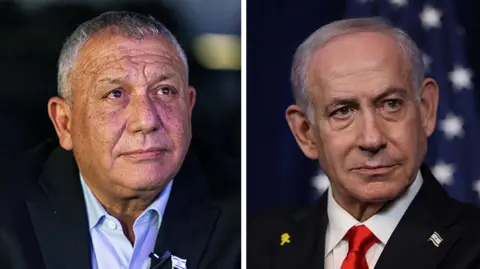
Israel election exit polls revealed a closely contested race between Prime Minister Benjamin Netanyahu and opposition leader Gadi Eisenkot, with neither political bloc securing a clear parliamentary majority.
The initial projections raised concerns about a potential political deadlock, leaving both sides facing difficult negotiations to form Israel’s next government.
Israel Election Exit Polls Show No Clear Majority
Exit polls conducted by major Israeli broadcasters, including N12, Channel 13, and Kan 11, initially suggested that Netanyahu’s governing coalition and Eisenkot’s opposition alliance were nearly tied.
Revised projections from two broadcasters placed both blocs at 51 seats each. However, neither reached the 61 seats required to control the 120-member Knesset.
As vote counting progressed, updated projections gave Netanyahu’s bloc a modest advantage. Nevertheless, the prospect of a parliamentary majority remained uncertain.
Arab Parties Could Play a Decisive Role
Arab-led political parties were initially projected to secure between 17 and 19 parliamentary seats, potentially giving them significant influence over coalition negotiations.
However, both Netanyahu’s alliance and most opposition parties have expressed reluctance to form a government with Arab political groups. This position could make the formation of a stable coalition increasingly difficult.
Voter Turnout Reaches Historic Levels
The election attracted exceptionally high participation, with voter turnout reaching approximately 77.7%, its highest level since 1999.
Meanwhile, election officials continued counting ballots following Tuesday’s vote. Final official results are expected on November 4, although preliminary figures could provide a clearer picture earlier.
Iran, Gaza and National Security Dominate the Campaign
National security concerns shaped the election campaign, particularly Israel’s confrontation with Iran and the continuing conflict involving Hamas in Gaza.
Netanyahu emphasized his leadership during wartime and highlighted his close relationship with U.S. President Donald Trump.
In contrast, Eisenkot, a former chief of staff of the Israel Defense Forces, criticized Netanyahu’s handling of national security. He specifically questioned the government’s responsibility for the security failures surrounding Hamas’s deadly October 7, 2023, attacks.
Trump publicly supported Netanyahu ahead of the election. He also called for the dismissal of the corruption proceedings against the Israeli prime minister.
Despite their political rivalry, both Netanyahu and Eisenkot have advocated eliminating Hamas’s control over Gaza. Eisenkot has pledged to end the group’s rule in the territory within 18 months if he becomes prime minister.
With neither bloc holding a clear majority, Israel could face prolonged coalition negotiations and continued political uncertainty.