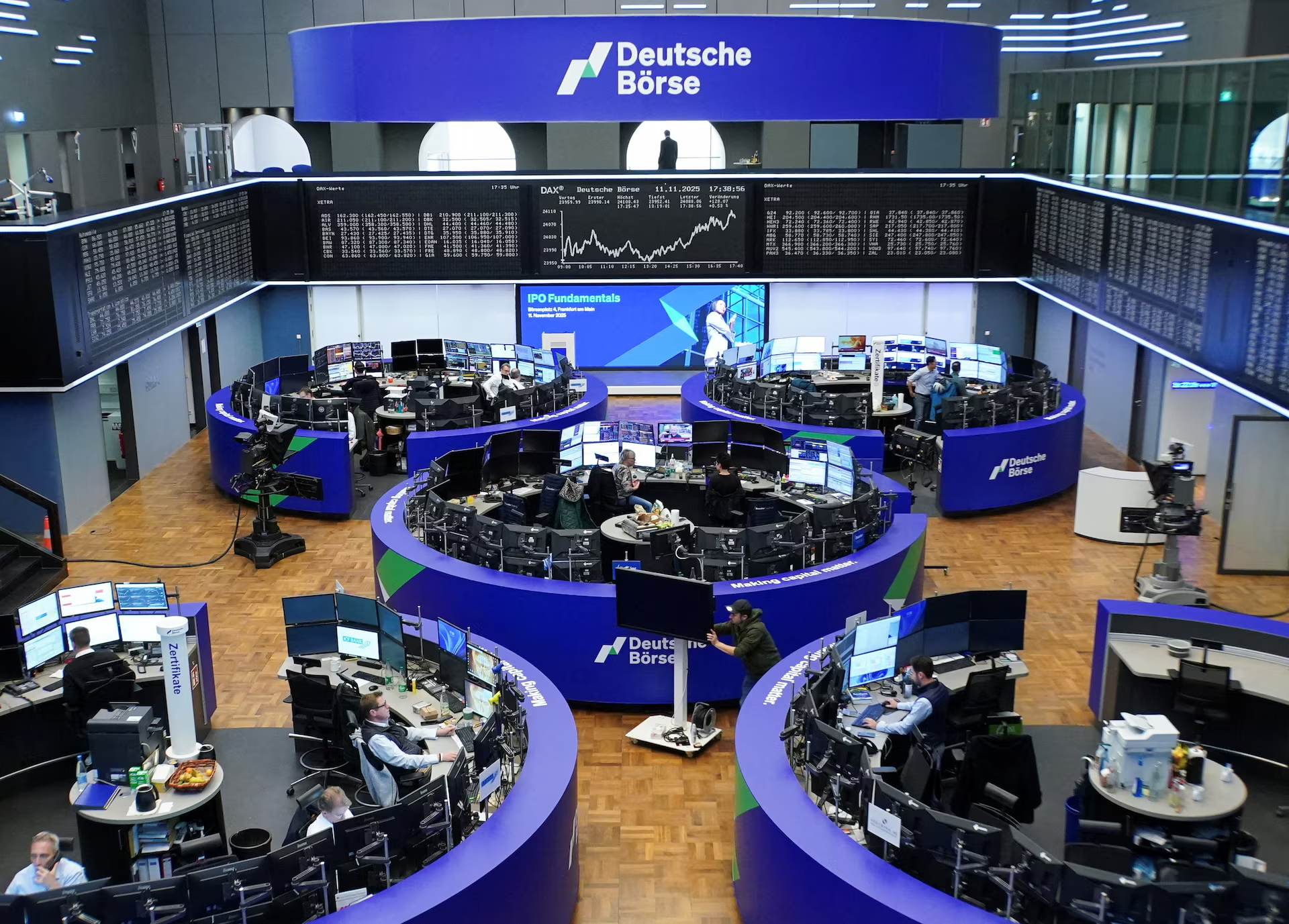
European stocks opened the week lower on Monday as escalating civil unrest in France weighed on investor confidence. Meanwhile, market participants remained cautious ahead of a busy week of corporate earnings reports from major European and US companies.
The pan-European STOXX Europe 600 Index declined 0.33%, reflecting growing concerns about political instability and sovereign debt risks in France, the eurozone’s second-largest economy.
France’s CAC 40 Index fell nearly 1%, underperforming other major European benchmarks following widespread protests and violence over the weekend.
Germany’s DAX slipped 0.4%, while London’s FTSE 100 remained largely unchanged.
European Stocks Fall as French Civil Unrest Intensifies
Political and social tensions in France emerged as a major concern for European financial markets after the country experienced some of its most severe civil disturbances in recent years.
Thousands of demonstrators gathered across major French cities over the weekend to protest rising living costs, persistent inflation and deteriorating public services.
The demonstrations escalated into violent clashes, resulting in numerous arrests, widespread property damage and the looting of retail establishments.
The unrest highlighted growing public dissatisfaction with President Emmanuel Macron’s administration as his final presidential term approaches its conclusion in 2027.
France continues to face significant economic and political challenges, including sluggish growth, rising government debt and mounting pressure on public finances.
Consequently, investors have become increasingly concerned about the country’s fiscal stability and the potential implications for European financial markets.
France’s Political Uncertainty Raises Sovereign Debt Concerns
The latest wave of protests has added to existing worries about France’s economic outlook and public debt burden.
Investors are closely monitoring the potential consequences of prolonged political instability for government finances, fiscal reforms and economic activity.
Continued unrest could complicate efforts to address France’s budgetary challenges while putting additional pressure on domestic equities.
Moreover, uncertainty surrounding the government’s ability to implement economic measures may influence sentiment toward French government bonds and other financial assets.
For now, the CAC 40’s underperformance highlights the market’s sensitivity to developments in France.
European Corporate Earnings Take Center Stage
Beyond political developments, European investors are preparing for a particularly important week of third-quarter corporate earnings.
The reporting season has already encountered difficulties following disappointing revenue figures from French luxury goods giant LVMH.
The company’s weaker-than-expected sales, partly linked to subdued demand in China, have raised concerns about the outlook for Europe’s luxury sector.
Investors will now turn their attention to upcoming financial results from other major French companies, including EssilorLuxottica and Kering.
Their earnings reports could provide additional insight into consumer spending trends and the resilience of demand for premium products.
Stronger results could help restore confidence in European luxury stocks. However, further evidence of weak consumer spending could intensify pressure on the sector.
SAP and BE Semiconductor Earnings Put European Tech Stocks in Focus
The European technology sector is also attracting attention following the previous week’s sharp selloff in global technology shares.
Investors will closely examine earnings reports from German enterprise software company SAP and Dutch semiconductor equipment manufacturer BE Semiconductor Industries.
Both companies recorded gains ahead of their announcements, with SAP advancing 0.8% and BE Semiconductor rising 1.3%.
Their financial results could offer important clues about business technology spending, semiconductor demand and investment in artificial intelligence infrastructure.
Meanwhile, concerns about elevated AI valuations and the substantial costs of developing advanced computing systems continue to influence global technology stocks.
Meta Earnings Could Influence Global AI Market Sentiment
Outside Europe, attention will also focus on Meta Platforms, which is scheduled to release its third-quarter financial results on Wednesday.
As one of the world’s largest investors in artificial intelligence infrastructure, Meta is expected to provide important updates on its capital expenditure plans.
Investors will closely monitor management’s comments on AI spending, infrastructure expansion and potential returns on investment.
The company’s outlook could influence sentiment across the global artificial intelligence sector, particularly following recent weakness in AI-linked equities.
Any indication of slowing investment or increasing financial pressure could affect technology shares in both Europe and the United States.
Oil Prices Decline as Trump Eases Russia Energy Sanctions
Meanwhile, falling crude oil prices provided some relief to European financial markets by easing concerns about energy-related inflation.
Oil prices declined after US President Donald Trump issued an executive order waiving certain sanctions and tariffs affecting Russian energy transactions.
The administration presented the measure as being in the national interest, with elevated domestic fuel costs remaining a major concern.
The decision could allow additional Russian petroleum products to reach international markets, potentially improving global energy supplies.
Lower oil prices may help reduce inflationary pressures and ease operating costs for energy-intensive European businesses.
However, the broader impact will depend on the availability of Russian exports and developments in international energy markets.
European Stock Market Outlook: French Unrest and Earnings Remain Key Risks
Looking ahead, European stocks are likely to remain sensitive to political developments in France, corporate earnings and shifts in global technology market sentiment.
The ongoing French protests have increased uncertainty surrounding the country’s economic and fiscal outlook, placing additional pressure on domestic equities.
At the same time, upcoming earnings from luxury goods companies, semiconductor manufacturers and major US technology firms could determine whether investor confidence improves.
Declining oil prices may provide some support by reducing inflation concerns, although geopolitical developments remain an important source of uncertainty.
Overall, European equity markets face a challenging combination of political instability, corporate earnings uncertainty and global economic risks as investors assess the potential for a more sustained recovery.