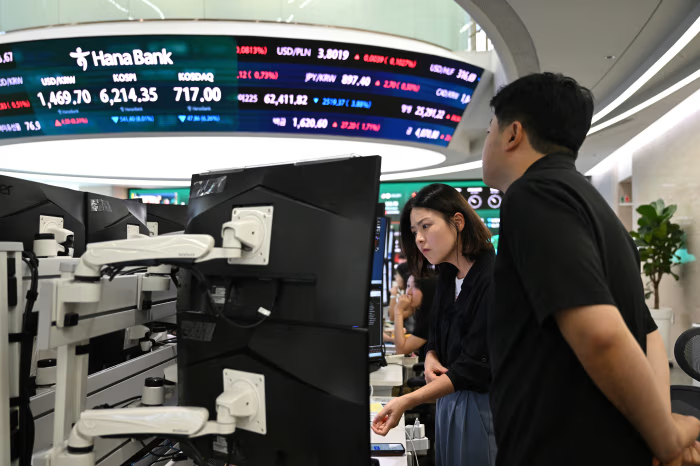
Asian stocks traded mostly lower on Monday as concerns surrounding artificial intelligence investments and technology sector valuations continued to weigh on investor sentiment. However, stronger-than-expected economic data from China helped mainland equities recover from earlier losses.
China’s economy expanded 4.5% year-on-year during the third quarter, exceeding market forecasts and strengthening expectations that Beijing could achieve its annual economic growth target.
Meanwhile, retail sales increased 1.1% in September, surpassing expectations, while industrial production rose 5.5%.
Despite the encouraging figures, broader Asian equity markets remained under pressure as investors assessed the profitability and financing requirements of the global artificial intelligence industry.
Asian Stocks Struggle Despite Stronger China GDP Growth
Mainland Chinese stock markets recovered from earlier declines following the release of positive economic indicators.
The Shanghai Composite Index gained 0.2%, while the benchmark CSI 300 advanced 0.1%.
However, the broader MSCI Asia-Pacific Index declined approximately 0.3%, although it recovered from steeper losses earlier in the session.
Hong Kong’s financial markets remained closed for a public holiday.
Meanwhile, US stock futures moved higher, providing some relief following the previous week’s sharp Wall Street selloff.
Nasdaq 100 futures climbed 1.3%, while S&P 500 futures advanced 0.8%, suggesting a modest recovery in investor appetite for technology stocks.
Nevertheless, uncertainty surrounding artificial intelligence spending continued to dominate market sentiment across Asia.
Semiconductor Stocks Remain Under Pressure as AI Concerns Persist
Asian semiconductor stocks delivered mixed performances as investors continued questioning the sustainability of massive investments in artificial intelligence infrastructure.
Japan’s Nikkei 225 declined 0.8%, while South Korea’s KOSPI gained 0.6%.
Technology shares across the region showed significant differences in performance.
Samsung Electronics advanced 0.8%, while fellow South Korean memory chip manufacturer SK Hynix slipped 0.7%.
In Japan, Kioxia shares gained 1.3%. However, electronic component manufacturers TDK and Murata Manufacturing declined 1.3% and 2.4%, respectively.
Taiwan Semiconductor Manufacturing Company (TSMC) also faced selling pressure, with its shares falling 0.6%.
Meanwhile, Chinese memory chip producer ChangXin Memory Technologies (CXMT) dropped 7.6%, reversing recent gains.
The decline came amid investor concerns about growing competition in the global memory chip industry as Chinese manufacturers advance their next-generation DRAM technologies.
The weakness followed a particularly difficult week for semiconductor companies worldwide.
The Philadelphia Semiconductor Index plunged 11.4% during the previous week, extending its longest losing streak since the 2008 global financial crisis.
CoreWeave Debt Concerns Weigh on Artificial Intelligence Stocks
Growing concerns about the financial sustainability of AI infrastructure investments have emerged as a major source of market volatility.
Investors have focused particularly on CoreWeave, whose substantial debt burden has raised questions about the ability of AI infrastructure providers to finance continued expansion.
Concerns surrounding the company’s borrowing requirements have contributed to broader selling pressure across artificial intelligence-related equities.
The market downturn has continued despite strong financial results and encouraging forecasts from several major semiconductor suppliers.
This divergence suggests that investors are increasingly distinguishing between robust demand for AI technologies and the financial risks associated with funding their development.
Memory Chip Demand Remains Strong Despite Market Selloff
Anna Wu, investment strategist and founder of Floodline Research, highlighted the contrast between strong memory chip demand and weakening technology stock prices.
According to Wu, investors remain concerned about increasing competition from Chinese semiconductor companies and the broader global technology selloff.
However, underlying demand for memory products continues to demonstrate resilience.
DDR5 memory prices have increased 79% this year, including a further 4.5% rise during the current month.
Furthermore, memory chip manufacturers have not reported a meaningful deterioration in demand despite the recent market turbulence.
Wu suggested that sustained strength in industry fundamentals could eventually attract investors back to semiconductor stocks.
Nevertheless, she cautioned that a more durable recovery would likely require market anxiety to subside.
Easing inflation pressures, or at least a stabilization in inflation expectations, could help restore confidence in technology sector valuations.
Indonesia Stocks Plunge as MSCI Downgrade Fears Intensify
Elsewhere in Asia, Indonesian equities extended their recent selloff amid concerns about the country’s international market classification.
The Jakarta Composite Index fell more than 5%, following a historic decline during the previous week.
The weakness came after global index provider MSCI warned that Indonesia could lose its emerging-market classification.
Such a development could have substantial consequences for foreign investment flows and the country’s attractiveness to international equity investors.
Meanwhile, other regional stock markets delivered mixed results.
Australia’s S&P/ASX 200 gained 0.3%, while New Zealand’s NZX 50 declined 0.7%.
Singapore’s Straits Times Index advanced 0.4%, whereas India’s Nifty 50 fell 0.4%.
The contrasting performances reflected uneven investor sentiment across Asian financial markets.
Major US Technology Earnings Could Determine Market Direction
Investors are turning their attention toward a busy corporate earnings calendar that could provide fresh insight into the strength of the artificial intelligence investment cycle.
Several major US technology companies are scheduled to report quarterly results, potentially influencing sentiment across global equity markets.
Netflix is expected to release its earnings on Tuesday, followed by Tesla, Meta Platforms and IBM on Wednesday.
Other prominent companies scheduled to report include Lam Research, Texas Instruments, Procter & Gamble, General Motors and GE Aerospace.
Technology investors will closely examine corporate earnings, forward guidance and capital expenditure plans for indications of whether artificial intelligence investments are delivering sustainable financial returns.
Stronger-than-expected results could help stabilize technology shares following the recent selloff.
Conversely, disappointing earnings or concerns about elevated spending could increase pressure on already vulnerable AI-related stocks.
Inflation and Oil Market Risks Add to Investor Uncertainty
Beyond corporate earnings, investors remain concerned about the potential consequences of persistent US inflation and increasing financial market volatility.
Elevated fuel and food prices have complicated the outlook for central bank monetary policy, raising uncertainty about future interest rate decisions.
Meanwhile, bond market volatility has remained relatively high, reflecting investor concerns about inflation and broader economic conditions.
Energy markets have also attracted attention as traders assess developments in the Middle East and potential changes to Russian oil sanctions.
Crude oil prices declined as investors weighed renewed regional hostilities against indications that some Middle Eastern supplies were recovering toward pre-war levels.
The decline followed comments from US President Donald Trump suggesting that certain restrictions on Russian oil shipments could be waived.
However, subsequent remarks indicated that a final decision had not yet been confirmed.
Asian Stock Market Outlook: AI Earnings and Inflation in Focus
The near-term direction of Asian stocks will likely depend on developments in global technology markets, upcoming US corporate earnings and inflation expectations.
Although stronger Chinese economic growth has provided some support for mainland equities, persistent concerns about AI financing and elevated semiconductor valuations continue to limit broader market confidence.
Investors will also monitor competition within the global memory chip industry, particularly as Chinese manufacturers expand their technological capabilities.
Meanwhile, developments in oil markets and geopolitical tensions could influence inflation expectations and international capital flows.
For now, Asian equity markets remain vulnerable to shifts in investor sentiment, with technology sector earnings and macroeconomic developments likely to determine whether a more sustained recovery can emerge.