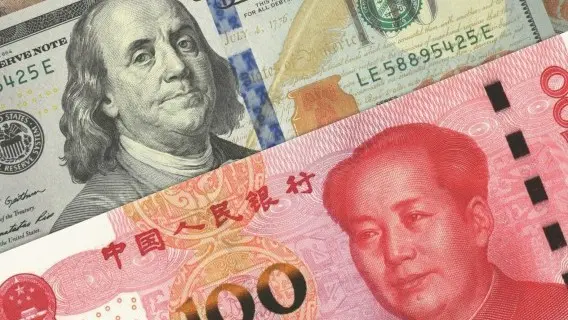
The US dollar remained largely unchanged on Monday following its first weekly decline in five weeks, while the Chinese yuan climbed to a four-year high after stronger-than-expected economic data from China.
The US Dollar Index held steady at 101.87 by 02:32 ET (06:32 GMT), following a 0.4% decline during the previous week. The drop ended a four-week winning streak for the American currency.
Meanwhile, developments across Europe and Asia influenced foreign exchange markets, with investors monitoring political uncertainty, central bank policies and economic growth indicators.
Euro Weakens as Political Unrest in France Raises Concerns
The euro declined against the US dollar as escalating protests in France increased political and economic uncertainty.
The EUR/USD currency pair slipped 0.1% to $1.219, reflecting growing concerns about the potential financial consequences of widespread demonstrations over rising living costs.
The unrest also intensified scrutiny of France’s fiscal outlook and government bond yield spreads, adding pressure to the European currency.
French President Emmanuel Macron condemned the violence over the weekend as the country experienced some of its most serious civil disturbances in recent years.
Consequently, investors remained cautious about the potential implications for political stability and financial markets.
Chinese Yuan Hits Four-Year High Following Stronger Q3 GDP
The Chinese yuan strengthened to its highest level since July 2022 after economic figures showed that China’s growth exceeded market expectations.
The onshore USD/CNY exchange rate declined 0.1% to 6.6812 yuan per dollar. Similarly, the offshore USD/CNH pair weakened, reflecting the Chinese currency’s strongest performance in approximately four years.
China’s gross domestic product expanded 4.5% year-on-year during the third quarter, exceeding economists’ forecasts of 4.4%. The reading also marked an acceleration from the previous quarter’s 4.3% growth.
Additional economic indicators reinforced signs of improving activity in the world’s second-largest economy.
Industrial production increased 5.5% year-on-year in September, while retail sales advanced 1.1%. Both readings surpassed market expectations, suggesting that manufacturing activity and domestic consumer demand were gaining momentum.
The stronger economic performance provided support for the yuan, even as investors continued to assess broader challenges facing China’s economy.
Elsewhere in Asian currency markets, the Australian dollar recorded notable gains. The AUD/USD pair advanced 0.4%, outperforming several regional currencies.
The South Korean won also strengthened against the greenback, with USD/KRW declining 0.4%.
Japanese Yen Stabilizes as Intervention Concerns Persist
The Japanese yen traded relatively flat against the US dollar amid ongoing speculation about possible intervention by Japanese authorities.
The USD/JPY pair remained near 158 yen, a level that has previously prompted warnings from policymakers concerned about excessive currency depreciation.
Market participants remained alert to potential measures aimed at preventing disorderly movements in the foreign exchange market.
Meanwhile, Bank of Japan Governor Kazuo Ueda indicated that underlying inflation was approaching the central bank’s 2% target.
His comments kept attention focused on Japan’s monetary policy outlook and the possibility of further adjustments to interest rates.
As a result, investors continued to monitor both official statements and currency movements for indications of potential intervention.
Indian Rupee Remains in Focus Following Strong Weekly Recovery
The Indian rupee also attracted investor attention after recording its strongest weekly performance in almost four years.
The recovery followed measures introduced by the Reserve Bank of India to reduce demand for US dollars, alongside direct intervention in currency markets.
Nevertheless, the USD/INR pair edged 0.1% higher to 95.03, compared with Friday’s closing level of 94.96 rupees per dollar.
Central bank support could help stabilize the Indian currency in the near term. However, persistent foreign capital outflows and elevated global oil prices remain important downside risks.
These factors could continue influencing the rupee’s performance, particularly if international investors maintain a cautious approach toward emerging markets.
US Treasury Yields Decline as Investors Assess Global Risks
Beyond foreign exchange markets, broader investor sentiment remained cautious amid uncertainty surrounding global economic conditions.
Market participants continued evaluating the substantial financing requirements associated with artificial intelligence infrastructure development. At the same time, attention shifted toward upcoming corporate earnings reports for further insights into business performance.
Meanwhile, declining crude oil prices following US developments involving sanctions on Russia helped support demand for government bonds.
The benchmark 10-year US Treasury yield fell to 5.05%, reflecting the bond market’s response to changing economic and geopolitical expectations.
Overall, currency markets presented a mixed picture, with the US dollar stabilizing after recent losses while the Chinese yuan benefited from stronger economic growth.
However, political uncertainty in Europe, possible Japanese currency intervention and persistent risks facing emerging-market currencies could continue driving foreign exchange volatility in the coming sessions.