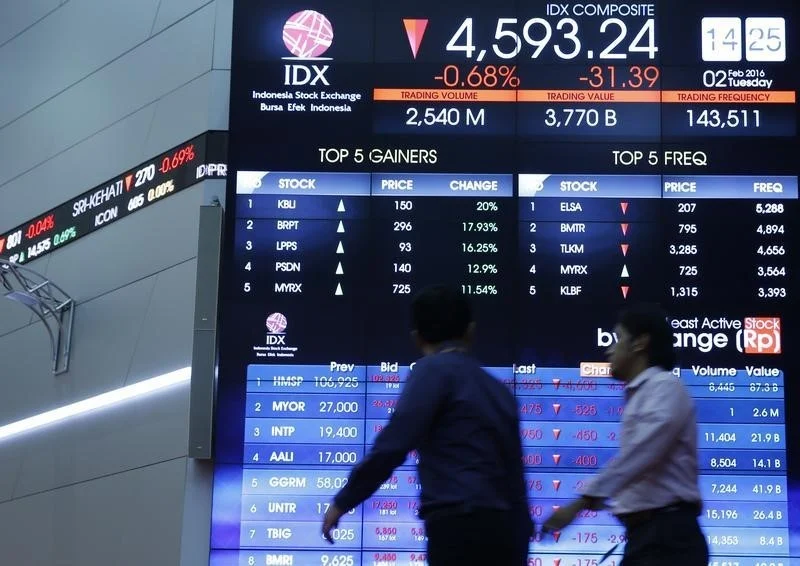
Indonesian stocks plunged to their lowest level in six years on Monday as fears of a potential market downgrade by MSCI triggered another wave of selling. Investors grew increasingly concerned that a change in the country’s market classification could accelerate foreign capital outflows and further undermine confidence in Indonesian equities.
The Jakarta Composite Index dropped 5.1% to 4,923.26, after hitting an intraday low of 4,907.37. This marked its weakest level since early October 2020.
The decline followed Friday’s dramatic 11.6% collapse, which represented the benchmark index’s steepest single-day loss since 1998.
MSCI Downgrade Fears Intensify Indonesia Stock Market Selloff
Global index provider MSCI is evaluating whether to reclassify Indonesia from an emerging market to a standalone market.
The potential downgrade follows concerns about insufficient transparency in share ownership, suspected coordinated trading activities and weaknesses in regulatory oversight.
Such a decision would carry more significant consequences than the previously considered possibility of moving Indonesia into the frontier-market category.
A standalone classification could result in Indonesian equities being excluded from major international stock indexes. Consequently, investment funds tracking these benchmarks could reduce their exposure to the country’s stock market.
Foreign investors have already withdrawn substantial amounts of capital from Indonesian equities. According to Reuters, overseas investors have sold a net $4.88 billion worth of local stocks this year.
If the trend continues, Indonesia could experience its largest annual foreign equity outflow in at least 16 years.
Indonesian Regulators Introduce Measures to Stabilize Markets
In response to the escalating market turmoil, the Indonesia Stock Exchange introduced additional measures aimed at limiting extreme price fluctuations.
On Monday, the exchange reduced its lower auto-rejection threshold from 15% to 7%. The adjustment followed discussions between financial regulators and market participants over the weekend.
The revised trading mechanism is intended to provide investors with more time to evaluate developments during periods of heightened market volatility.
Meanwhile, Indonesia’s Financial Services Authority announced penalties against parties allegedly involved in manipulating the shares of three listed companies.
The sanctions, disclosed on Friday, included fines totaling 2.1 trillion rupiah, equivalent to approximately $116.4 million.
Although these enforcement actions demonstrate efforts to address market irregularities, uncertainty remains over whether they will be sufficient to ease MSCI’s concerns.
Indonesian Rupiah Weakens as Investor Confidence Deteriorates
The selling pressure has also affected Indonesia’s currency market, extending the impact of the equity downturn beyond domestic stocks.
The Indonesian rupiah weakened to 18,040 against the U.S. dollar, approaching its record low of 18,190 per dollar recorded in June.
The currency’s depreciation highlights broader concerns surrounding capital outflows and international investor confidence.
Furthermore, the combination of falling equity prices and currency weakness could increase pressure on Indonesian financial markets if foreign investors continue reducing their exposure.
MSCI Decision Expected by June 2027
Investors will closely monitor the next stages of MSCI’s review, as the outcome could significantly influence Indonesia’s access to international equity investment.
The consultation period is scheduled to conclude on April 30, 2027. MSCI is expected to announce its final decision regarding Indonesia’s market classification on or before June 30, 2027.
However, the index provider could publish an interim update before the consultation ends.
Meanwhile, MSCI’s existing restrictions on certain Indonesian stock index changes will remain in effect until further notice.
The coming months could therefore prove critical for Indonesia’s financial markets. Although regulators have introduced measures to restore confidence, the possibility of a market downgrade continues to pose substantial risks to foreign investment flows, equity valuations and the rupiah.