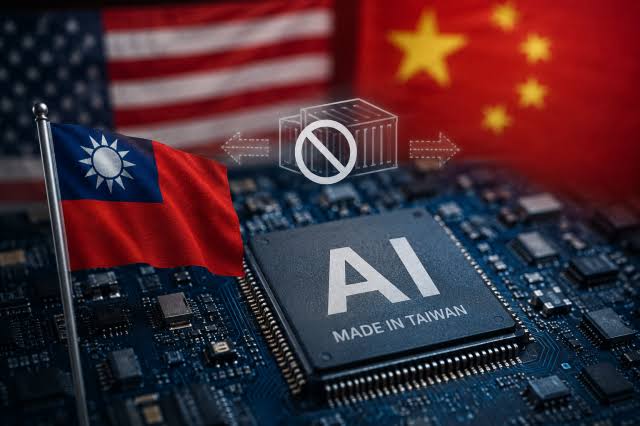
Taiwan is considering stricter AI chip export restrictions on China as it seeks to align its technology trade policies more closely with the United States. The proposed measures would strengthen oversight of advanced semiconductor shipments and help prevent sensitive artificial intelligence hardware from reaching Chinese buyers through unauthorized channels.
According to a Bloomberg report citing people familiar with the discussions, Taiwanese authorities are exploring additional legal powers to combat AI chip smuggling, particularly involving high-performance servers equipped with Nvidia processors.
The potential restrictions could further escalate tensions between Taiwan and Beijing, adding another layer to the ongoing U.S.-China technology rivalry.
Taiwan Considers Tougher AI Chip Export Controls on China
Taiwanese officials are evaluating new regulations designed to prevent advanced AI hardware from being diverted to China in violation of existing trade restrictions.
The proposals reportedly focus on strengthening enforcement capabilities and providing authorities with more effective legal tools to investigate suspicious semiconductor shipments.
Particular attention is being given to AI servers containing Nvidia’s advanced processors, which are widely used in data centers and artificial intelligence development.
By tightening export controls, Taiwan aims to reduce the risk of restricted technologies reaching Chinese companies through intermediaries or unauthorized distribution networks.
The initiative would also bring Taiwan’s semiconductor trade policies into closer alignment with Washington’s approach to limiting China’s access to cutting-edge computing technology.
U.S.-China Technology Rivalry Intensifies Over Nvidia Chips
The potential Taiwanese restrictions come amid an increasingly competitive technological relationship between the United States and China.
Washington first introduced significant export controls on advanced AI chips in 2022, seeking to restrict Beijing’s access to powerful processors with potential military and strategic applications.
Since then, U.S. authorities have expanded efforts to prevent restricted semiconductor technologies from reaching China without the necessary licenses.
However, enforcement has remained challenging.
Despite existing restrictions, reports have indicated that advanced Nvidia AI processors have continued entering the Chinese market through unauthorized distribution networks.
Southeast Asian countries have reportedly served as transit points for some shipments, allowing restricted hardware to be redirected toward China.
Taiwan’s proposed regulatory changes are intended to address these vulnerabilities and strengthen oversight of international semiconductor trade.
Nevertheless, further restrictions could provoke criticism from Beijing, which has repeatedly opposed U.S. efforts to limit Chinese access to advanced technology.
Super Micro Computer Linked to Major AI Chip Smuggling Investigation
Concerns about semiconductor diversion have intensified following a major U.S. Department of Justice investigation involving individuals associated with server manufacturer Super Micro Computer.
Federal prosecutors accused several individuals of participating in a scheme to illegally redirect advanced servers containing Nvidia AI processors to China.
The case involved approximately $2.5 billion in server purchases linked to the alleged export-diversion operation.
Among those charged was Yih-Shyan “Wally” Liaw, a co-founder of Super Micro Computer, who was arrested in connection with the investigation.
The allegations also involved other individuals associated with the company’s operations and international distribution activities.
According to U.S. authorities, the operation used intermediaries and complex shipping arrangements to conceal the final destination of restricted computing equipment.
The charges against individual defendants should not be interpreted as a finding of wrongdoing by Super Micro Computer itself.
The investigation has highlighted the difficulties regulators face in monitoring advanced semiconductor exports across multiple jurisdictions.
Nvidia Employees Also Face Scrutiny Over Alleged Chip Diversion
Separate investigations have also raised concerns about the potential involvement of individuals employed by Nvidia in unauthorized semiconductor shipments.
Taiwanese authorities have investigated alleged smuggling activities involving advanced Nvidia AI chips destined for China.
These cases have intensified attention on how sensitive computing equipment moves through international supply chains.
They also demonstrate the challenges facing technology companies and regulators attempting to enforce export restrictions without disrupting legitimate semiconductor trade.
As demand for advanced AI computing power continues to grow, authorities may face increasing pressure to strengthen compliance requirements and monitor high-risk transactions.
Taiwan’s AI Chip Restrictions Could Reshape Semiconductor Trade
The proposed export controls could have broader implications for the global semiconductor industry.
Taiwan plays a crucial role in advanced chip manufacturing and technology supply chains, making its regulatory decisions particularly important for international AI development.
Stricter enforcement could increase compliance requirements for semiconductor manufacturers, server producers and technology distributors operating across Asia.
At the same time, closer cooperation between Taiwan and the United States could further restrict China’s access to certain advanced computing technologies.
However, the measures remain under consideration, and their eventual scope and implementation have yet to be confirmed.
For now, Taiwan’s potential policy shift underscores the growing importance of semiconductor export controls in the geopolitical competition surrounding artificial intelligence.