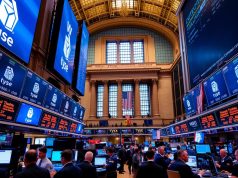
US stocks recovered from steep intraday losses on Thursday as falling Treasury yields helped offset renewed weakness in technology shares and unexpectedly strong inflation data.
The Nasdaq Composite trimmed much of an earlier decline exceeding 1%, while the S&P 500 returned to positive territory. Meanwhile, the Dow Jones Industrial Average posted solid gains as investors shifted toward more defensive sectors.
Despite the recovery, concerns surrounding artificial intelligence investments, elevated corporate borrowing and persistent inflation continued to weigh on Wall Street sentiment.
The bond market also experienced a significant reversal, with US Treasury yields falling sharply as investors sought protection from growing uncertainty in technology stocks.
Nasdaq Cuts Losses as S&P 500 and Dow Recover
At approximately 2:46 p.m. Eastern Time, the S&P 500 gained 0.1% to trade near 7,726 points, recovering from an earlier decline of approximately 0.6%.
The technology-heavy Nasdaq Composite slipped 0.3% to around 26,607 points after falling as much as 1.4% earlier in the session.
Meanwhile, the Dow Jones Industrial Average outperformed, climbing approximately 1% to 52,113 points.
The mixed performance highlighted a growing divergence between technology companies and other segments of the US stock market.
Investors continued reducing exposure to artificial intelligence-related companies amid concerns about elevated valuations and the financial sustainability of massive infrastructure investments.
However, declining government bond yields provided some relief, helping broader equity benchmarks recover from their session lows.
Oliver Pursche, senior vice president at Wealthspire Advisors, attributed the volatility to increasing sensitivity toward economic developments and corporate news.
He noted that investors are attempting to determine how long inflation will remain elevated, whether consumers can withstand higher prices and whether the current pace of AI investment is sustainable.
These unresolved questions could contribute to further market volatility in the coming months.
US Producer Price Inflation Surges to Highest Monthly Gain Since 2022
Thursday’s economic calendar featured a significantly stronger-than-expected Producer Price Index (PPI) report.
According to the Bureau of Labor Statistics, US producer prices increased 1.3% in September, marking their largest monthly advance since March 2022.
The reading substantially exceeded market expectations of approximately 0.6% and accelerated from August’s 0.5% increase.
On an annual basis, wholesale inflation climbed to 6.3%, compared with 5.6% in August and forecasts of 5.3%.
The latest data reinforced concerns that inflationary pressures remain deeply embedded in the American economy.
Core producer inflation, which excludes volatile food and energy prices, also exceeded expectations.
Core PPI increased 0.7% month over month, compared with an anticipated 0.3% rise.
Meanwhile, the annual core inflation rate reached 5%, above forecasts of 4.4%.
These figures followed Wednesday’s stronger-than-expected Consumer Price Index report, adding to uncertainty surrounding the Federal Reserve’s future interest rate decisions.
Energy Prices Drive Sharp Increase in US Inflation
Higher energy costs were responsible for much of September’s acceleration in producer inflation.
According to the Labor Department, the index for final demand energy surged 10.8% during the month.
This increase accounted for more than 80% of the 2.6% rise in final demand goods prices.
The advance in goods prices was the largest since the relevant data series began in December 2009.
The figures highlight the economic consequences of elevated petroleum prices and ongoing disruptions to global energy supplies.
Higher fuel costs can increase transportation and manufacturing expenses, potentially spreading inflationary pressures across other sectors.
Consequently, investors remain concerned that persistent energy inflation could force the Federal Reserve to maintain restrictive monetary policy for longer than previously anticipated.
US Retail Sales Beat Forecasts as Labor Market Remains Stable
Separate economic reports suggested that consumer spending remains resilient despite elevated prices.
The US Census Bureau reported that retail sales increased 0.8% in September, reaching approximately $745 billion.
Although the figure exceeded economists’ expectations of 0.3%, it represented a slowdown from August’s revised 1.3% expansion.
Higher gasoline prices contributed significantly to the headline increase, suggesting that underlying consumption may be less robust than the overall figures indicate.
Meanwhile, weekly unemployment claims remained historically low.
The number of Americans applying for initial jobless benefits rose to 199,000 during the week ending October 10.
The four-week moving average increased slightly to 198,500, remaining near its lowest levels since October 2022.
Together, the reports pointed toward an economy experiencing persistent inflation, relatively strong consumer spending and limited layoffs.
These conditions could allow the Federal Reserve to keep interest rates elevated without immediately threatening labor market stability.
Federal Reserve Rate Hike Expectations Ease as Bonds Rally
The inflation reports initially strengthened expectations that the Federal Reserve could increase borrowing costs at its October 27–28 monetary policy meeting.
According to CME FedWatch pricing cited during Thursday’s session, the probability of a 25-basis-point rate hike briefly increased to approximately 34%, compared with around 29% before the economic releases.
However, those expectations subsequently weakened as government bond prices recovered.
By later in the session, the market-implied probability of an October rate increase had fallen toward 27%.
The shift reflected a broader reassessment of financial risks, particularly those surrounding heavily indebted technology companies and the sustainability of artificial intelligence infrastructure spending.
Despite elevated inflation, investors increasingly favored US government securities as a defensive investment.
US Treasury Yields Slide Despite Hot Inflation Data
The rally in US Treasury bonds emerged as one of Thursday’s most important financial market developments.
The benchmark 10-year Treasury yield declined approximately 10.7 basis points to 5.082%.
Meanwhile, the two-year yield dropped around 5.3 basis points to 4.749%.
Because Treasury prices move inversely to yields, the declines indicated stronger demand for government bonds.
The reversal was particularly notable because US Treasuries had recently experienced substantial selling pressure, pushing yields toward multi-decade highs.
However, concerns about artificial intelligence investments and corporate credit risks prompted investors to reconsider the safety of government debt.
José Torres, senior economist at Interactive Brokers, highlighted increasing anxiety surrounding technology companies, semiconductor manufacturers and aggressive borrowing to finance AI projects.
He suggested that potential weaknesses in the corporate credit cycle were encouraging investors to seek safer assets.
As a result, concerns about financial stability temporarily outweighed the inflation pressures that would normally push Treasury yields higher.
AI Stock Selloff Deepens as Chinese Competition Raises Concerns
Technology stocks continued to face significant selling pressure as investors reassessed the outlook for artificial intelligence spending.
The weakness began earlier in the week following reports of technological advances by Chinese memory chipmaker ChangXin Memory Technologies.
These developments increased concerns about competition in the global semiconductor industry.
Major memory chip manufacturers experienced substantial losses during the week.
Micron Technology shares declined approximately 11.9%, while South Korea’s Samsung Electronics and SK Hynix fell roughly 19.9% and 24.9%, respectively.
The selling pressure extended into Asian equity markets.
South Korea’s KOSPI index plunged more than 7% on Thursday, reflecting the significant impact of semiconductor weakness on the country’s stock market.
The index had also fallen more than 39% from its recent record closing level.
The sharp declines highlighted growing uncertainty about the future profitability of companies supplying components for AI computing infrastructure.
CoreWeave and Nebius Fall as AI Infrastructure Debt Worries Intensify
Companies specializing in artificial intelligence cloud infrastructure also came under pressure.
These businesses, often described as neocloud providers, supply specialized computing capacity used to train and operate advanced AI models.
CoreWeave shares fell approximately 15.5% on Wednesday, while Nebius declined around 10.1%.
The losses followed growing concerns about the capital-intensive nature of AI infrastructure development.
A recent Gartner report added to those worries by predicting that more than 80% of neocloud providers could cease operating independently by 2030.
The forecast reflects expectations that rising infrastructure costs and insufficient differentiation could force widespread consolidation.
CoreWeave has also attracted attention because of concerns surrounding its borrowing requirements and debt obligations.
Some of the company’s bonds reportedly declined to new secondary-market lows, indicating increasing investor unease about credit risk.
However, Nvidia CEO Jensen Huang expressed confidence in CoreWeave’s financial position, indicating that the company did not require additional financial support from Nvidia.
His comments helped stabilize sentiment, allowing CoreWeave shares to recover and climb nearly 4% during Thursday’s session.
Anthropic Revenue Growth Slows Ahead of Potential IPO
Investor concerns about artificial intelligence profitability also intensified following reports about Anthropic’s latest financial performance.
The developer of the Claude AI chatbot reportedly generated $16.8 billion in third-quarter revenue, representing a 45% increase from the previous quarter.
Although the figures demonstrated substantial continued growth, the pace of expansion slowed compared with earlier periods.
This deceleration attracted attention because AI developers are committing enormous amounts of capital to computing infrastructure, data centers and advanced model development.
Investors are increasingly examining whether future revenue growth will justify those expenditures.
Anthropic is also preparing for a potentially significant initial public offering, placing additional attention on its financial performance and long-term profitability.
The broader concern is that even rapidly expanding AI companies may face difficulties maintaining the exceptional growth rates currently reflected in market expectations.
TSMC Reports Record Profit as AI Chip Demand Remains Strong
Despite the broader technology selloff, demand for advanced semiconductors continues to support strong corporate earnings.
Taiwan Semiconductor Manufacturing Company (TSMC), the world’s leading contract chip manufacturer, reported record third-quarter profitability.
Net income reached approximately NT$763.06 billion during the three months ending September 30.
The result represented a 68.7% increase from the corresponding period a year earlier.
The performance highlighted continued demand for advanced processors used in artificial intelligence applications, high-performance computing and other sophisticated technologies.
TSMC’s results also demonstrated that the semiconductor industry’s fundamental growth drivers remain strong despite recent stock market volatility.
However, investors are increasingly distinguishing between companies generating substantial profits from AI demand and businesses relying heavily on debt financing to fund future expansion.
Corporate Earnings Season Adds Another Test for Wall Street
Beyond the artificial intelligence sector, investors continued monitoring third-quarter corporate earnings.
Financial institutions including Charles Schwab, Bank of New York Mellon, U.S. Bancorp and PNC Financial Services were among the major companies reporting results.
Their financial performance could provide additional insight into consumer activity, lending conditions, capital markets and the broader economic outlook.
Bank earnings are particularly relevant as investors assess whether elevated interest rates are creating additional stress across the financial system.
Meanwhile, results from technology companies may help determine whether recent concerns about AI spending translate into weaker earnings expectations.
Stock Market Outlook: AI Risks and Fed Policy Remain in Focus
Thursday’s trading session highlighted the conflicting forces influencing US financial markets.
Strong inflation data reinforced expectations that the Federal Reserve could maintain restrictive monetary policy.
At the same time, growing uncertainty surrounding artificial intelligence investments encouraged investors to move into government bonds, pushing Treasury yields lower.
The Nasdaq’s recovery from deeper losses suggested that falling borrowing costs provided some support for technology stocks.
However, the continued weakness in semiconductor manufacturers and AI infrastructure companies indicates that investor confidence remains fragile.
For the S&P 500 and Nasdaq, future market direction may depend on whether corporate earnings justify elevated valuations and whether Treasury yields continue declining.
Investors will also closely monitor Federal Reserve communications, upcoming inflation reports and developments in corporate credit markets.
For now, Wall Street remains caught between concerns about persistent inflation and growing questions over the sustainability of the artificial intelligence investment boom.