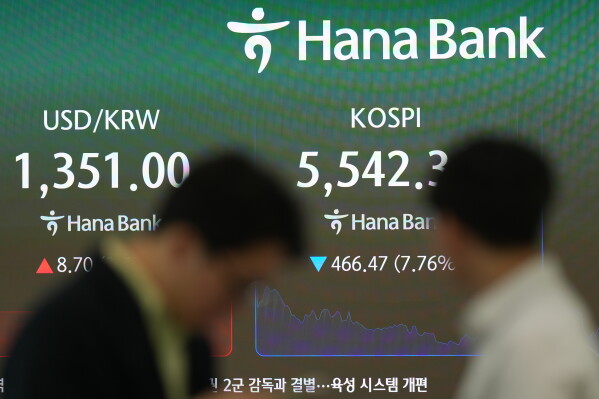
Asian stock markets suffered heavy losses on Thursday as a widespread technology sector selloff triggered a circuit breaker in South Korea. The country’s benchmark KOSPI index plunged nearly 9%, while concerns about Chinese semiconductor competition and stronger-than-expected US inflation intensified investor uncertainty.
The downturn reflected growing fears that the Federal Reserve could introduce additional interest rate increases, potentially raising borrowing costs for technology companies and putting further pressure on artificial intelligence investments.
South Korea’s KOSPI dropped to 5,483.65, its lowest level in almost three months. The sharp decline activated a market circuit breaker for the tenth time this year and the sixteenth time in the index’s history. The previous activation occurred on July 29.
Asian Stock Markets Plunge as Technology Selloff Intensifies
The selling pressure spread across major Asian stock markets, with technology-heavy indexes suffering particularly severe losses.
Japan’s Nikkei 225 plunged 5%, extending the regional downturn. Meanwhile, the MSCI Asia Pacific Index declined nearly 3%, putting it on course for its weakest level since July.
Chinese equities also weakened significantly.
Hong Kong’s Hang Seng Index fell 1.3%, while mainland China’s CSI 300 dropped 1.5%. The Shanghai Composite declined 1.6%.
The regional losses followed another difficult trading session on Wall Street.
The Nasdaq Composite fell 1.9% overnight, reflecting continued weakness across major US technology companies.
Meanwhile, the Philadelphia Semiconductor Index extended its losing streak to six consecutive sessions, its longest since May 2025.
The Russell 2000 Equal Weight Index also entered correction territory after declining approximately 11% from its previous peak.
US equity futures continued to weaken during Asian trading hours. Nasdaq 100 futures dropped 1%, while S&P 500 futures declined 0.4%.
South Korean Chipmakers Lead Heavy Semiconductor Losses
Semiconductor manufacturers were among the hardest-hit companies as investors reassessed valuations across the artificial intelligence industry.
South Korean memory chip producer SK Hynix plunged 11.4%, while Samsung Electronics suffered a 10.6% decline.
Japan’s Kioxia recorded an even steeper loss of 12.2%, highlighting the intensity of selling pressure across the memory chip industry.
South Korea’s LG Innotek also dropped 10%, while major Taiwanese technology manufacturers experienced significant declines.
The weakness followed growing concerns about increased competition from Chinese semiconductor companies.
In particular, China’s ChangXin Memory Technologies (CXMT) has reportedly made progress in developing higher-density dynamic random-access memory (DRAM) chips capable of storing larger amounts of information.
These technological advances have raised questions about future competition, pricing power and profitability among established semiconductor manufacturers.
TSMC Record Earnings Fail to Support Technology Stocks
Even stronger-than-expected earnings from Taiwan Semiconductor Manufacturing Company (TSMC) failed to reverse the negative sentiment surrounding Asian technology shares.
The world’s largest contract chipmaker reported its sixth consecutive quarter of record profits, supported by strong demand for advanced artificial intelligence processors.
TSMC’s third-quarter net profit surged 68.7% year-on-year to T$763.06 billion, equivalent to approximately $23.6 billion.
The result exceeded analysts’ forecasts, reinforcing the company’s strong position in the global semiconductor industry.
Nevertheless, TSMC shares declined approximately 2.2% during Taiwanese trading.
The negative reaction demonstrated that investors remained concerned about broader risks affecting technology valuations, despite continued growth in AI-related semiconductor demand.
AI Investment Boom Faces Growing Financial Scrutiny
Beyond semiconductor competition, investors are increasingly questioning whether the enormous investments flowing into artificial intelligence infrastructure will generate sufficient financial returns.
Broadcom CEO Hock Tan recently warned about speculative behavior among certain AI investors, adding to concerns that valuations across the industry may have become excessive.
The expanding use of debt to finance AI infrastructure projects has also attracted greater attention.
CoreWeave, a major provider of AI computing infrastructure, saw its shares decline as much as 17% on Wednesday.
Meanwhile, the company’s debt securities maturing in 2032 traded below 78 cents on the dollar, despite having been issued at face value only four months earlier.
The decline highlights growing concerns about credit risk and the financial sustainability of aggressive infrastructure expansion.
Investor uncertainty also increased following an update from artificial intelligence developer Anthropic.
The company reportedly informed investors that third-quarter revenue reached $16.8 billion, representing 45% growth from the previous quarter.
Although Anthropic reported adjusted profitability, the revenue figure was reportedly below some market expectations.
Together, these developments have intensified questions about the sustainability of the AI investment boom.
Hot US Inflation Raises Federal Reserve Rate Hike Expectations
Stronger-than-anticipated US inflation figures added another source of pressure to global financial markets.
Consumer prices accelerated in September, partly driven by higher gasoline costs, raising concerns that inflation could remain elevated for longer than previously anticipated.
The latest figures strengthened expectations that the Federal Reserve may need to tighten monetary policy further.
The central bank had already increased interest rates in September, bringing its benchmark target range to 3.75%–4.00%.
However, persistent inflation has complicated expectations that policymakers could pause their tightening cycle.
Market-implied probabilities of a 25-basis-point interest rate increase at the October 27–28 Federal Reserve meeting rose to 31.6%, compared with 22.1% a day earlier.
Investors also priced in approximately 40 basis points of additional tightening by the end of January.
Higher interest rates could create particular challenges for technology and AI infrastructure companies, many of which require substantial financing to support expansion.
Investors Await Federal Reserve Commentary and US Economic Data
Market attention is now turning toward additional US economic indicators and upcoming statements from Federal Reserve officials.
Federal Reserve Chair Kevin Warsh is scheduled to participate in a discussion with International Monetary Fund Managing Director Kristalina Georgieva in Bangkok on Friday.
Although Warsh has indicated that he does not intend to provide direct guidance about his near-term monetary policy expectations, investors will closely examine his remarks for potential signals.
Meanwhile, upcoming US producer price inflation and retail sales figures could provide further insight into economic conditions.
The data may influence expectations surrounding future Federal Reserve interest rate decisions and the outlook for global financial markets.
Oil Prices Retreat as Regional Markets Remain Mixed
Energy markets also experienced losses on Thursday.
Brent crude futures declined $1.39 to $104.67 per barrel, while US West Texas Intermediate crude fell $1.02 to $94.07.
Elsewhere in Asia, Singapore’s Straits Times Index dropped 0.9%, a day after the Monetary Authority of Singapore unexpectedly maintained its existing monetary policy stance.
Australia’s S&P/ASX 200 declined 0.1%, while New Zealand’s NZX 50 also slipped 0.1%.
India’s Nifty 50 was a notable exception to the broader regional weakness, advancing 1.4%.
Asian Stock Market Outlook Remains Clouded by AI and Inflation Risks
The latest market downturn highlights the growing vulnerability of Asian technology stocks to changing investor expectations.
Concerns about Chinese semiconductor competition, elevated AI valuations and debt-financed infrastructure expansion have combined with persistent US inflation to create a challenging environment for equities.
South Korea’s dramatic KOSPI decline demonstrates how quickly selling pressure can intensify when investors reassess risk across interconnected technology markets.
Although strong earnings from companies such as TSMC suggest that underlying semiconductor demand remains robust, financial markets are increasingly focused on the sustainability of future growth.
Looking ahead, developments in US monetary policy, inflation trends and artificial intelligence investment could determine whether Asian stock markets stabilize or experience further volatility.