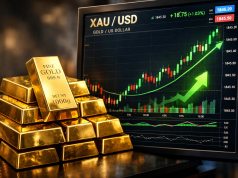
Gold prices declined on Monday as a stronger US dollar weighed on precious metals. Investors also assessed hopes for an energy ceasefire between Russia and Ukraine alongside escalating Middle East tensions that could intensify global inflation pressures.
Spot gold (XAU/USD) fell 0.6% to $4,169.23 per ounce at 05:01 ET (09:01 GMT), while US gold futures dropped 0.6% to $4,193.05.
Meanwhile, silver (XAG/USD) slipped 0.3% to $60.6255 per ounce. Platinum gained 0.3% to $1,695.41, while palladium advanced 0.5% to $1,158.30. Palladium futures also edged higher to $1,158.75.
The US Dollar Index strengthened 0.2% to 102.19, adding pressure to dollar-denominated commodities. Gold had previously recorded a 1.3% gain during the preceding week.
Gold Prices Face Pressure From Stronger Dollar and Geopolitical Risks
The latest decline in gold prices comes as financial markets assess conflicting geopolitical developments.
US President Donald Trump announced that an energy-related ceasefire between Russia and Ukraine had taken effect immediately, raising expectations of improved global fuel supplies.
Trump had previously urged Ukrainian President Volodymyr Zelenskyy to suspend attacks against Russian oil refineries. He also claimed that Moscow had agreed to release additional diesel supplies into international markets.
If implemented, these measures could help ease concerns about global energy shortages and reduce some of the inflationary pressures affecting financial markets.
However, continued instability in the Middle East has complicated the outlook for energy prices and investor sentiment.
Middle East Attacks Raise Fresh Inflation Concerns
Renewed violence in Saudi Arabia has heightened fears of a broader regional conflict and further disruptions to energy supplies.
On Sunday, Yemen’s Houthi rebels reportedly launched another attack against King Khalid International Airport in Riyadh.
The incident followed a deadly strike on Saturday that reportedly killed 12 people and injured more than 300 others.
According to the reports, Saturday’s attack represented the deadliest incident in Saudi Arabia since the outbreak of the war involving Iran in late February.
The Houthis described their operations as retaliation for what they characterized as Saudi aggression, including an attack against an airport in Yemen’s capital, Sanaa.
These developments have raised concerns that regional hostilities could expand, potentially driving oil and other energy prices higher.
A sustained increase in energy costs could worsen inflation expectations and encourage central banks to maintain restrictive monetary policies.
Higher Interest Rates Continue to Weigh on Gold
Although gold traditionally benefits from geopolitical uncertainty, its recent performance has been complicated by inflation risks and changing interest rate expectations.
The precious metal has reportedly lost approximately 20% of its value since the US-Iran conflict began in late February, despite its latest weekly recovery.
Higher energy prices have intensified inflation concerns, prompting some central banks to increase borrowing costs.
This environment presents challenges for gold because the metal does not generate interest income.
When interest rates rise, yield-bearing investments such as government bonds can become more attractive relative to non-yielding assets.
Furthermore, a stronger US dollar generally makes gold more expensive for investors holding other currencies, potentially reducing international demand.
Consequently, expectations surrounding Federal Reserve monetary policy remain an important influence on gold prices.
Central Bank Gold Purchases and ETF Inflows Provide Support
Despite the challenging interest rate environment, analysts at ANZ highlighted several factors supporting longer-term demand for gold.
According to the bank, investment flows into gold-backed exchange-traded funds (ETFs) have strengthened significantly, reaching their highest level in four years based on Bloomberg data.
ANZ attributed the growing investor interest partly to concerns surrounding government debt, rising debt-servicing expenses and global money supply trends.
Persistent fiscal uncertainty has encouraged some investors to increase their exposure to gold as a potential store of value.
Central banks have also continued expanding their bullion reserves, providing another important source of demand.
In particular, the People’s Bank of China reportedly purchased an additional 740,000 ounces of gold in September.
The acquisition extended China’s reported gold-buying streak to 23 consecutive months, highlighting the country’s continued interest in strengthening its precious metal reserves.
Gold Price Outlook Hinges on Inflation and Federal Reserve Policy
While investment demand and central bank purchases have supported bullion, ANZ warned that persistent inflation could restrict further price gains.
If energy costs remain elevated, the Federal Reserve could face additional pressure to tighten monetary policy.
Higher US interest rates would potentially strengthen the dollar and increase the attractiveness of interest-bearing assets, creating further obstacles for gold.
On the other hand, easing geopolitical tensions and stabilizing energy markets could help reduce inflation concerns and improve expectations for future monetary easing.
Looking ahead, gold traders will closely monitor developments in the Russia-Ukraine conflict, Middle Eastern energy supplies and upcoming US economic data.
The interaction between geopolitical risks, inflation expectations and Federal Reserve policy will likely determine whether gold prices regain upward momentum or remain under selling pressure.