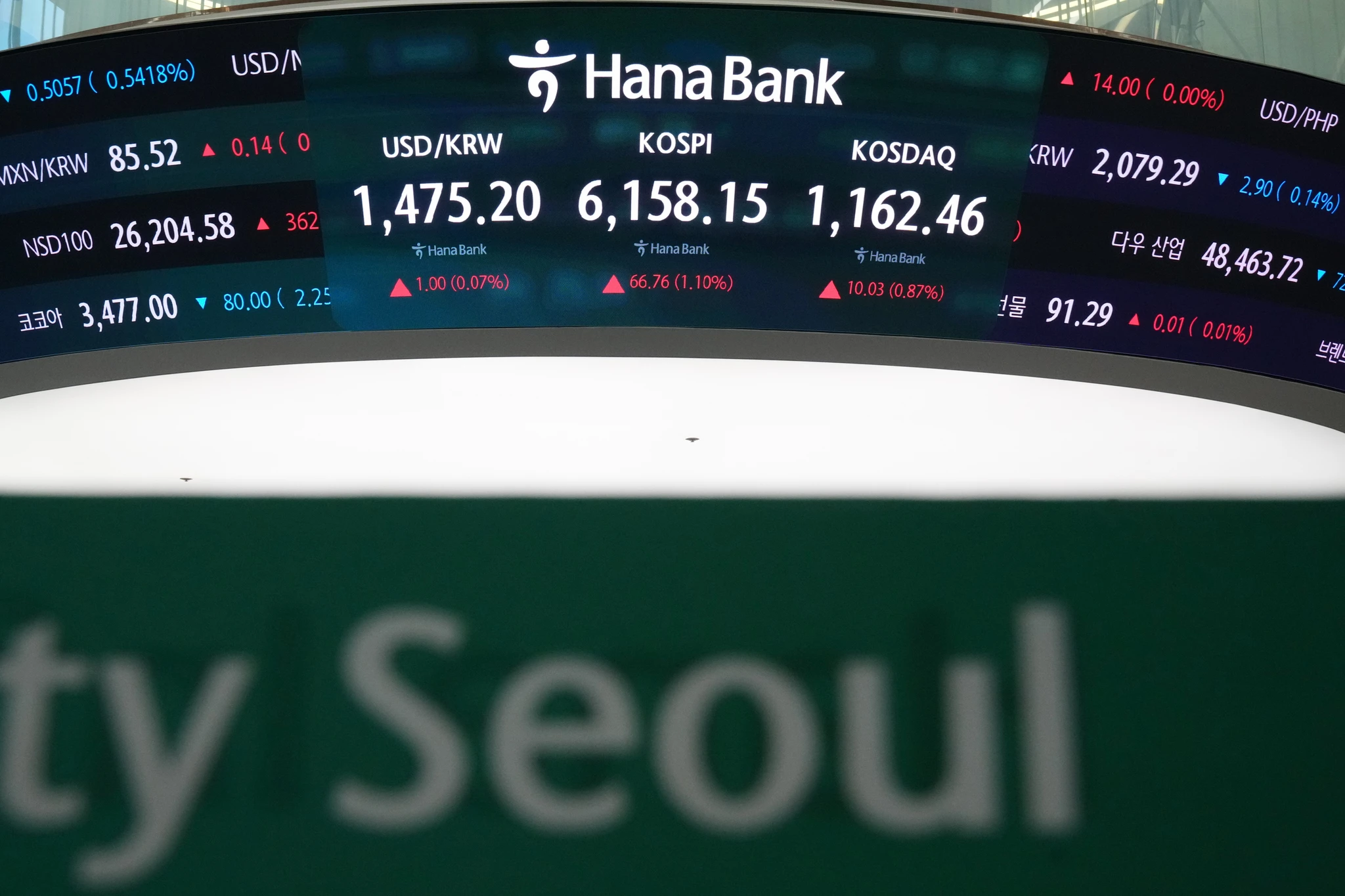
Asian stock markets traded mixed on Monday, with South Korean equities suffering heavy losses amid growing concerns about competition in the semiconductor industry. Meanwhile, falling oil prices and uncertainty surrounding a possible Russia-Ukraine energy ceasefire influenced broader market sentiment.
South Korea’s KOSPI index plunged 3.5%, as investors reacted to technological advances by Chinese memory-chip manufacturer ChangXin Memory Technologies (CXMT).
Elsewhere, Hong Kong’s Hang Seng Index gained 0.2%, while China’s CSI 300 declined 0.8%.
Trading activity remained relatively subdued because of public holidays in major financial markets. Japan’s stock exchanges were closed for Sports Day, while US bond markets observed Columbus Day.
However, American stock exchanges remained open, with investors preparing for important inflation reports and third-quarter corporate earnings.
Asian Stocks Mixed Following Wall Street’s Strong Performance
Asian markets entered the new trading week after Wall Street recorded another positive session on Friday.
The S&P 500 advanced 0.6%, while the Dow Jones Industrial Average gained 0.8%. Meanwhile, the technology-heavy Nasdaq Composite climbed 0.6%.
These gains extended Wall Street’s strong performance following a record-setting week.
US stock futures also edged higher during Asian trading hours.
Nasdaq 100 futures rose 0.2% to 31,163.25 points, while S&P 500 futures gained 0.2% to 7,877.75 points.
Despite the positive momentum in American equities, Asian investors remained cautious ahead of several potentially market-moving economic releases.
This week’s calendar includes US consumer inflation, producer prices and retail sales figures.
The data could influence expectations surrounding the Federal Reserve’s next monetary policy decisions.
Markets were pricing in an 18% probability of an interest rate increase in October and an 85% chance of a hike in December.
Consequently, investors remain sensitive to economic indicators that could alter the outlook for borrowing costs and corporate valuations.
South Korean Chip Stocks Slide as China’s CXMT Advances
South Korea’s stock market experienced particularly heavy selling pressure as trading resumed following an extended weekend.
The KOSPI dropped 3.5%, with several major technology companies recording significant declines.
SK Hynix shares fell 2.6%, while Samsung Electronics lost 2.3%. Meanwhile, electronics component manufacturer LG Innotek plunged 13.1%.
The selloff followed reports of technological progress at Chinese semiconductor manufacturer ChangXin Memory Technologies.
CXMT has reportedly made advances in its 4F² DRAM architecture, a memory-chip design aimed at increasing storage density.
The development raised concerns that Chinese semiconductor manufacturers could become stronger competitors in the global memory market.
CXMT’s New Memory Technology Threatens Samsung and SK Hynix
CXMT is reportedly preparing to introduce next-generation DDR5 server-memory modules by the end of the year.
The planned launch could intensify competition with South Korea’s leading semiconductor manufacturers, particularly Samsung Electronics and SK Hynix.
Both companies maintain significant positions in the higher-value memory market, including products used in servers and advanced computing systems.
According to technology research firm TrendForce, CXMT’s new architecture could improve memory density by approximately 30% to 50%.
Such improvements could strengthen the competitiveness of Chinese memory products and potentially increase pressure on established manufacturers.
However, the commercial impact will depend on factors including production efficiency, product performance and customer adoption.
The reported developments nevertheless contributed to investor concerns about future competition and profitability in the semiconductor industry.
Taiwan Technology Stocks Mixed Ahead of TSMC Earnings
Technology shares elsewhere in Asia delivered mixed performances.
Taiwanese optical component manufacturer Largan surged 8%, while electronics manufacturing giant Foxconn advanced 2.6%.
In contrast, Taiwan Semiconductor Manufacturing Company (TSMC) slipped 0.4%.
Investors are now preparing for TSMC’s third-quarter earnings announcement on Thursday.
Analysts expect the world’s leading contract chipmaker to report its sixth consecutive quarter of record profits, supported by strong demand for artificial intelligence semiconductors.
Advanced chip packaging technology, particularly TSMC’s CoWoS solutions, is also expected to contribute to the company’s financial performance.
Consensus forecasts point to third-quarter net profit of T$746.3 billion, equivalent to approximately $23.4 billion.
That would represent an impressive 65% increase compared with the previous year.
The results could provide important indications of whether global investment in AI infrastructure remains strong.
Given TSMC’s central role in advanced semiconductor manufacturing, its outlook could also influence broader Asian technology stocks.
Geely Shares Rise as China and EU Make Trade Progress
In the automotive sector, Geely Automobile shares gained 2.5% after the Chinese carmaker announced plans to expand into Canada.
The company aims to begin selling vehicles in the Canadian market in 2027.
The announcement highlighted Geely’s efforts to strengthen its international presence and expand beyond its existing markets.
Meanwhile, China and the European Union reportedly reached a 16-point consensus covering several important areas of economic cooperation.
The discussions addressed trade, investment, export controls and intellectual property.
As part of the understanding, Beijing agreed to restrict hybrid vehicle exports while European authorities considered possible safeguard measures.
The developments could influence future trade relations between China and the European automotive industry.
However, investors will continue monitoring how these commitments translate into practical regulatory and commercial changes.
Australia’s MAAS Group Slumps After Firmus IPO Cancellation
Australian stocks generally performed better than their South Korean counterparts.
The S&P/ASX 200 index gained 0.8%, supported by broader market resilience.
However, MAAS Group experienced substantial selling pressure.
The company’s shares declined 11.2% to A$4.11, extending previous losses following the cancellation of a planned initial public offering by AI data-center operator Firmus.
Firmus had been preparing for an IPO valued at approximately $5 billion.
The cancellation unsettled investors and raised concerns about valuations and financing conditions in the rapidly expanding AI infrastructure sector.
The reaction illustrates how developments involving major artificial intelligence investments can influence companies exposed to related industries.
Oil Prices Fall as Russia-Ukraine Ceasefire Remains Uncertain
Energy markets also influenced Asian stocks as crude oil prices retreated following an earlier advance.
Brent crude fell 1.3% to $103.38 per barrel, while US crude declined 1.7% to $90.29.
Both benchmarks remained below their recent highs.
The decline followed US President Donald Trump’s announcement that Russia and Ukraine had agreed to an immediate ceasefire covering attacks on energy infrastructure.
However, neither country had officially confirmed a finalized agreement.
Ukrainian President Volodymyr Zelenskyy stated that no deal had been completed, leaving considerable uncertainty over the proposed arrangement.
Trump’s proposal for Russia to increase diesel exports also attracted criticism from both Republican and Democratic senators.
Lawmakers questioned whether the proposed arrangement could violate existing legal restrictions.
These uncertainties complicated the market’s assessment of potential improvements in global energy supplies.
Middle East Conflict Keeps Oil Supply Risks Elevated
Despite falling crude prices, escalating tensions in the Middle East continued to support concerns about energy security.
Over the weekend, Yemen’s Iran-backed Houthi movement carried out attacks targeting commercial shipping and Riyadh’s main airport.
The incidents raised fears that the regional conflict could intensify and threaten critical energy transportation routes.
Further disruptions to maritime shipping or energy infrastructure could restrict oil supplies and push prices higher.
Consequently, traders remain cautious about assuming that a potential Russia-Ukraine energy agreement will deliver a lasting decline in crude prices.
The combination of geopolitical uncertainty and volatile energy costs continues to create challenges for global financial markets.
Other Asian Markets Show Mixed Performance
Stock market performance varied across the Asia-Pacific region.
New Zealand’s NZX 50 advanced 0.6% to 13,827.62 points, while Singapore’s Straits Times Index gained 0.3%.
However, Indonesian equities weakened considerably, with the Jakarta Composite declining 1.9%.
Indian stocks also moved lower.
The Nifty 50 fell 0.7%, while the benchmark Sensex lost 0.8%.
These contrasting movements highlighted the uneven performance of regional equities as investors assessed economic conditions, geopolitical risks and corporate developments.
Asian Stock Market Outlook: Earnings and Inflation in Focus
Asian stock markets face several important challenges as investors prepare for a busy week of economic data and corporate earnings.
The sharp decline in South Korean semiconductor shares highlights growing competition from Chinese memory-chip manufacturers.
Meanwhile, TSMC’s upcoming earnings could provide fresh evidence of the strength of global demand for artificial intelligence chips.
US inflation figures will also play a crucial role in shaping expectations for Federal Reserve interest rate policy.
Higher-than-expected inflation could reinforce concerns about rising borrowing costs, potentially weighing on stock market valuations.
At the same time, developments surrounding the Russia-Ukraine conflict and tensions in the Middle East could drive further volatility in oil prices.
Third-quarter corporate earnings represent another major test for global equities.
Leading US banks begin reporting on Tuesday, followed by TSMC on Thursday.
Strong corporate profits could help support current stock valuations, while disappointing results may increase selling pressure.
For now, Asian stocks remain divided as semiconductor competition, geopolitical uncertainty and upcoming economic releases shape investor sentiment.
Market participants will closely monitor inflation data, semiconductor earnings and developments in global energy markets for indications of the next major direction in equities.