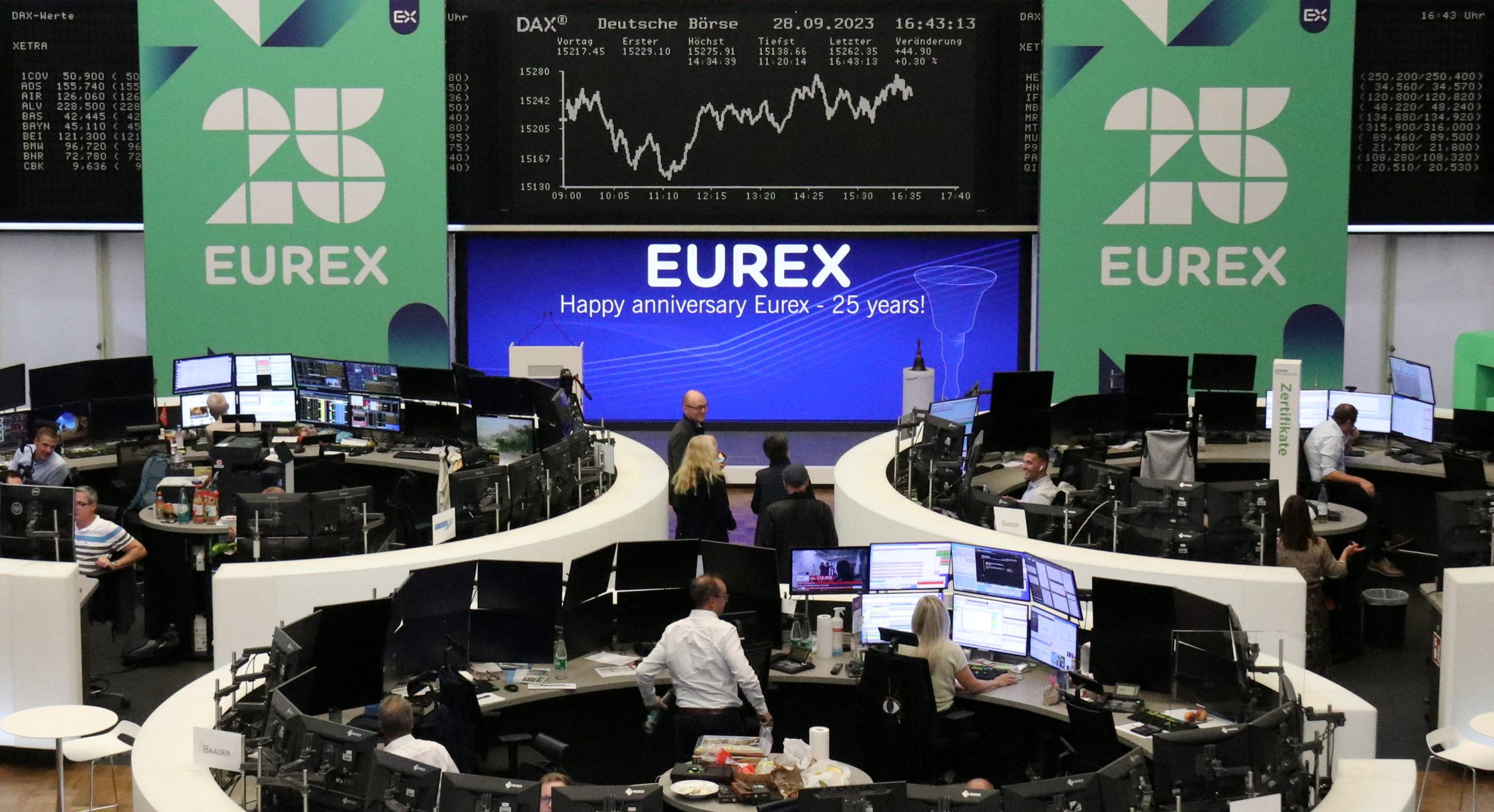
European stocks traded slightly higher on Monday as investors assessed a sharp rise in global bond yields and higher crude oil prices.
The mixed backdrop left major equity indices struggling to build clear momentum.
The pan-European STOXX 600 gained around 0.3%. Germany’s DAX was little changed, while France’s CAC 40 and the UK’s FTSE 100 both rose about 0.2%.
European Stocks Head for Monthly Loss
European equities have been volatile throughout September as rising sovereign bond yields put pressure on valuations.
Bond yields across major economies have climbed to levels not seen since the global financial crisis, creating a more difficult environment for stocks.
A fresh European Central Bank rate hike, continued hawkish comments from policymakers and growing concerns over the pace of artificial intelligence development have all contributed to weaker sentiment.
The STOXX 600 was down nearly 2% for the month and remained on course for its first monthly decline in six months.
AI Investment Faces Greater Scrutiny
Investors are also becoming more selective about artificial intelligence-related investments.
Javier de Berenguer, Fund Selector at MAPFRE Asset Management, said markets are increasingly focusing on whether companies can actually deliver on ambitious AI investment plans.
This marks a shift away from simply rewarding companies for promising future growth.
As spending on artificial intelligence infrastructure rises, investors are paying closer attention to profitability, execution and return on investment.
Rising Bond Yields Pressure Equity Valuations
Sovereign bond yields are an important benchmark for global financial markets.
They influence the pricing of equities, corporate debt, mortgages and other financial assets.
When bond yields rise, the discount rate applied to future corporate earnings also increases.
This can reduce equity valuations, particularly for companies whose share prices depend heavily on long-term growth expectations.
Technology and other rate-sensitive sectors are often among the most affected.
Middle East Tensions Keep Investors Cautious
Geopolitical uncertainty also continues to limit investor confidence.
Earlier hopes of a diplomatic breakthrough in the Middle East faded quickly, leaving markets facing an extended period of uncertainty.
Tensions between the United States and Iran remain focused on the Strait of Hormuz, a key route for global energy shipments.
With diplomatic progress limited and military tensions still elevated, energy markets continue to price in a significant geopolitical risk premium.
Higher Oil Prices Add to Market Pressure
Elevated crude oil prices are creating another challenge for European markets.
Higher energy costs can add to inflation, which may force central banks to maintain restrictive monetary policy for longer.
This reduces the likelihood of rapid interest-rate cuts and keeps borrowing costs elevated for businesses and consumers.
As a result, rising oil prices can weigh particularly heavily on rate-sensitive and consumer-focused sectors.
Investors Consider Longer-Term Debt
Berenguer also suggested that increasing exposure to longer-term debt could become more attractive in the current environment.
Higher bond yields may offer investors more appealing returns compared with previous years.
This could also create additional competition for equities as investors reassess the balance between risk and return across asset classes.
Eurozone Consumer Confidence in Focus
Investors are now turning their attention to upcoming eurozone consumer confidence data.
The figures could provide fresh insight into household sentiment as consumers deal with higher energy costs and elevated borrowing rates.
Weak consumer confidence could raise further concerns about the outlook for European economic growth.
ECB Comments Could Shape Market Outlook
Markets are also preparing for remarks from European Central Bank President Christine Lagarde.
Traders will be watching closely for any signs that persistent energy-market volatility could influence the ECB’s policy outlook.
If inflation risks remain elevated, the central bank may need to keep interest rates restrictive for longer than previously expected.
For European stocks, the combination of high bond yields, elevated oil prices and geopolitical uncertainty is likely to remain a key driver of market sentiment in the near term.