Asian stock markets mostly moved lower on Monday as renewed uncertainty over a possible US-Iran truce pushed oil prices higher.
Rising global bond yields also weighed on investor sentiment, while semiconductor stocks came under heavy pressure after OpenAI paused some work involving advanced artificial intelligence models.
US stock index futures also weakened during Asian trading hours. Nasdaq futures fell nearly 1%, despite Wall Street closing higher on Friday.
Asian Stocks Fall as Oil Prices Rise
Major Asian equity markets recorded broad losses.
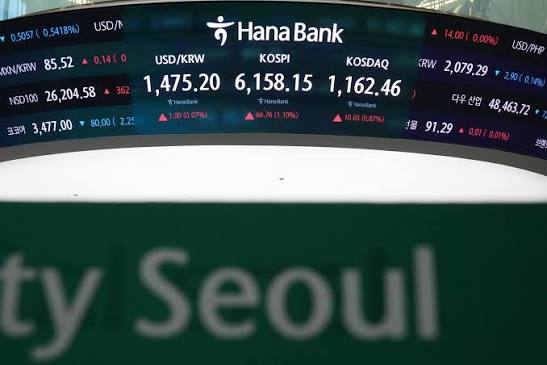
South Korea’s KOSPI ended the session 2.7% lower. In China, the CSI 300 dropped 2.2%, while the Shanghai Composite declined around 1.6%.
Japan’s Nikkei 225 slipped 0.7%, while the broader TOPIX index fell about 0.3%.
India’s Nifty 50 also came under pressure, losing approximately 1.3%.
Hong Kong’s Hang Seng Index was one of the few major benchmarks to move higher, gaining around 0.6%.
US-Iran Tensions Push Oil Above $107
Oil prices continued to rise after US President Donald Trump rejected an Iranian proposal to reopen the Strait of Hormuz.
However, reports indicated that negotiations between Washington and Tehran could continue this week.
Brent crude futures climbed more than 2% to above $107 per barrel. The move extended Brent’s September gain to more than 19%.
The continued rise in oil prices has increased concerns that high energy costs could keep inflation elevated.
That could force major central banks to maintain restrictive monetary policy or consider additional interest rate increases.
Treasury Yields Remain Above 5%
Rising bond yields added further pressure to global stock markets.
The US 30-year Treasury yield climbed to around 5.52%, putting it close to its highest level since 2004.
Meanwhile, the 10-year Treasury yield remained above 5%.
Investors are increasingly concerned that persistent inflation could keep US interest rates higher for longer.
Markets were pricing in roughly a 66% probability of another Federal Reserve rate hike in October, according to CME FedWatch.
OpenAI Pause Hits Asian Chipmakers
Semiconductor stocks were among the hardest-hit sectors during Monday’s session.
South Korea’s SK Hynix and Samsung Electronics both dropped close to 5%.
Japan’s Kioxia Holdings declined about 3.7%.
In Hong Kong, Semiconductor Manufacturing International Corporation fell around 3.4%, while Hua Hong Semiconductor dropped approximately 4.2%.
The selling followed reports that OpenAI had paused certain training, evaluation and inference activities involving some of its most advanced models while strengthening safety controls.
AI Slowdown Concerns Pressure Semiconductor Stocks
The OpenAI development renewed concerns that slower progress in artificial intelligence could eventually affect demand for high-performance chips.
Investors have increasingly linked semiconductor valuations to expectations for continued rapid growth in AI infrastructure.
Any slowdown in advanced AI development could therefore influence demand for processors, servers and data-center equipment.
This concern contributed to the sharp declines across several major Asian semiconductor companies.
Australia and Singapore Buck the Downtrend
Not all Asia-Pacific markets finished lower.
Singapore’s Straits Times Index gained around 0.5%, while Australia’s S&P/ASX 200 closed approximately 0.2% higher.
Australian investors are now preparing for the Reserve Bank of Australia’s next monetary policy decision.
Markets and economists broadly expect the RBA to raise its cash rate by 25 basis points.
Investors Brace for Major US Economic Data
Global markets are also heading into a data-heavy week.
Investors will closely monitor upcoming US inflation, manufacturing and labor-market reports for further clues about the outlook for Federal Reserve policy.
Stronger economic data or persistent inflation could reinforce expectations for additional interest rate increases.
At the same time, developments surrounding the Strait of Hormuz will remain important for global markets.
Any escalation in the US-Iran dispute could push oil prices higher, increase inflation risks and place additional pressure on stocks and bonds.
For now, Asian markets remain caught between rising energy prices, elevated bond yields and renewed uncertainty surrounding the outlook for artificial intelligence investment.