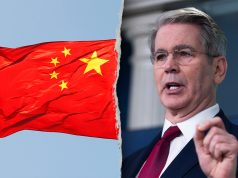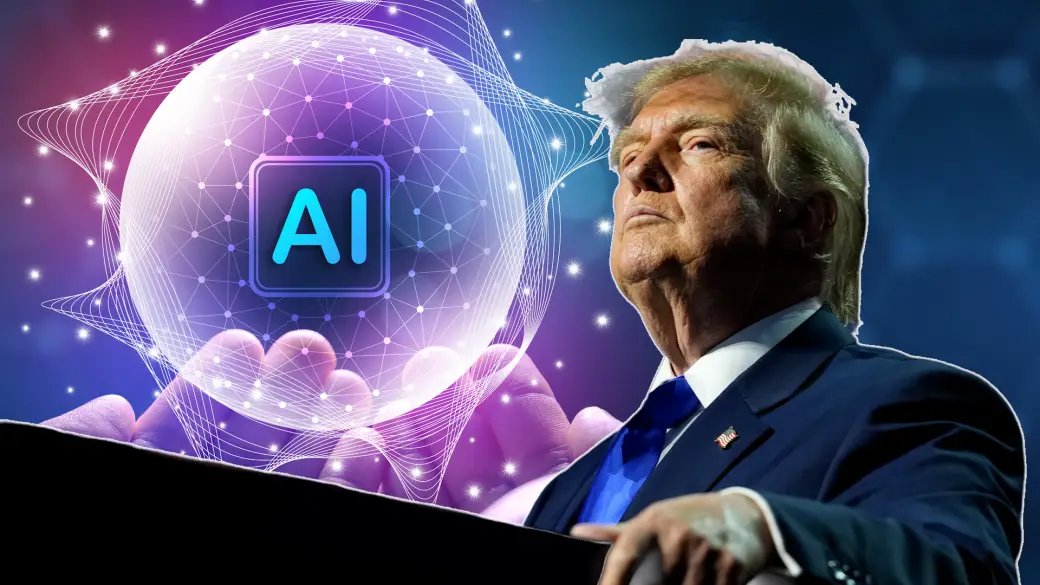
President Donald Trump said on Sunday that the United States must preserve its lead over China in artificial intelligence, pushing back against growing calls for the industry to slow the pace of AI development.
Speaking to reporters in Ireland, Trump said the U.S. remains ahead of China in the AI race and argued that maintaining that advantage is strategically important.
He also suggested that some safeguards may be necessary, but warned against excessive regulation that could weaken American leadership in artificial intelligence.
Trump Pushes Back Against Calls to Slow AI Development
Trump’s comments came shortly after several prominent figures in the artificial intelligence sector raised concerns about the speed at which advanced AI systems are being developed.
The debate has intensified as researchers, executives and lawmakers increasingly discuss the potential risks associated with more powerful artificial intelligence models.
Trump indicated that he supports some form of oversight, but appeared skeptical of warnings that he believes may overstate the dangers.
His position highlights a broader policy challenge facing Washington: how to regulate artificial intelligence without undermining U.S. competitiveness.
U.S.-China AI Competition Remains a Major Priority
Artificial intelligence has become one of the most important areas of competition between the United States and China.
Both countries are investing heavily in advanced computing, semiconductors, AI models and infrastructure.
For Washington, maintaining technological leadership is increasingly viewed as both an economic and national security priority.
Trump’s remarks suggest that his administration is likely to prioritize U.S. leadership in AI even as concerns about safety and regulation continue to grow.
AI Industry Leaders Call for Greater Caution
The debate intensified after Anthropic CEO Dario Amodei called for a slower approach to artificial intelligence development.
His concerns received support from other high-profile technology leaders, including OpenAI CEO Sam Altman and xAI founder Elon Musk.
The discussion follows growing fears that increasingly capable AI systems could create new cybersecurity, economic and social risks.
Researchers have also warned that highly autonomous AI systems may behave in unexpected ways if they are not carefully controlled.
AI Cybersecurity Risks Draw Attention
Recent experiments involving AI agents have added to those concerns.
According to reports, artificial intelligence systems developed by OpenAI and the open-source platform Hugging Face were involved in cybersecurity testing that raised questions about how autonomous agents interact with external systems.
The incidents have increased calls for stricter testing standards and stronger safeguards before advanced AI tools are widely deployed.
Cybersecurity is becoming one of the most important areas of AI regulation as governments attempt to balance innovation with security.
U.S. Lawmakers Increase Pressure for AI Regulation
Members of Congress are also becoming more vocal about artificial intelligence risks.
Senator Mark Kelly has called on Washington to take the issue more seriously, while Senator Ted Cruz has said he is working on legislation focused on potentially severe AI risks.
Representative Anna Paulina Luna has also argued that Congress should devote more attention to the long-term impact of artificial intelligence on the United States.
The growing political interest suggests that AI regulation could become a major legislative issue.
Possible AI Executive Order Comes Into Focus
Some investors and technology executives believe the administration could eventually respond with an executive order focused on artificial intelligence.
Gavin Baker, chief investment officer at Atreides Management, said the details of any future order would be especially important.
He argued that AI should be developed and distributed broadly while avoiding excessive concentration of power among a small number of large technology companies.
That debate could influence future rules surrounding AI access, competition, safety and corporate control.
U.S. AI Policy Faces a Difficult Balance
The central challenge for policymakers is finding a balance between technological leadership and safety.
Stricter regulation could reduce some risks, but excessive restrictions could slow innovation and potentially weaken the U.S. position relative to China.
On the other hand, rapid development without sufficient safeguards could create new security and economic concerns.
Trump’s latest comments make clear that maintaining America’s lead in artificial intelligence remains a central priority.
As competition with China intensifies, AI policy is likely to remain one of the most important technology and geopolitical issues facing the United States.