U.S. Treasury Secretary Scott Bessent has urged Japanese officials to present a clearer path toward fiscal sustainability and higher interest rates, according to a report from NHK on Tuesday.
The comments highlight growing U.S. attention on Japan’s monetary policy, fiscal outlook and the continued weakness of the Japanese yen.
Bessent Meets BOJ Governor and Japan’s Finance Minister
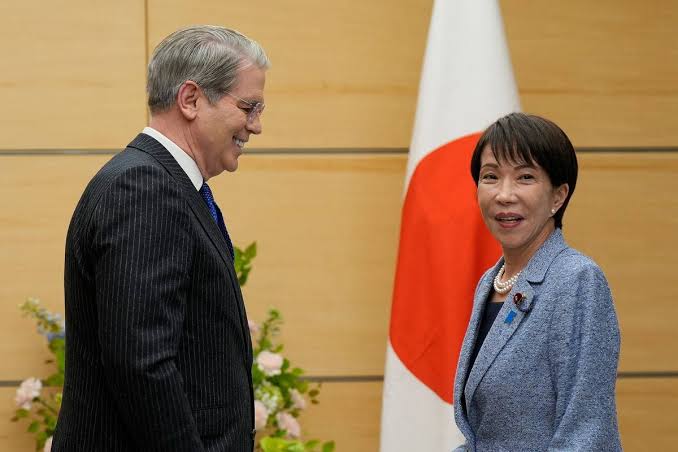
According to NHK, Bessent held separate meetings with Bank of Japan Governor Kazuo Ueda and Japanese Finance Minister Satsuki Katayama.
The discussions took place on the sidelines of the G20 meeting of finance ministers and central bank governors in Asheville, North Carolina.
A senior U.S. Treasury official told NHK that Bessent emphasized the need for Japan to clearly communicate how it plans to achieve fiscal sustainability.
He also reportedly highlighted the importance of showing markets a credible path toward further interest-rate increases.
Yen Weakness Keeps Pressure on Japan
Bessent’s comments come as the Japanese yen remains under pressure near the closely watched 160-per-dollar level.
At the same time, expectations for another Bank of Japan rate hike in September have increased.
The combination of a weak yen and rising inflation concerns has intensified pressure on Japanese policymakers to continue normalizing monetary policy.
Bessent Expects Actions That Could Strengthen the Yen
Bessent separately told CNBC on Monday that he expects the Japanese government and the BOJ to take measures that could support a stronger yen.
He also noted that financial markets are already pricing in the possibility that such action could include another interest-rate increase.
This suggests that investors are increasingly focusing on monetary policy rather than relying solely on direct currency intervention.
Focus Shifts From Yen Intervention to Monetary Policy
Bessent’s latest comments mark a notable shift in emphasis toward fiscal and monetary policy.
Japan and the United States carried out a rare joint currency intervention in July in an effort to support the yen.
However, the currency later weakened again and moved back toward the 160-per-dollar level.
That limited impact has increased attention on whether higher Japanese interest rates could provide more lasting support for the currency.
Interest-Rate Gap Remains a Key Issue
One of the main pressures on the yen is the wide difference between interest rates in Japan and the United States.
Japanese rates remain relatively low, while U.S. borrowing costs are significantly higher.
This gap can encourage investors to move capital toward dollar-denominated assets, placing additional downward pressure on the yen.
Concerns over Japan’s expansionary fiscal policy have also contributed to investor uncertainty.
Japanese Bond Yields Rise Sharply
Japan’s benchmark 10-year government bond yield has climbed sharply in recent sessions.
The move has drawn greater attention to Japan’s large debt burden and the relationship between government spending and tighter BOJ policy.
Higher bond yields increase borrowing costs and can create additional pressure on public finances.
BOJ September Meeting in Focus
The Bank of Japan’s next policy meeting is scheduled for September 17-18.
Economists are increasingly expecting another rate increase as the central bank continues its gradual move away from years of ultra-loose monetary policy.
Some forecasts suggest the BOJ policy rate could reach at least 1.5% by the end of March 2027.
Markets will therefore be watching closely for any new signals from Japanese officials on interest rates, fiscal policy and the yen.