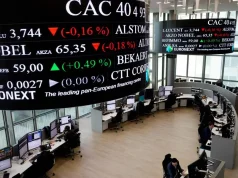
European stocks traded broadly flat on Tuesday as a deepening global bond market sell-off and renewed military tensions in the Middle East weakened investor appetite for risk.
The pan-European STOXX 600 was little changed. Germany’s DAX fell around 0.6%, France’s CAC 40 edged 0.1% higher, while London’s FTSE 100 slipped about 0.4%.
Gains in energy stocks were not enough to offset broader weakness across European markets.
Investors remained focused on rising government borrowing costs, inflation risks and several important economic data releases due later in the day.
Global Bond Sell-Off Intensifies
The latest market pressure followed a sharp rise in Japanese government bond yields.
Japan’s benchmark 10-year government bond yield climbed to its highest level in decades, triggering a broader repricing across global fixed-income markets.
The move pushed both U.S. Treasury yields and European government bond yields higher.
Investors have increasingly demanded greater compensation for holding longer-term debt amid concerns about persistent inflation, high government borrowing and heavy bond issuance.
Rising Bond Yields Pressure European Equities
Higher yields weighed particularly heavily on rate-sensitive sectors.
Technology, real estate and high-dividend utility stocks came under pressure as rising borrowing costs reduced the relative appeal of equity valuations.
When bond yields rise, future corporate earnings are typically discounted at higher rates, which can place downward pressure on stock prices.
This effect is often strongest in sectors with high valuations or significant exposure to financing costs.
U.S.-Iran Conflict Adds to Market Uncertainty
Geopolitical risks also increased after another military escalation between the United States and Iran.
Iran launched overnight missile strikes targeting two U.S. military bases in Jordan.
The attacks followed earlier U.S. strikes against Iranian targets, raising fears that the conflict could broaden further.
U.S. President Donald Trump later warned that additional strikes against Iranian infrastructure remained possible.
Strait of Hormuz Risks Push Energy Prices Higher
The latest escalation reduced hopes of an immediate ceasefire or diplomatic agreement.
Markets remain particularly concerned about the Strait of Hormuz, one of the world’s most important routes for oil and energy exports.
Any prolonged disruption to commercial shipping through the region could restrict global energy supplies.
Oil prices moved higher following the latest developments, increasing concerns that elevated energy costs could feed into inflation across Europe.
Higher Energy Costs Could Reinforce Inflation
Rising oil and gas prices present another challenge for European economies.
Higher energy costs can increase expenses for manufacturers, transportation companies and consumers.
That could create additional inflationary pressure at a time when central banks are already focused on keeping price growth under control.
As a result, markets are closely monitoring whether the latest rise in energy prices will influence future interest-rate decisions.
Eurozone Inflation Data in Focus
Investors are awaiting the latest Eurozone Consumer Price Index data for August.
The figures are expected to show that underlying inflation remains persistent.
A stronger-than-expected inflation reading could reinforce expectations that the European Central Bank will raise interest rates by another 25 basis points at its next policy meeting.
The inflation report could therefore have a significant impact on European bond yields, the euro and regional stock markets.
U.S. JOLTS Report Also in Focus
Attention is also turning to the U.S. Job Openings and Labor Turnover Survey, or JOLTS report.
The July data will provide an early indication of conditions in the U.S. labor market ahead of Friday’s nonfarm payrolls report.
Investors will use the data to assess whether labor demand remains strong enough to justify tighter Federal Reserve policy.
The report could also influence expectations ahead of the Fed’s September interest-rate decision.
DAX Weakens While FTSE 100 Gets Energy Support
Germany’s DAX remained under pressure, with industrial, automobile and consumer stocks among the weaker areas of the market.
France’s CAC 40 traded close to flat, while London’s FTSE 100 experienced more limited losses.
The FTSE 100 received some support from its large weighting toward oil, energy and mining companies, which benefited from higher commodity prices.
For now, European stocks remain caught between rising bond yields, geopolitical risks and expectations for further central bank tightening.