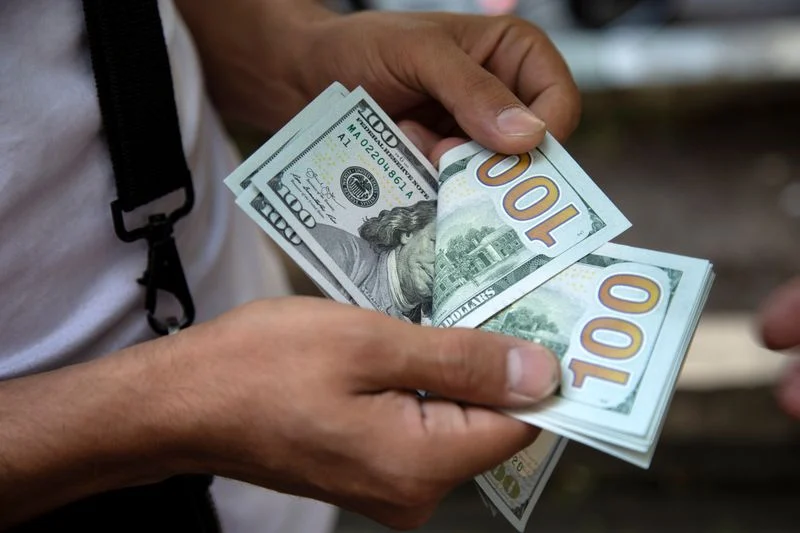
The U.S. dollar remained broadly stable near multi-month lows on Tuesday as investors reduced expectations for an imminent Federal Reserve interest rate increase. At the same time, renewed tensions between the U.S. and Iran, alongside rising oil prices, continued to weigh on global risk sentiment.
The U.S. Dollar Index was little changed at around 99.65 by 02:26 ET (06:26 GMT), remaining close to its weakest level since early June.
Traders Reassess Fed Rate Outlook
Recent weakness in the dollar has followed a series of softer U.S. economic indicators.
Retail sales declined in July for the first time in nine months, while unexpected job losses and relatively moderate inflation data have reduced expectations that the Federal Reserve will tighten monetary policy in the near term.
Markets are now pricing in roughly a 35% probability of a Federal Reserve rate increase at the September meeting, according to CME FedWatch.
However, Asian currencies struggled to benefit significantly from the weaker dollar as rising energy prices and higher U.S. Treasury yields created additional pressure.
Oil Prices Rise as U.S.-Iran Tensions Return
Brent crude climbed above $91 per barrel on Tuesday as geopolitical concerns returned following the expiration of the U.S.-Iran ceasefire.
Reports indicated that Tehran was preparing to adopt a more aggressive military stance, increasing concerns over the possibility of further instability in the Middle East.
President Donald Trump also threatened military action against Oman if the country interfered with U.S. efforts to reach an agreement with Iran.
The developments have increased uncertainty surrounding the Strait of Hormuz, one of the world’s most important routes for global oil shipments.
Higher oil prices could also increase inflation risks for Asian economies that depend heavily on imported energy.
Japanese Yen Remains Under Pressure
The Japanese yen continued to weaken, with the USD/JPY pair rising around 0.2% to trade near the 160 level.
The yen has now surrendered much of the appreciation recorded following coordinated U.S.-Japan intervention in currency markets toward the end of July.
Meanwhile, the Australian dollar showed little movement, with the AUD/USD pair trading broadly unchanged.
Indian Rupee Faces Renewed Selling Pressure
The Indian rupee was also among the Asian currencies facing additional pressure.
The USD/INR pair gained around 0.1% to 95.67, marking its highest level since July 30.
Higher crude oil prices and rising U.S. Treasury yields have added to pressure created by the Reserve Bank of India’s decision to bring forward the deadline for its foreign-currency deposit swap facility.
According to Reuters, the RBI was also believed to be intervening in the foreign-exchange market for an eighth consecutive session on Tuesday in an effort to limit the impact of elevated oil prices on the rupee.
Rising U.S. Treasury Yields Add Pressure
Higher U.S. bond yields remain another important challenge for emerging-market currencies across Asia.
The 10-year U.S. Treasury yield has moved above 4.7%, while the 30-year Treasury yield has climbed above 5.3%, reaching its highest level since 2007.
Higher U.S. yields can increase demand for dollar-denominated assets while making emerging-market currencies comparatively less attractive to investors.
Fed Minutes Become the Next Key Market Focus
Investors will now turn their attention to the Federal Reserve meeting minutes due on Wednesday.
The minutes could provide further insight into policymakers’ views on inflation, economic growth and the outlook for U.S. interest rates.
Any indication that Fed officials are becoming more cautious about additional rate increases could place renewed pressure on the dollar. Conversely, signs that policymakers remain concerned about inflation could support the U.S. currency and keep Treasury yields elevated.