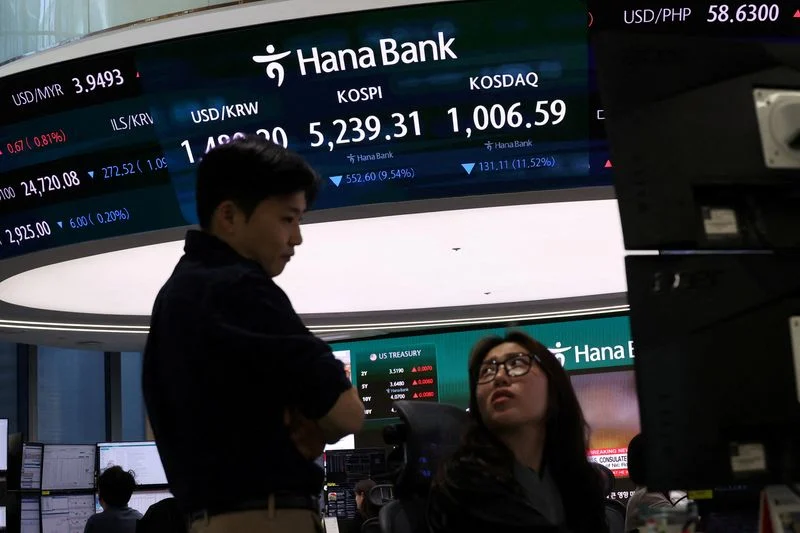
South Korea’s benchmark KOSPI fell more than 4% on Monday as investors resumed selling major semiconductor stocks. The decline followed the index’s worst monthly performance since the 2008 global financial crisis.
The latest drop erased much of Friday’s earnings-driven recovery and renewed concerns about South Korea’s technology-heavy stock market.
KOSPI Extends Historic Market Decline
The KOSPI plunged 22% in July as concerns surrounding artificial intelligence valuations intensified.
Investors also became increasingly worried about slower spending from major cloud and data-centre companies. Heavy retail positioning added further pressure, contributing to one of the market’s sharpest corrections in decades.
Although the index rebounded on Friday, Monday’s sell-off quickly reversed much of that recovery.
Samsung and SK Hynix Shares Slide
Samsung Electronics shares fell by around 8%, while SK Hynix dropped more than 7%.
The two memory-chip manufacturers represent more than half of the KOSPI’s total weighting. As a result, sharp movements in their share prices can have a major effect on the wider South Korean market.
Their latest declines showed that investor sentiment toward AI-related semiconductor stocks remains fragile.
Strong Earnings Fail to Calm Investors
Both Samsung Electronics and SK Hynix reported strong quarterly results during the previous week.
Samsung recorded a more than 250-fold increase in operating profit from its semiconductor division. The company also announced long-term supply agreements with major data-centre operators.
However, Samsung warned that shortages across the global memory-chip market could continue until 2028.
SK Hynix also delivered record quarterly earnings. Nevertheless, investors remained concerned that expectations for AI-driven chip demand may have become too optimistic.
Crowded AI Trade Fuels Volatility
July’s market rout exposed the extent to which investors had concentrated their positions in artificial intelligence stocks.
Samsung shares declined 21% during the month, while SK Hynix fell 35%. Despite those losses, both companies remain well above their levels from a year earlier following strong gains over the past 18 months.
Trading in KOSPI-listed companies was halted four times during July. This marked a record number of circuit-breaker suspensions and highlighted the extreme level of market volatility.
Retail Investors Face Heavy Losses
Retail investors poured an estimated 78 trillion won, or approximately $54.2 billion, into KOSPI shares during May and June.
Many were encouraged by the South Korean government’s stock market reform programme and the introduction of leveraged exchange-traded funds linked to individual companies.
However, leveraged investments can magnify both gains and losses, leaving investors more exposed during a rapid market downturn.
Authorities Move to Limit Speculation
South Korean authorities temporarily suspended new listings of single-stock leveraged ETFs in mid-July.
Officials have also promised further measures designed to stabilise the market and reduce excessive speculation among retail investors.
These actions followed growing concerns that leveraged products had contributed to extreme price movements in some of the country’s largest stocks.
Investors Watch for a Technology Recovery
Despite the recent correction, the KOSPI remains one of the strongest-performing major stock indexes globally in 2026.
Investors are now assessing whether solid corporate earnings and continued spending on artificial intelligence infrastructure can restore confidence in South Korea’s technology sector.
The future direction of the market may depend heavily on whether Samsung, SK Hynix and other semiconductor companies can meet the high growth expectations already reflected in their valuations.