U.S. Central Command said on Sunday evening that it had completed its latest wave of strikes against Iran.
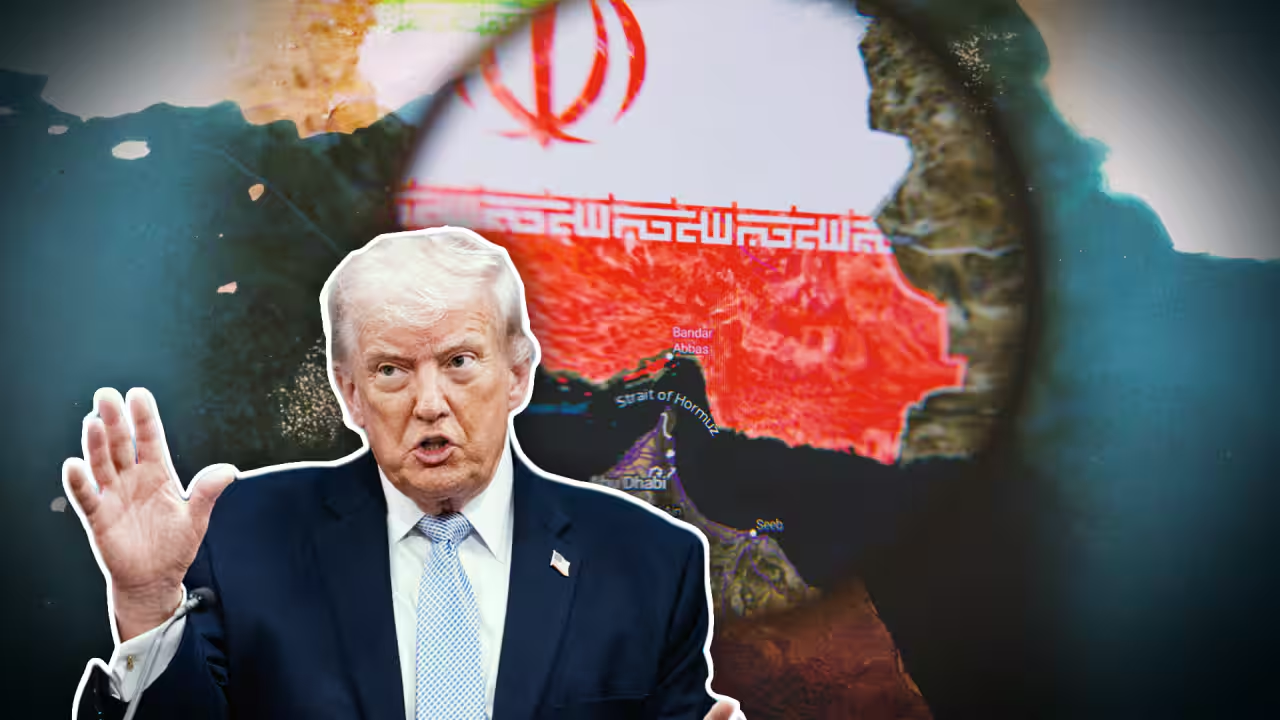
The announcement followed comments from President Donald Trump, who said the Strait of Hormuz remained open to commercial shipping despite Iran’s claim that the waterway had been closed.
U.S. Completes Latest Strikes on Iran
U.S. Central Command, also known as CENTCOM, said its forces struck dozens of targets across several locations in Iran.
According to the statement, the operation aimed to weaken Tehran’s ability to attack international vessels travelling through the Strait of Hormuz.
CENTCOM said the latest strikes were designed to reduce Iran’s capacity to threaten commercial shipping in the region.
Trump Says Strait of Hormuz Remains Open
Earlier on Sunday, President Trump rejected Iran’s claim that the Strait of Hormuz had been closed.
Trump said commercial vessels could still pass through the strategically important waterway.
Iran, however, said it had restricted access in response to recent U.S. military action.
The conflicting statements increased uncertainty over the true status of one of the world’s most important energy shipping routes.
U.S. Campaign Hits More Than 300 Targets
U.S. forces struck around 140 Iranian military targets on Saturday.
The attacks followed an incident involving the Cyprus-flagged container ship M/V GFS Galaxy.
According to the report, the latest action brought the number of targets hit during Washington’s three-day campaign to more than 300.
Iran responded with attacks that it said were aimed at U.S. and allied military facilities across the Gulf.
UAE Intercepts Iranian Missiles and Drones
The United Arab Emirates said its air defence systems intercepted Iranian missiles and drones.
Warning sirens were also heard in Bahrain, while explosions were reported in Doha.
Iran’s Islamic Revolutionary Guard Corps said it had disabled a second vessel in the Strait of Hormuz.
These developments showed how rapidly the conflict was spreading across the Gulf region.
Iran Declares Hormuz Closed Until Further Notice
Iran said the Strait of Hormuz would remain closed until further notice.
Tehran claimed that vessels had attempted to use routes it considered unauthorised.
The Islamic Revolutionary Guard Corps said the closure would continue until U.S. involvement in the region ended.
It also warned that any retaliation would receive a severe response.
U.S. Defence Secretary Warns Iran
U.S. Defence Secretary Pete Hegseth issued a sharp warning following the latest military action.
In a post on X, Hegseth said Iran had made a serious mistake and would now face the consequences.
His comments reinforced the increasingly confrontational tone between Washington and Tehran.
Oil Prices Rise on Supply Fears
Oil prices climbed by more than 3% on Monday following the weekend escalation.
Markets became increasingly concerned that further fighting could disrupt energy supplies from the Middle East.
MarineTraffic data showed that only a small number of vessels were moving through the Strait of Hormuz.
Any prolonged reduction in shipping activity could tighten global crude supplies and increase transportation and insurance costs.
Oman Hosts Diplomatic Talks
Diplomatic efforts continued despite the renewed military action.
Iranian Foreign Minister Abbas Araghchi met Oman’s Foreign Minister Sayyid Badr Albusaidi in Muscat.
The talks focused on possible mechanisms to guarantee safe passage through the Strait of Hormuz.
Oman said discussions would continue at both political and technical levels.
Iran Calls for Regional Control of Hormuz Transit
Iran’s Foreign Ministry said future rules governing movement through the Strait of Hormuz should be developed through discussions between the countries bordering the waterway.
Tehran said recent security developments and the wider conflict should be considered when creating any new transit arrangements.
Iran also argued that regional countries should play the leading role in deciding how the strait is managed.
U.S.-Iran Negotiations Face New Obstacles
The latest exchange of attacks has reduced expectations for a renewed diplomatic agreement between the United States and Iran.
Tehran accused Washington of violating the recent ceasefire.
Araghchi said that any agreement would require both sides to meet their commitments.
The United States, meanwhile, continues to demand guarantees that commercial vessels will be able to travel safely through the Strait of Hormuz before broader negotiations can resume.
Gulf Conflict Threatens Global Energy Supplies
The conflict has expanded across the Gulf, raising concerns about regional security and energy markets.
Roughly one-fifth of the world’s oil supply passes through the Strait of Hormuz.
Any effective blockade could push oil prices higher, increase inflation and weaken global economic growth.
Higher fuel prices may also become a political challenge for President Trump ahead of November’s congressional elections.
Iran’s New Supreme Leader Vows Retaliation
Iran’s new Supreme Leader, Ayatollah Mojtaba Khamenei, pledged to avenge the killing of his father and predecessor, Ayatollah Ali Khamenei.
He said Iran would continue to pursue retaliation regardless of future developments.
His statement followed a warning from Trump that the U.S. military was prepared to launch a major response if Iran attempted to assassinate him.
The exchange added another layer of uncertainty to an already fragile geopolitical situation.