Rising Bond Yields May Pressure Stocks, but UBS Says Bull Market Remains Intact
Higher bond yields unsettled financial markets last week, raising concerns about whether increasing borrowing costs could threaten the ongoing stock market rally. However, according to UBS, stronger economic growth and sustained spending trends suggest the broader equity bull market is unlikely to be derailed in the near term.
U.S. Treasury Yields Rise as Markets Reassess Interest Rate Outlook
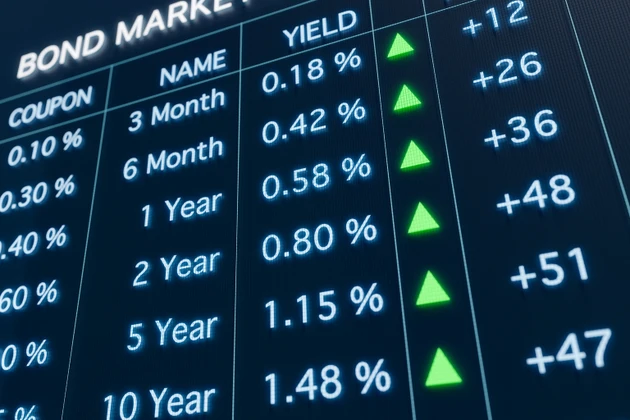
The yield on the U.S. 10-year Treasury climbed from 4.4% to 4.6% during the week, widening the gap between long-term and short-term bond yields.
UBS strategist Ulrike Hoffmann-Burchardi described the move as a “bear steepener,” a market condition where long-term bond yields rise faster than short-term yields.
Investors are now pricing in approximately 0.6 interest rate hikes by December, reflecting expectations that rates may remain higher for longer.
According to UBS, the rise in yields was largely driven by two factors:
- Higher oil prices after President Donald Trump’s visit to Saudi Arabia failed to resolve concerns surrounding the Strait of Hormuz
- Rising U.K. bond yields caused by political uncertainty and domestic leadership challenges
UBS Identifies Three Major Drivers Supporting Stocks
Despite rising yields, UBS believes the equity bull market continues to be supported by three powerful growth factors.
1. Government Spending Remains Strong
The world’s four largest economies — the United States, China, Germany and Japan — continue to pursue expansionary fiscal policies.
Collectively, these countries account for more than half of global GDP, providing significant support for economic activity.
2. Consumer Spending Continues to Show Resilience
Consumer demand also remains strong.
U.S. retail sales increased 0.5% month-over-month in April, suggesting households continue to spend despite inflation pressures and elevated borrowing costs.
3. AI Infrastructure Investment Is Accelerating
Corporate spending on artificial intelligence infrastructure remains another major growth driver.
UBS noted that data center capital expenditures now represent roughly 2.5% of U.S. GDP and continue to rise as companies expand AI capabilities.
According to Hoffmann-Burchardi, spending from governments, consumers and corporations is helping sustain economic momentum.
Higher Interest Rates Could Slow Consumers but Not AI or Government Spending
UBS acknowledged that rising rates may gradually pressure consumers, particularly through higher mortgage costs.
However, the bank argued that already-approved government spending programs are unlikely to be reduced, while corporate investment in AI infrastructure appears largely unaffected by elevated financing costs.
The strategist pointed out that demand for computing power remains strong despite high electricity prices and expensive financing conditions for large technology firms.
As a result, economic growth is expected to remain relatively resilient over the short term.
History Suggests Stocks Usually Need Multiple Fed Hikes Before Major Declines
Historically, equity markets have tended to weaken only after extended periods of Federal Reserve tightening.
UBS highlighted May 2000 as an example, when a sixth consecutive 50-basis-point rate increase accelerated declines in the Nasdaq.
The current environment differs, as the Federal Reserve is not actively raising rates and official guidance still leans toward an easing stance.
The strategist also noted that real 10-year Treasury yields between 2.0% and 2.5% have historically been an important threshold for markets. Current real yields are approaching the lower end of that range.
Rising Yields Are Not Always a Bearish Signal for Stocks
UBS argued that a bear steepening yield curve has not historically been a reliable indicator of major equity selloffs.
In many cases, periods of rising long-term yields have been followed by positive stock market returns.
While temporary pullbacks may occur as investors adjust to higher rates, Hoffmann-Burchardi believes stronger economic growth should continue supporting equities.
“Higher rates do not derail bull markets when growth remains strong,” the strategist concluded.