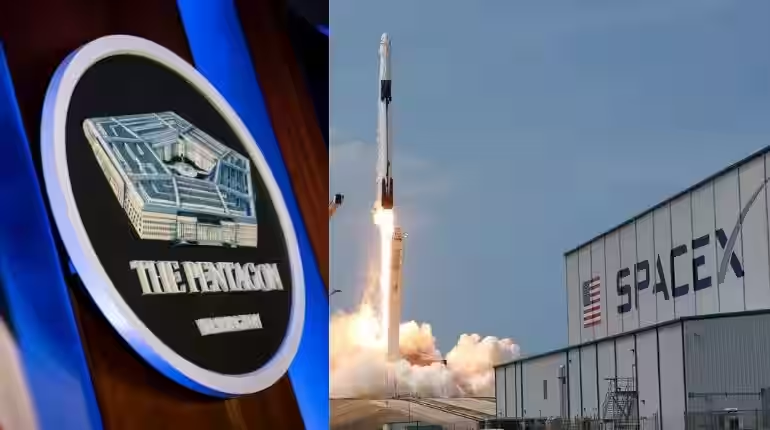
SpaceX shares briefly recovered from deeper losses on Friday after reports suggested the aerospace company was discussing a major artificial intelligence computing agreement with the Pentagon.
However, the rebound quickly faded. SpaceX stock remained down approximately 4.4% as investors continued to focus on the company’s recent market weakness.
Pentagon AI Report Briefly Lifts SpaceX Stock
The Wall Street Journal reported that SpaceX was in talks to provide the US Department of Defense with billions of dollars in AI computing capacity.
The news initially attracted buyers and helped the shares recover part of their earlier decline.
However, the positive reaction was short-lived. Investors appeared cautious because negotiations remain ongoing and no final agreement has been announced.
CoreWeave Falls on Pricing Concerns
The report had a more significant effect on CoreWeave shares.
According to people familiar with the discussions, SpaceX employees have considered competing directly with specialist cloud-computing companies by offering AI capacity at substantially lower prices.
CoreWeave was specifically identified as a potential competitor.
The possibility of cheaper SpaceX AI services raised concerns that established providers could face greater pricing pressure and weaker profit margins.
As a result, CoreWeave shares moved into negative territory as traders assessed the risk of an aggressive price battle.
SpaceX Could Build Dedicated Pentagon Capacity
The proposed agreement would reportedly provide dedicated data-centre capacity for the Pentagon.
The Department of Defense could use that infrastructure to operate artificial intelligence models and support military applications.
Although the potential deal is believed to be worth several billion dollars, negotiations could still change or collapse before an agreement is reached.
A successful contract would expand SpaceX’s existing relationship with the US military.
Pentagon Already Relies Heavily on SpaceX
The Pentagon already uses several SpaceX services.
These include rocket launches, satellite communications and missile-tracking capabilities.
Adding AI infrastructure would deepen the company’s role within US defence operations.
However, it could also increase concerns about the military’s dependence on businesses controlled by Elon Musk.
Some national-security officials may question whether relying heavily on a single private company creates operational or strategic risks.
Defense Department Expands AI Infrastructure
The negotiations come as the Pentagon seeks secure cloud-computing capacity for intelligence agencies and military personnel.
Organisations such as the National Security Agency require significant computing power to process data and run advanced AI systems.
Active military units are also exploring artificial intelligence for intelligence analysis, logistics, surveillance and battlefield decision-making.
This growing demand has created intense competition among the largest technology and cloud companies.
Amazon and Microsoft Compete for Government Contracts
Amazon is investing approximately $50 billion in cloud and computing infrastructure focused on US government customers.
Microsoft, Google and Oracle are also established suppliers of cloud technology to federal agencies.
These companies already compete for large defence, intelligence and government contracts.
SpaceX’s reported entry into the sector could increase competition further, particularly if it offers computing services at lower prices.
SpaceX Signals Broader AI Ambitions
A Pentagon computing agreement would represent a significant expansion beyond SpaceX’s traditional aerospace and satellite businesses.
The company would gain a stronger position in the rapidly growing market for AI infrastructure.
It could also combine its satellite network, launch capabilities and computing resources to offer government customers a broader technology platform.
However, entering the cloud-computing market would place SpaceX in direct competition with some of the world’s largest technology companies.
Pricing Strategy Could Disrupt AI Cloud Market
The greatest concern for competitors may be SpaceX’s reported willingness to reduce prices.
Lower-cost AI capacity could help the company win major government contracts. At the same time, it could force competing providers to lower their own prices.
That scenario could reduce profit margins across the cloud-computing industry.
CoreWeave may be particularly exposed because its business is closely tied to demand for specialised AI computing capacity.
SpaceX and CoreWeave Face Different Investor Reactions
Investors treated the Pentagon report differently for the two companies.
SpaceX received only a brief boost because uncertainty surrounding the potential deal remained high.
CoreWeave faced more immediate pressure because traders focused on the competitive threat posed by lower-priced AI services.
The market reaction suggests that pricing competition may matter more to investors than the potential size of the Pentagon contract itself.
Pentagon AI Talks Remain Uncertain
No final agreement between SpaceX and the Department of Defense has been confirmed.
Therefore, investors will closely monitor any new information about the contract’s value, duration and computing requirements.
They will also watch whether SpaceX formally enters the commercial AI cloud market.
A completed Pentagon deal could strengthen SpaceX’s position in government technology. However, aggressive pricing could create wider disruption for CoreWeave and other cloud-computing providers.