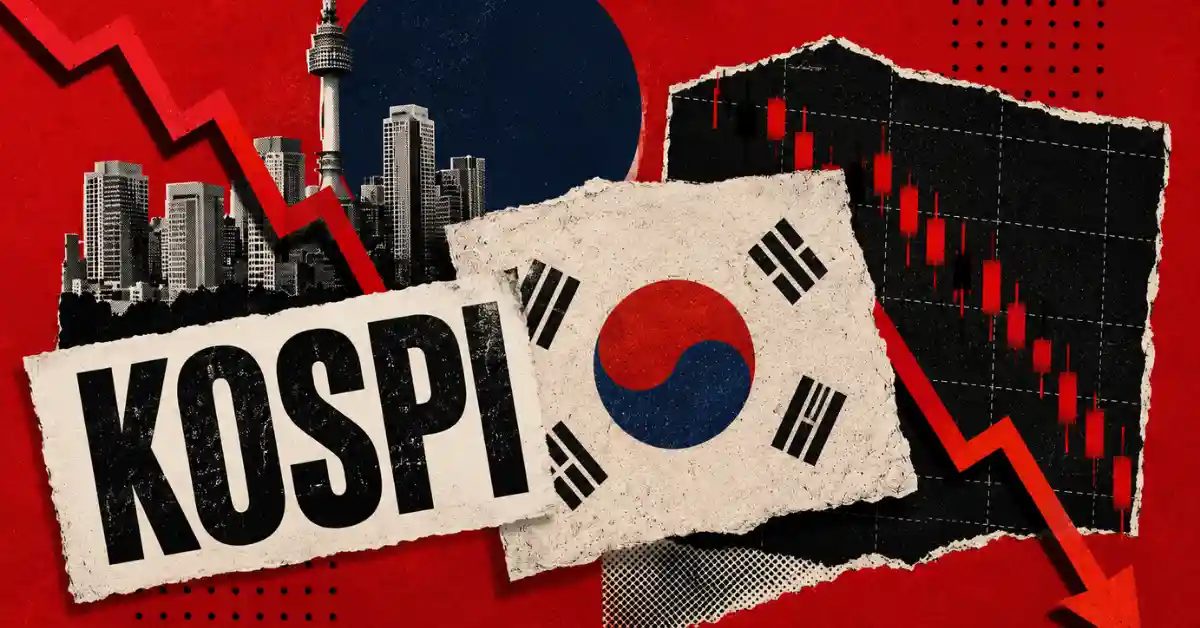
South Korean stocks suffered a sharp selloff on Tuesday, with the benchmark KOSPI falling more than 8% and triggering a second trading halt during the session.
Investors moved to secure profits after a record-breaking rally fueled by semiconductor stocks, artificial intelligence optimism and strong foreign capital inflows.
KOSPI Triggers Second Circuit Breaker
The KOSPI dropped 8.2% to 8,362.24 points, activating a circuit breaker for the second time on Tuesday.
The automatic trading halt was triggered as losses accelerated across the South Korean stock market.
Despite the sharp decline, the index had fallen during only two of the previous seven sessions. This suggests that much of Tuesday’s selling was driven by profit-taking after one of the strongest global market rallies of 2026.
MSCI Decision Weighs on South Korean Stocks
Market sentiment was also damaged by reports that South Korea would not be added to MSCI’s Developed Markets Index during its upcoming review.
Investors had viewed possible inclusion as an important catalyst for further foreign investment.
Overseas investors played a major role in pushing the KOSPI to record highs. Therefore, the possibility of delayed MSCI inclusion weakened expectations for another large wave of international buying.
Investors Question Elevated Valuations
Analysts said traders were becoming increasingly cautious about stretched stock valuations following the KOSPI’s rapid rise.
Even after Tuesday’s selloff, the South Korean benchmark remained approximately 78% to 83% higher since the beginning of the year.
This continued to rank the KOSPI among the world’s strongest-performing major stock indexes in 2026.
However, the scale of the rally also increased the risk of a significant correction as investors began locking in gains.
Samsung and SK Hynix Lead Semiconductor Selloff
Heavyweight semiconductor companies were among the largest contributors to the market decline.
SK Hynix shares dropped 10.6%, while Samsung Electronics fell 8.2%.
Both companies carry substantial weight in the KOSPI. As a result, their sharp losses placed significant downward pressure on the broader market.
Hyundai Motor was also among the session’s worst-performing major stocks, falling 10.5%.
SK Hynix Faces Questions Over HBM Strategy
SK Hynix came under additional pressure following a local media report about a possible change in its production strategy.
The company reportedly planned to reduce production of high-bandwidth memory chips in favour of higher-margin DRAM products.
Such a shift could weaken its dominant position in the HBM market as competitors including Samsung Electronics and Micron work to increase their market share.
High-bandwidth memory has become a vital component in artificial intelligence systems because it can process large amounts of data at high speeds.
AI Boom Transforms South Korea’s Stock Market
Despite Tuesday’s decline, semiconductor companies remain central to South Korea’s equity market story.
SK Hynix overtook Samsung Electronics on Monday to become the country’s most valuable publicly traded company.
The milestone reflected a major change in South Korea’s corporate landscape as artificial intelligence demand reshaped the global semiconductor industry.
SK Hynix shares have risen by more than 340% this year, making the company one of the largest beneficiaries of the global AI investment boom.
SK Hynix Dominates the HBM Market
SK Hynix has become the leading supplier of high-bandwidth memory chips used in advanced AI systems.
Its customers include major technology companies such as Nvidia and Alphabet. Strong demand from the artificial intelligence industry helped lift its market value above Samsung Electronics and US chipmaker Micron.
Analysts estimated that SK Hynix controlled approximately 61% of the global HBM market in 2025. Samsung held an estimated 17% share.
SK Hynix Completes Historic Turnaround
The company’s rise represents one of the most significant corporate recoveries in South Korean history.
Previously known as Hynix Semiconductor, the company came close to collapse during the debt crisis of the early 2000s.
It was once considered a penny stock before transforming itself into a critical supplier for the global artificial intelligence ecosystem.