Gold Prices Hold Steady Amid Geopolitical and Rate Uncertainty
Gold prices remained stable during Asian trading on Monday, as the market continued to grapple with ongoing uncertainty surrounding the Middle East conflict and the future direction of interest rates.
The precious metal has now recorded two consecutive months of losses. While geopolitical tensions—particularly involving the U.S. and Iran—typically support safe-haven demand, concerns about rising inflation have limited gold’s upside.
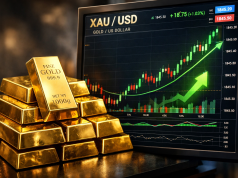
Spot gold held firm at $4,612.98 per ounce in early trading (00:18 ET / 04:18 GMT), while gold futures slipped 0.4% to $4,624.14 per ounce.
Other Precious Metals Edge Higher
While gold remained subdued, other precious metals posted modest gains. Silver rose 0.4% to $75.6945 per ounce, while Platinum advanced 0.9% to $2,010.0 per ounce, reflecting broader resilience in the metals market.
Iran Tensions Persist as Trump Announces Hormuz Operation
Geopolitical risks intensified after Donald Trump announced a new initiative aimed at securing commercial shipping routes through the Strait of Hormuz.
Details of the operation remain unclear. However, United States Central Command confirmed that additional military assets—including ships and personnel—will be deployed in the region.
Iran responded by warning that any U.S. intervention in the Strait of Hormuz would be viewed as a breach of the fragile ceasefire currently in place. Meanwhile, Iranian officials acknowledged receiving a U.S. response to their proposed 14-point plan aimed at reopening the vital shipping route and ending hostilities.
Despite these developments, there is still no clear short-term resolution to the conflict. This ongoing uncertainty is expected to keep oil prices elevated and inflation concerns firmly in focus.
Fed Signals Rate Risks as Inflation Concerns Grow
Neel Kashkari, President of the Federal Reserve Bank of Minneapolis, warned that a prolonged conflict involving Iran could increase both inflationary pressures and economic risks.
He also emphasized that the current geopolitical environment makes it difficult for the Federal Reserve to provide clear forward guidance on interest rates. Kashkari did not rule out the possibility of future rate hikes, citing persistent inflation risks.
Recent reports indicate that Kashkari was among several policymakers who opposed the Fed’s recent dovish stance, reflecting growing concern about energy-driven inflation.
Global Central Banks Lean Toward Higher Rates
Beyond the Federal Reserve, other major central banks are also shifting toward tighter monetary policy. Institutions such as the Bank of Japan, European Central Bank, and Bank of England have all signaled potential rate hikes.
Additionally, the Reserve Bank of Australia is widely expected to increase interest rates in its upcoming policy decision.
Higher interest rates typically weigh on non-yielding assets like gold, as they raise the opportunity cost of holding such investments compared to interest-bearing alternatives.