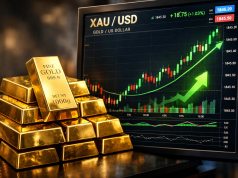
Gold prices recovered modestly on Thursday after falling to their lowest level since early August during the previous session. Escalating tensions around the Strait of Hormuz continued to raise concerns about global inflation, strengthening expectations that the Federal Reserve could increase interest rates again before the end of the year.
At 01:04 ET (05:04 GMT), spot gold (XAU/USD) climbed 0.6% to $4,133.60 per ounce. Meanwhile, US gold futures advanced 0.4% to $4,157.45.
Other precious metals also recorded gains. Silver (XAG/USD) rose 0.4% to $60.05 per ounce, while platinum (XPT/USD) jumped 2.07% to $1,667.82.
The US Dollar Index remained relatively unchanged at 102.24, reflecting cautious trading conditions across currency and commodity markets.
Strait of Hormuz Tensions Increase Global Energy and Inflation Risks
Geopolitical uncertainty in the Middle East remains a major influence on gold prices as tensions surrounding the Strait of Hormuz continue to threaten global energy supplies.
Iran has reportedly intensified attacks against oil tankers traveling through the strategically important waterway. These developments have renewed concerns about the security of one of the world’s most critical maritime routes for oil transportation.
Meanwhile, reports indicate that the White House is considering additional military strikes against Iranian targets ahead of the US midterm elections in November.
Although oil shipments from the Middle East have recovered to levels approaching those seen before the conflict, persistent security threats have pushed shipping costs to record highs.
Energy markets are also facing disruptions outside the Middle East. A tropical storm in the Gulf of Mexico has affected American oil production, with MMA reporting that approximately 25% of the region’s output has been temporarily shut down.
Together, these developments have increased uncertainty surrounding global energy prices and the inflation outlook.
The ongoing US-Iran conflict has lasted more than seven months. During that period, gold has reportedly declined approximately 20% since hostilities began in late February.
Despite gold’s traditional reputation as a safe-haven asset, rising energy costs have created a challenging environment for precious metals.
Higher oil prices can accelerate inflation, encouraging central banks to maintain restrictive monetary policies. Consequently, elevated interest rates can reduce the attractiveness of gold because the metal does not generate interest income.
Federal Reserve Minutes Strengthen Expectations for Another Rate Hike
The Federal Reserve’s latest meeting minutes added further pressure to the gold market by reinforcing expectations of additional monetary tightening.
According to the minutes, all 19 Federal Reserve policymakers supported the September interest rate increase. Furthermore, most officials indicated that another rate hike could be appropriate before the end of the year.
Financial markets currently assign approximately a 20% probability to an interest rate increase at the Fed’s October meeting.
However, expectations become significantly stronger toward December, with traders pricing an estimated 80% probability of another increase by year-end.
These expectations have contributed to higher US Treasury yields, which typically create headwinds for gold prices.
Unlike government bonds, gold does not provide regular interest payments. Therefore, when Treasury yields rise, some investors may prefer income-generating assets over holding physical bullion.
The prospect of prolonged monetary tightening has also supported the US dollar, creating an additional obstacle for precious metals.
Strong US Dollar and Treasury Yields Weigh on Gold Demand
The US dollar remained near its strongest level of the year as investors continued to assess the Federal Reserve’s increasingly restrictive monetary policy outlook.
A stronger dollar generally makes gold more expensive for international buyers using other currencies. This can weaken global demand and limit the precious metal’s ability to recover.
At the same time, elevated US Treasury yields increase the opportunity cost of holding gold.
These factors help explain why bullion has struggled despite ongoing geopolitical uncertainty and concerns about global economic stability.
However, gold prices continue to receive support from an important source of demand: central bank purchases.
While private investors may reduce their exposure when interest rates rise, central banks often accumulate gold for reserve diversification and long-term financial stability.
This distinction has become particularly important as official-sector buying helps offset weaker investment demand.
China’s Central Bank Gold Purchases Help Limit Market Losses
Strong central bank demand has provided a degree of stability to gold prices despite pressure from rising bond yields and the stronger US dollar.
According to analysts at ANZ, continued purchases by monetary authorities have helped prevent deeper declines in the precious metals market.
The People’s Bank of China remains one of the most significant buyers.
China’s central bank increased its gold reserves by approximately 740,000 ounces in September, extending its accumulation streak to 23 consecutive months.
The continued buying reflects China’s ongoing efforts to strengthen and diversify its foreign exchange reserves.
ANZ analysts also highlighted that Chinese gold purchases have accelerated in recent months following the decline in international bullion prices.
This increased demand suggests that lower prices may be attracting long-term institutional buyers, even as short-term investors remain cautious.
China’s sustained accumulation is particularly important because the country ranks among the world’s largest gold consumers and official-sector buyers.
As a result, central bank purchases may continue to provide underlying support for gold during periods of heightened market volatility.
Gold Price Outlook: Fed Policy and Middle East Risks Remain in Focus
The near-term direction of gold prices will likely depend on developments in the Strait of Hormuz, global energy costs and the Federal Reserve’s next monetary policy decisions.
If geopolitical tensions intensify and oil prices continue climbing, inflation expectations could rise further.
Such a scenario may strengthen the case for additional interest rate increases, potentially pushing US Treasury yields and the dollar higher.
That combination would likely remain challenging for gold, despite the precious metal’s traditional safe-haven appeal.
Conversely, easing inflation pressures or signs that the Federal Reserve could pause its tightening cycle may improve investor sentiment toward bullion.
Continued purchases by central banks, particularly China’s monetary authorities, could also help cushion future declines.
For now, gold’s stabilization near a nine-week low highlights the competing forces influencing the market. While geopolitical risks and central bank buying offer support, elevated bond yields and expectations of higher interest rates continue to restrict the precious metal’s upside potential.