FTSE 100 Falls as Iran Tensions Overshadow UK Growth
British stocks moved lower on Thursday as escalating tensions between the United States and Iran outweighed stronger-than-expected UK economic growth.
Iran’s warning that it could target infrastructure across the region increased concerns about a prolonged conflict. Market strategists also warned that disruption around the Strait of Hormuz could continue for several weeks.
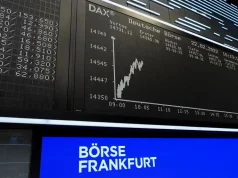
The FTSE 100 fell 0.37% in early trading, extending its losses from Wednesday. Germany’s DAX declined 0.22%, while France’s CAC 40 slipped 0.21%.
The British pound was broadly unchanged at $1.3535.
UK GDP Growth Beats Market Forecasts
Data from the Office for National Statistics showed that the UK economy performed better than expected.
Gross domestic product expanded by 0.7% during the three months to May. Economists had forecast growth of 0.5%.
Annual economic growth accelerated to 1.3%, marking the fastest pace in 13 months.
Meanwhile, monthly GDP increased by 0.1% in May after declining by the same amount in April. A 0.3% rise in services activity supported the recovery.
However, the positive UK GDP figures failed to lift the FTSE 100 as geopolitical risks dominated investor sentiment.
Iran Warns of Strikes on Regional Infrastructure
A spokesperson for Iran’s military headquarters warned that regional infrastructure could face severe attacks if the United States targeted Iranian facilities.
The statement followed comments from US President Donald Trump, who threatened to strike Iran’s power plants, bridges, and other infrastructure unless Tehran returned to negotiations.
The increasingly hostile language raised fears that the conflict could expand further across the Middle East.
US Intensifies Military Strikes on Iran
US forces increased their attacks early on Thursday.
The strikes reportedly targeted areas around Tehran and Iran’s Semnan province, which hosts facilities connected to the country’s ballistic missile programme.
American forces also fired on a vessel accused of violating Washington’s naval blockade.
Iran responded before dawn with missile and drone attacks against targets in Bahrain, Jordan, and Kuwait.
Iran’s Revolutionary Guard said it struck a US base in Jordan. The group described the action as retaliation for an alleged American attack near a children’s cancer hospital in Ahvaz.
Strait of Hormuz Traffic Slows Sharply
Shipping through the Strait of Hormuz has slowed considerably, according to Jefferies strategist Mohit Kumar.
The strait is one of the world’s most important routes for oil and gas shipments. Any prolonged disruption could reduce global energy supplies and push prices higher.
Kumar said the current escalation appeared different from earlier confrontations. Previous rounds of tension were often designed to strengthen negotiating positions before an eventual de-escalation.
However, he argued that Iran may be unwilling to abandon its claim of sovereignty over the Strait of Hormuz.
He also questioned whether Iran currently has a unified leadership capable of approving such a major compromise.
Jefferies Expects Standoff to Last for Weeks
Jefferies said it was maintaining low risk exposure because of the uncertain geopolitical outlook.
The firm still expects the two sides to eventually reach some form of agreement. However, it warned that any settlement could involve an imperfect or temporary compromise.
The investment bank believes the standoff may continue for several weeks. As a result, oil prices could remain under upward pressure.
US Officials Send Mixed Diplomatic Signals
US Vice President JD Vance described the recent attacks as part of a delicate diplomatic process during an interview with Joe Rogan.
Trump delivered a more forceful message while speaking in Pennsylvania.
The US president said Washington would soon determine whether the dispute could be settled through negotiations or whether the United States would take stronger action against Iran.
The mixed statements highlighted the uncertainty surrounding the next stage of the conflict.
Oil and Gold Prices Move Lower
Despite concerns about energy supplies, oil prices edged lower during Thursday’s session.
Brent crude declined 0.38% to $84.63 per barrel. West Texas Intermediate crude slipped 0.08% to $79.54.
Gold also moved lower. Gold futures fell 0.55% to approximately $4,029.27, while spot gold declined 0.88% to around $4,024.62.
Investors continued to balance safe-haven demand against changing expectations for interest rates and the wider geopolitical outlook.
Crest Nicholson Warns About Weak Housing Demand
Crest Nicholson said it expects its 2026 operating profit to finish near the lower end of its £5 million to £15 million guidance range.
The British housebuilder cited continued weakness in housing demand.
The company also extended a covenant waiver until September 30, 2026.
Ocado Pursues New US Retail Partnerships
Ocado said it was seeking several new retail partnerships in the United States.
The online grocery technology group maintained its forecast that it will become cash-flow positive, despite reporting weaker underlying earnings during the first half of the year.
TotalEnergies Sees Profit Boost From Energy Prices
TotalEnergies said higher oil and natural gas prices linked to the Middle East conflict should support its second-quarter earnings.
Energy companies could benefit from rising commodity prices, although prolonged instability may also create operational and supply-chain risks.
Premier Foods Reports Higher Branded Sales
Premier Foods recorded a 4% increase in branded sales during its first quarter.
Strong demand for sweet products and recently launched items supported the company’s performance.
Frasers Group Withholds 2027 Outlook
Frasers Group declined to provide guidance for its 2027 financial year.
The retailer cited uncertainty surrounding ongoing takeover activity involving Hugo Boss and Accent Group.
SSE Maintains Earnings Guidance
SSE kept its earnings outlook unchanged after reporting increased investment in its electricity networks and stronger renewable power generation.
The energy company also appointed former National Grid chief executive John Pettigrew to its board.