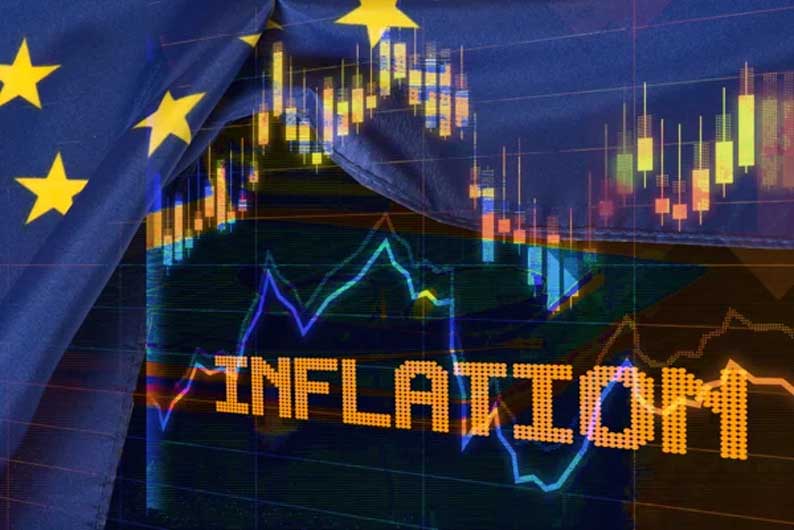
Eurozone inflation accelerated on an annual basis in May as the Iran war continued to push European energy prices higher. However, consumer prices increased at a slower pace compared with the previous month.
Policymakers are closely monitoring the data to determine whether the energy shock is spreading into other parts of the Eurozone economy.
Eurozone Inflation Rises to 3.2%
The headline consumer price index across the 21-member Eurozone increased by 3.2% in the 12 months to May, according to data released by Eurostat.
The result was in line with market expectations and marked an increase from the 3% annual inflation rate recorded in April.
On a monthly basis, inflation slowed to 0.1% from 1% in April, matching economists’ forecasts.
Energy Prices Remain the Main Inflation Driver
Energy prices recorded an annual increase of 10.8% in May, matching the pace reported in April.
The sharp rise followed the closure of the Strait of Hormuz after the joint US-Israeli military operation against Iran began in late February.
Attacks on important natural gas production facilities in the Gulf also disrupted supplies and contributed to higher energy costs across Europe.
US-Iran Peace Deal Could Ease Energy Costs
Oil prices remain above the levels recorded before the conflict. However, they have declined since Washington and Tehran announced a framework agreement aimed at ending the war.
The agreement is expected to be formally signed on Friday.
According to media reports, the deal could reopen the Strait of Hormuz and end the US blockade of Iranian ports. These measures could restore energy supplies and reduce pressure on global oil and gas prices.
ECB Raises Interest Rates Over Inflation Risks
The European Central Bank increased interest rates last week as officials warned that the Middle East conflict was creating additional inflationary pressure.
The ECB remains concerned that elevated energy costs could spread to other goods and services, making inflation more difficult to control.
Central banks worldwide are watching for similar signs that higher oil and gas prices are becoming embedded in the broader economy.
ECB Raises Eurozone Inflation Forecasts
New projections from Eurosystem staff estimate that headline inflation will average 3% this year.
Inflation is then expected to decline to 2.3% in 2027 and reach the ECB’s 2% target in 2028.
The previous projections had placed inflation at 2.6% this year, 2% in 2027 and 2.1% in 2028.
The updated forecasts show that officials now expect price pressures to remain stronger for longer.
Eurozone Growth Outlook Weakens
While inflation forecasts increased, the outlook for economic growth deteriorated.
The ECB now expects Eurozone gross domestic product to expand by only 0.8% this year. Its previous forecast had predicted growth of 0.9%.
The combination of persistent inflation and weak economic activity presents a difficult challenge for policymakers.
Lagarde Expects Inflation to Return to Target
ECB President Christine Lagarde said inflation could return to the central bank’s target during the autumn of 2027.
However, she warned that inflation could rise further if energy costs remain elevated or increase for a longer period.
Lagarde also described the current economic environment as one in which growth is either absent or under threat.
Core Inflation Exceeds Expectations
Core inflation, which excludes volatile categories such as energy, food, alcohol and tobacco, rose to 2.6% year on year.
This was higher than the 2.2% rate recorded in April and exceeded market expectations of 2.5%.
On a monthly basis, however, core inflation slowed to 0.3% from 0.9%, in line with forecasts.
The mixed data suggests that underlying price pressures remain elevated, even as monthly inflation begins to ease.